


Almost every woman who asks about this online asks the same question in the same nervous way. She has dark brown hair, she has wanted to go lighter for years, and she is frightened. One put it plainly: she had been thinking about it for a year and she was so scared she had run her own face through an editing app first to see it.
The replies she got are more useful than any article written on the subject, and they all pointed at one thing. Not a shade. Not a technique. The gap between her roots and her ends.
Short answer: Blonde highlights in brown hair succeed or fail on contrast, not on which blonde you pick. Two to three levels lighter than your base reads as expensive and grows out invisibly. Five or more levels lighter reads as stripes and leaves a hard line at the root within six weeks. Keep the root dark or shadowed, take the lightness through the mid lengths and ends, and you get the look people actually mean when they say balayage.
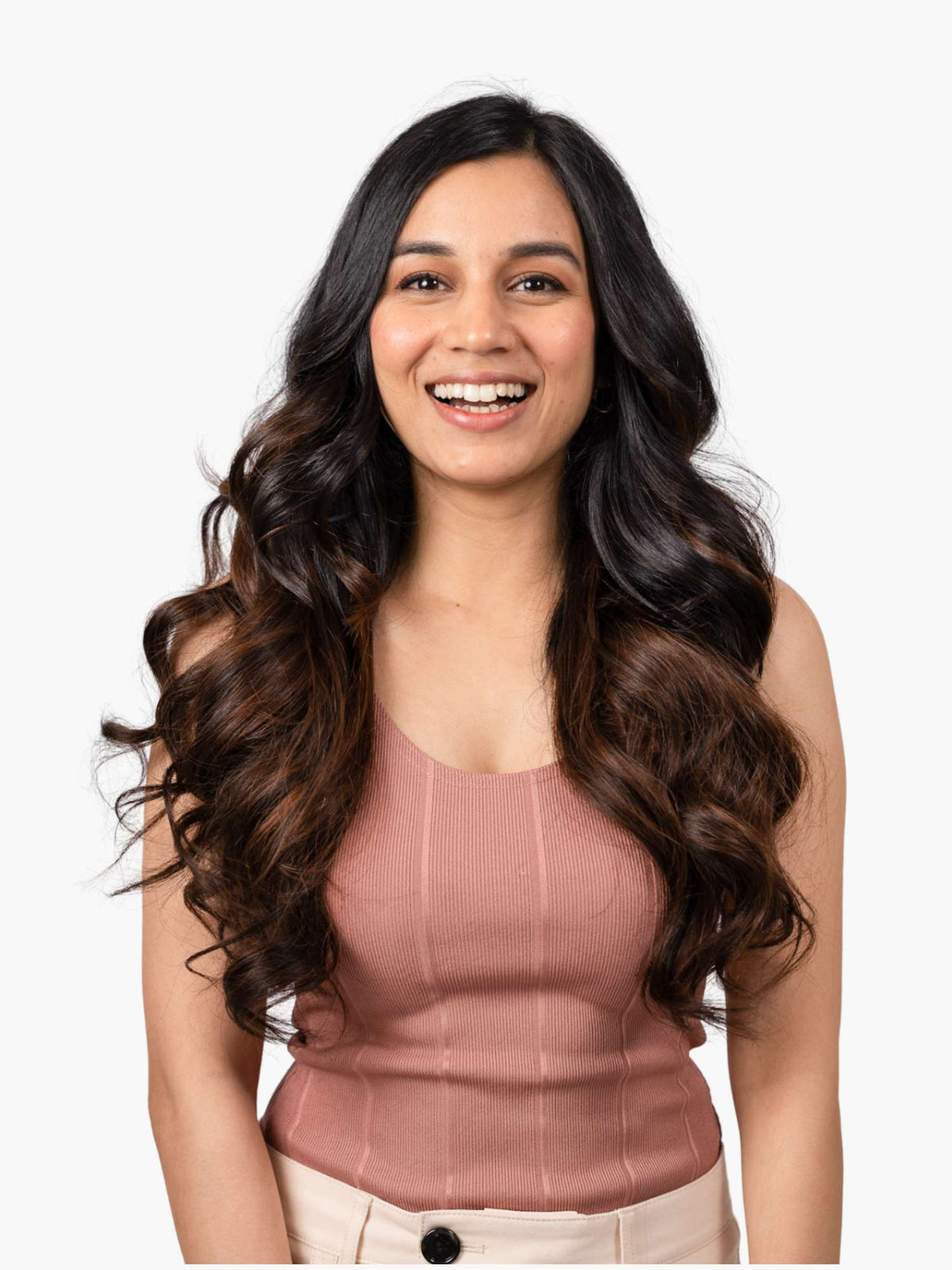
That piece is at the top of this article because it is the shortcut to the whole decision. The Caramel Brown Balayage Seamless 7 Set is made dark at the root and lighter through the lengths, which is the exact structure a good highlight job has. Clip it in and you are looking at the finished contrast level on your own head, with nothing bleached.
- Why Contrast Decides This, Not Colour
- The Four Ways Blonde Goes Into Brown Hair
- Choosing Your Contrast Level
- The Root Is the Whole Trick
- What It Actually Costs to Keep
- The Use Nobody Writes About: Covering Grey
- Test It Before Anybody Bleaches Anything
- Matching a Hair Piece to Highlighted Hair
- How 1 Hair Stop Makes This Easier
- Shop Balayage and Blend Sets
- Frequently Asked Questions
Why Contrast Decides This, Not Colour
Read enough of these conversations and one word does all the work. Contrast.
The single most upvoted piece of advice given to that frightened woman was not a shade name and not a technique. It was that she should go for something in between rather than anything platinum. A second reply told her the very light version did her skin tone no justice and suggested a warmer honey or caramel instead. A third said the same thing in fewer words: try something less harsh, a few highlights, and see how you feel.
Somewhere else, a woman asking whether blonde highlights in brown hair were still acceptable got the most precise answer in any of these threads. Very blonde, obvious highlights mixed with dark brown are tacky. But if there is not a lot of contrast and the highlights blend well, it can look great.
That is the entire subject in two sentences, and it is worth being clear about what it means, because it is not a style opinion.
Hair colour is measured in levels, from one at black to ten at the palest blonde. Most brown hair sits somewhere between three and six. A highlight is simply hair that has been lifted to a higher level than the base. The distance between those two numbers is your contrast, and it is the one variable that decides whether the result looks like money or like a mistake.
Two to three levels of lift: The hair reads as one colour with depth and movement in it. In a photograph you cannot point at where a highlight starts. This is what almost everybody means when they say they want balayage.
Four levels: Visible, deliberate brightness. Still blended if the placement is good, but now you can see individual lighter pieces. This is the upper limit for anybody who does not want a maintenance schedule.
Five or more levels: Stripes. The eye reads two separate colours sitting next to each other rather than one colour with variation. It can be worn on purpose and it looks very good on some people, but it is a commitment, not a subtle change.
Nobody in this category explains it in levels, which is why the advice you read is always shaped like a taste argument. It is not a taste argument. It is a number, and your colourist already knows yours.
The Four Ways Blonde Goes Into Brown Hair
The names are used loosely and interchangeably, which is how women end up asking for one thing and getting another. Here is what each one actually does, and more usefully, how each one looks in three months, because that is the part the pictures never show.
| Technique | What happens in the chair | What it looks like at three months |
|---|---|---|
| Traditional foils | Sections are woven out and wrapped in foil, lightened from very close to the scalp | A visible horizontal line where the new growth meets the lightened hair. This is the one that needs rebooking |
| Balayage | Lightener is painted on freehand, starting well below the root and getting heavier towards the ends | Softer and slightly grown out, with no line anywhere. This is the one designed to age well |
| Baby lights | Very fine foiled sections, close to the scalp, at low contrast | Almost no visible regrowth because each piece is too fine to draw a line on its own |
| Face framing or money piece | Only the sections around the face are lightened, usually at higher contrast than the rest | Grows out as a soft change of colour at the parting rather than a line across the head |
Two things in that table matter more than the rest.
The first is that balayage is not a colour. It is a way of applying one. You can have a balayage that is two levels lighter and invisible, or a balayage that is six levels lighter and very loud. When somebody says they want balayage, what they usually mean is that they want the grow-out to be soft. That is a fair thing to want and it is worth saying out loud at the consultation, because it changes the placement, not the shade.
The second is that the reason so many women land on balayage after first considering going fully blonde is not aesthetic. One woman gave the honest version of it in a thread: balayage is not as big a commitment and not as drastic as an all-over blonde, and it is easier to alter later if you want to darken it back up. That is a decision about reversibility, and it is the correct thing to be optimising for on a first attempt.
Four frames of the same base hair is the comparison this category never publishes, because the photographs available are always four different women in four different lights. Placement is the only variable that should be changing.
Choosing Your Contrast Level
Three things set the right number for you, and none of them is your face shape.
| What it is | How to check it | What it changes |
|---|---|---|
| How dark your base is | Look at the hair near your scalp in daylight, not in a bathroom mirror | The darker the base, the more processing each level of lift costs, and the more warmth appears on the way |
| Whether your skin runs warm or cool | Look at the veins on the inside of your wrist. Green reads warm, blue reads cool | Warm skin takes honey, caramel and gold. Cool skin takes ash, beige and mushroom. Getting this wrong is what people mean by washed out |
| How much upkeep you will genuinely do | Count how many salon appointments you kept last year | High contrast is a standing appointment. Low contrast is not. Be honest here rather than optimistic |
The middle row is the one that causes the most regret, and the threads are full of it. When a woman is told that blonde washes her out, what is usually happening is that a cool ashy blonde has been put onto warm skin, or a brassy gold onto cool skin. The level was fine. The tone was wrong.
One reply in that thread caught it exactly. It said the edited blonde did not do her skin tone justice, and suggested a warmer honey shade or caramel instead. Same lightness, different tone, completely different result against the same face.
The third row is the one people lie to themselves about. There is no shame in choosing low contrast because you know you will not come back in eight weeks. It is the more sophisticated choice, not the lesser one.
The Root Is the Whole Trick
If you take one thing from this article, take this. What separates highlights that look expensive from highlights that look cheap is almost never the ends. It is the four centimetres nearest your scalp.
A woman in one of these threads gave the professional answer in eight words without appearing to know it. Just add a shadow root so it blends more.
A shadow root, sometimes called a root smudge or a root melt, is a soft darker tone applied at the scalp after the highlights are done, blurring the point where the lightened hair begins. It takes a colourist a few minutes at the end of the appointment. It does three things.
- It removes the line: Without it, the highlight starts at a fixed point on the hair shaft and that point moves down your head at roughly a centimetre a month. With it, there is no point to move, so regrowth reads as depth rather than as a fault.
- It buys you months: A foil job with a hard root needs redoing at six to eight weeks. The same job with a shadow root is comfortably wearable at three or four months.
- It makes the whole head look more natural: Nobody's hair is lighter at the scalp than at the ends. Sun does not work that way. A dark root is what real hair does, which is why hair that has one always looks like real hair.
Ask for it by name. If a colourist offers to lighten right up to the scalp on your first appointment, that is worth a question rather than a nod.
Ten weeks is the frame that decides whether somebody rebooks or gives up on colour. It is also the frame nobody photographs, because salons post the day the client leaves the chair.
What It Actually Costs to Keep
Colour is sold on the day it is done and paid for over the following year. Four things are worth knowing before the first appointment, and only one of them is about money.
The rebooking rhythm: Foiled highlights need a visit roughly every eight weeks. Balayage, painted below the root, stretches to three or four months. That is not a small difference. It is two appointments a year against six.
Fading is not optional: Lighter tones lift out faster than darker ones, and this is true of coloured hair and of hair pieces equally. Anything blonde will shift over time, usually towards warmth. A purple or blue toned shampoo used sparingly slows it down. Nothing stops it.
Brass is a chemistry problem, not a mistake: When dark hair is lifted, it passes through red and then orange on the way to yellow. If the lightening stops early, or if a toner fades out, the underlying warmth shows again. This is why hair that looked ash in the salon can look orange eight weeks later, and it is not the colourist being careless.
Bleach changes the hair itself: Lightening opens the cuticle and removes pigment, and the hair that comes out of that process is more porous than the hair that went in. It takes colour differently afterwards, which is why one woman in a thread warned that colouring over bleached hair is not as simple as putting another shade on top, and that the new colour fades very quickly if it is not done properly. She was right. Hair that has been lifted several levels also holds a curl differently and tangles more readily at the ends.
None of that is an argument against colour. It is an argument for knowing the number of levels you are asking for, because every one of these costs scales with it. Two levels of lift is a low maintenance decision. Six is a hobby.
The Use Nobody Writes About: Covering Grey
Every consumer article about this treats highlights as a look. Watch a working colourist explain what she is actually doing on a real client and you get something completely different.
In one such session the colourist was highlighting a woman who was heavily grey. She was not doing it for brightness. She said so directly: the purpose was to soften the grow-out as the grey came in, and to mask the demarcation the client had at the root. The client was staying in the brunette family. The blonde was there to blur a line.
That is a use case a very large number of women need and almost nobody names, so it is worth setting out properly.
Solid single process colour on greying hair creates a hard problem. The colour is uniform, the regrowth is not, and within three weeks there is a band of silver at the parting sitting against a flat block of brown. The contrast is total and it is in the most visible place on your head.
Lightened pieces solve this by breaking up the uniformity. If there are already several tones in the hair, a few silver strands coming through read as one more tone rather than as a fault line. The eye has nothing single to compare them against.
Two details make this work, and both came out of watching the professional rather than reading about it.
- Diagonal sections, not horizontal ones: She took her sections on the diagonal specifically so the result would be diffused rather than banded. Horizontal sections stack, and stacked sections make stripes. This is a technical request you can make.
- Stay in the family: She kept the whole head brunette and worked with lightness rather than with a different colour. Grey camouflage fails when the highlight is so much brighter than the base that it becomes its own event.
If this is your reason for being here, say it at the consultation in those words. You want the grow-out blurred. It changes what a good colourist does with the first foil.
Test It Before Anybody Bleaches Anything
Here is the practical gap in this whole category. Every article tells you how to choose. None of them tells you that you can see the answer before you commit, on your own head, in your own bathroom light, for as long as you want to look at it.
The frightened woman in that thread ran her photograph through an editing app. It is a completely reasonable thing to do and it is also useless, because a filter changes pixels and gives you no information about how a colour behaves against your skin in daylight, under office lighting, or in a photograph taken by somebody else.
A clip-in set in a balayage shade gives you the real thing. It is your hair length, in human hair, in a specific contrast level, moving the way hair moves. You can wear it for a day and find out three things you cannot learn any other way.
- Whether the tone suits your skin: Warm or cool, in daylight, without a filter deciding for you. This is the question that produces most of the regret and it takes an afternoon to answer.
- Whether you can live with the contrast: A level of lift that looks exciting in a salon photograph can feel like too much on a Wednesday morning. Wearing it tells you before it is permanent.
- Where you want the lightness to sit: Around the face only, through the ends only, or all the way through. You can move a clip-in piece. You cannot move a foil.
There is also a version of this where the test becomes the answer. Plenty of women try the clip-in set, decide they like having the option rather than the commitment, and never book the appointment. Highlights that come out at night are not a lesser version of highlights. On fine or previously coloured hair they are frequently the better call, because the alternative is lifting hair that has already been through enough.
Where the lightness sits also depends on how your hair is cut. Layers move lighter pieces to the surface and make the same colour read as brighter, which is covered in our guide to long layered haircuts for women. On a solid one length cut the same highlights sit underneath and barely show. If you are cutting and colouring in the same season, do them in that order and let the cut decide the placement.
Matching a Hair Piece to Highlighted Hair
This is the part we know better than anybody writing about colour, because it is the problem we get sent photographs of every week.
Matching a hair piece to solid brown hair is straightforward. Matching one to highlighted hair is the hardest matching problem there is, and the reason is arithmetic. Highlighted hair is not one colour. It is at least two, arranged in a specific way, darker at the root and lighter through the lengths. A single flat shade cannot match it at any point, because if it matches the root it is too dark at the ends and if it matches the ends, it is too light at the top.
Three rules come out of that, and they hold for every piece we make.
- Match the root, never the ends: The root is where the piece meets your own hair and where anybody looking at you is looking. A piece that is slightly light at the ends reads as sun. A piece that is wrong at the root reads as a hairpiece. The same principle governs every join, which is set out in full in how to hide the join on a ponytail extension.
- Buy multi-tonal to match multi-tonal: A balayage set has the gradient built into it, so it behaves the way your own highlighted hair behaves as it moves. A solid set sitting under highlighted hair separates the moment you turn your head.
- Check it in three lights: Daylight, indoor warm light and a phone camera flash. Tone shifts hardest under flash, which is also where most of the photographs of you get taken.
One more thing worth saying because it surprises people. If you are going to colour your own hair and buy a piece, buy the piece first and take it to the appointment. Human hair takes colour, but it takes it differently to hair growing on a head, because it is not being fed by a scalp. Matching a piece to your new colour is far easier than matching your new colour to a piece.
How 1 Hair Stop Makes This Easier
We do not colour hair in a salon. We make hair, which means the women who reach us are usually at one of two points. Either they are thinking about colour and want to see it first, or they already have it and cannot find a piece that matches.
Trusted by 300,000+ women worldwide | 4.8★ from 14,700+ reviews | 100% Human Remy Hair | Sourced From Temples | Clip-Free | Handmade in our own facility since 2009 | Damage-free application guarantee
"Every balayage set we make is built dark at the root and lighter through the lengths, because that is what real highlighted hair does. We had to learn that the hard way. The first blended sets we made were beautiful on their own and impossible to match, because we had put the gradient in the wrong place. Match the root and the rest forgives you."
Raina Grover and Richa Grover, Co-Founders, 1 Hair Stop
Every piece is hand-knotted or wefted in 100% human Remy hair in our own facility in Hyderabad. Because it is human hair, a colourist can tone it towards you rather than you having to find an exact match off a chart. Our blended sets are heat resistant and can be re-coloured, with the single exception of anything taken to jet black.
We are also honest about the one drawback. Lighter shades fade, even with infrequent use, and honey and caramel tones fade faster than chestnut and mocha. A purple or blue toned shampoo used every few washes keeps brassiness down. That is true of every brand of human hair and of your own hair too, and anybody who tells you otherwise is selling.
Shop Balayage and Blend Sets
All four of these are seven-piece seamless sets, built dark at the root and lighter through the lengths. Choose by contrast level rather than by name.
-
The safest first step: Add warm lightness that suits almost every brown base with the Caramel Brown Balayage Seamless 7 Set, a blended grow-out colour with a soft caramel through the lengths. It is the set we send to most women testing highlights for the first time.
-
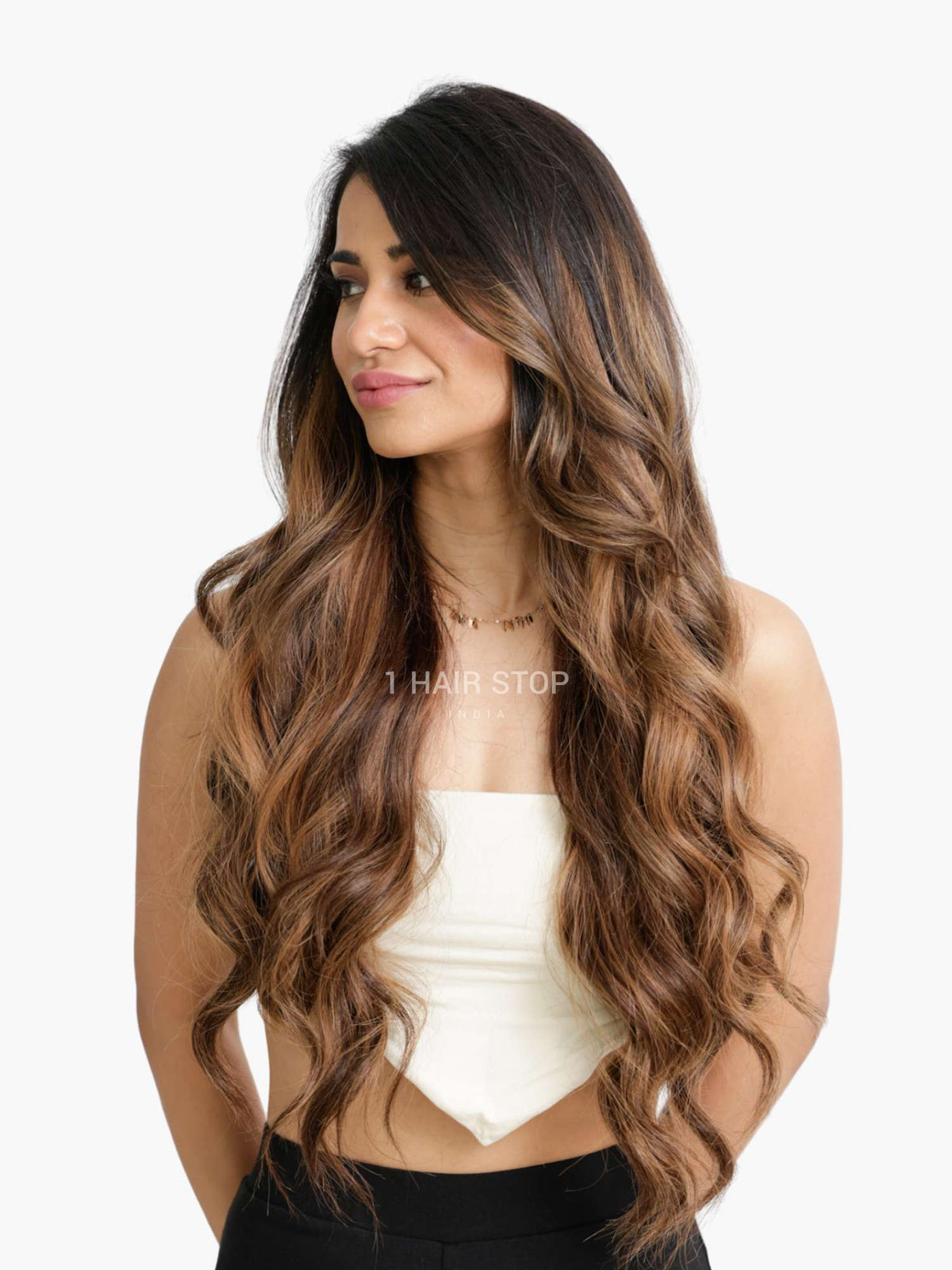
The lowest contrast option: Keep the change subtle with the Chestnut Blend Seamless 7 Set, whose lift sits close enough to a mid brown base that it reads as depth rather than as highlights. Choose this if you want movement without anybody asking what you have had done.
-
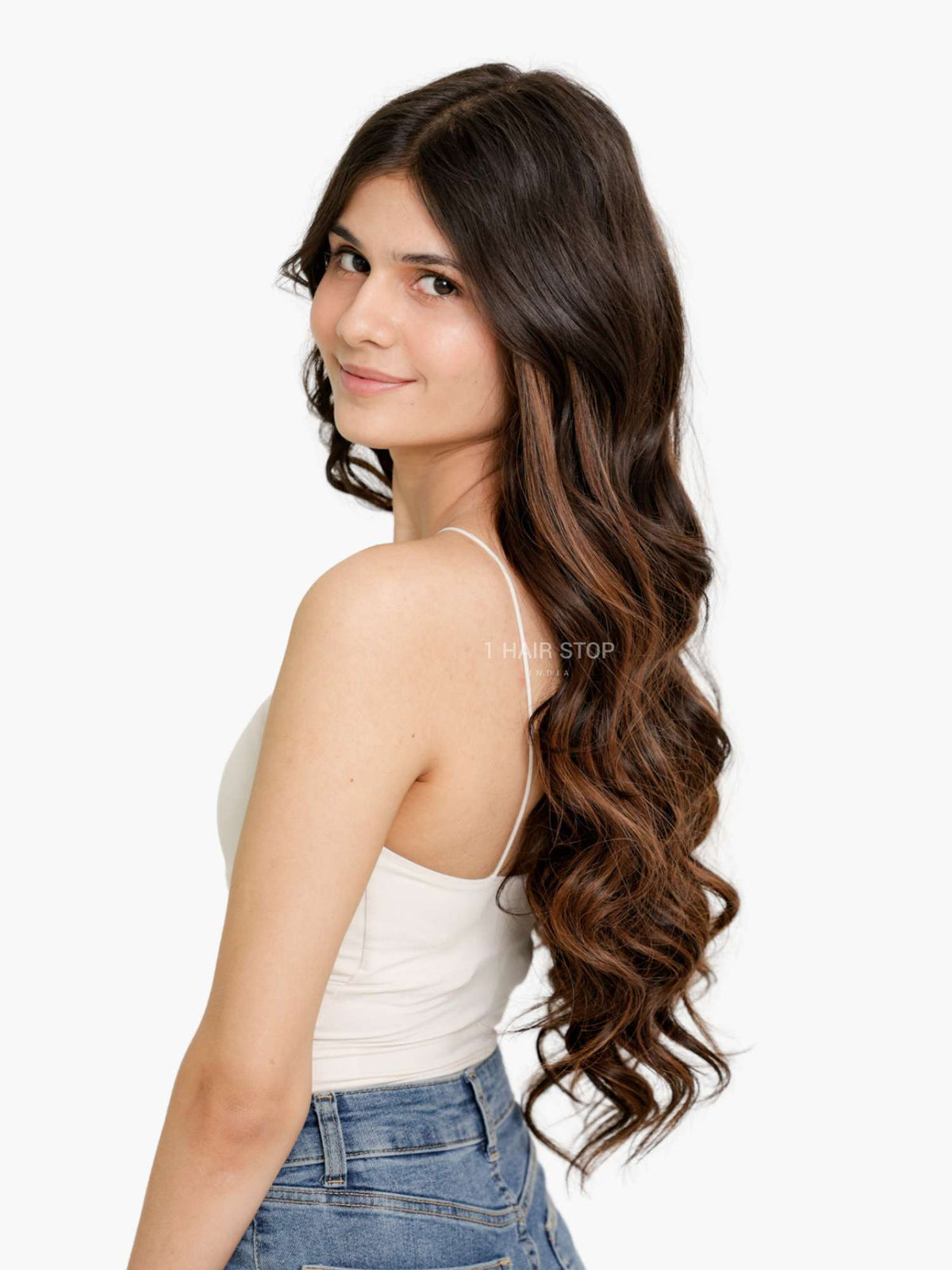
For cool skin and ashy tones: Avoid the brassiness that warm shades bring on cool complexions with the Mocha Brown Balayage Seamless 7 Set, a cooler blended grow-out colour on a thin silicone band. It is the right pick if gold tones have ever made you look washed out.
-
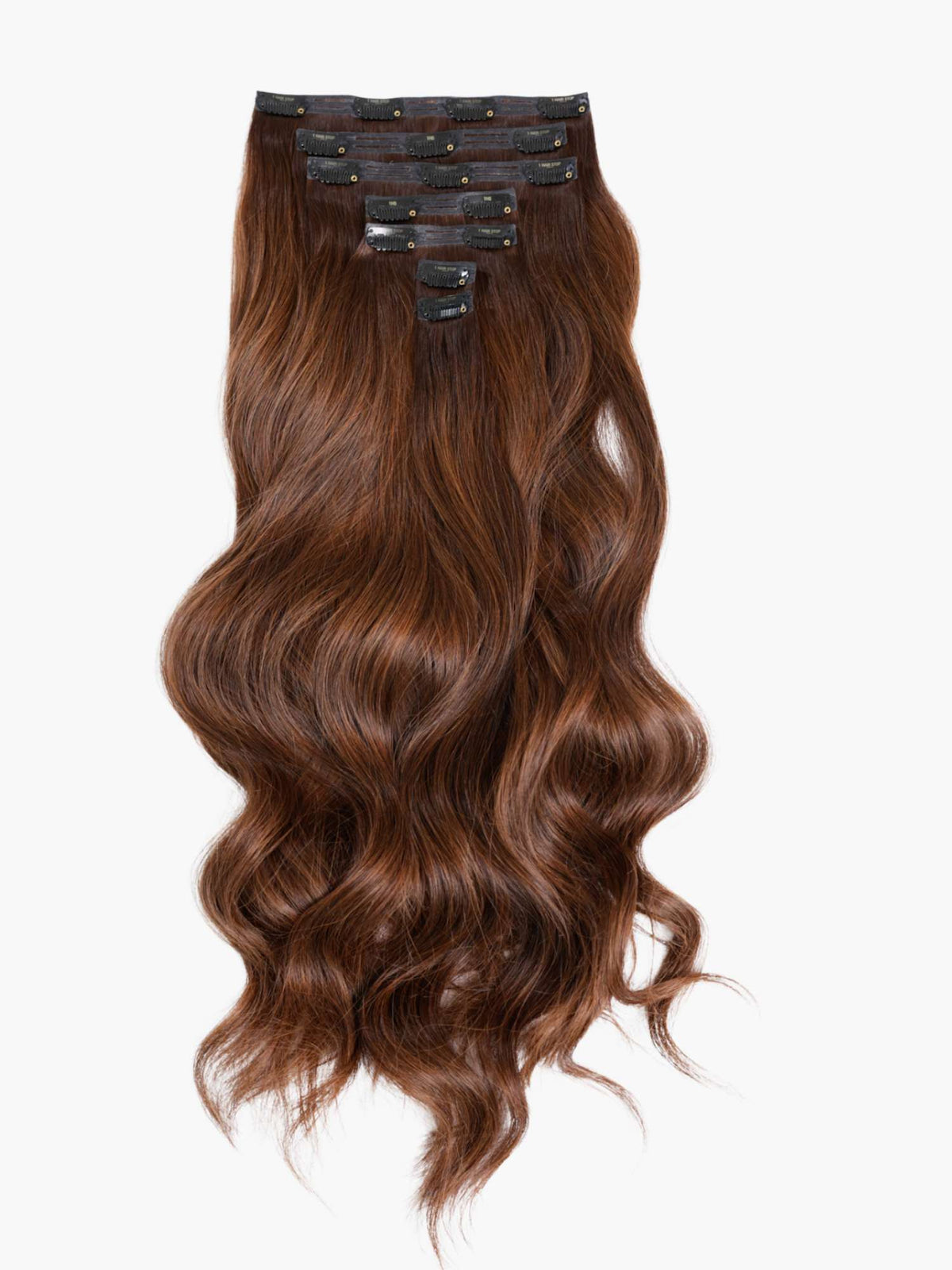
The brightest of the four: Go noticeably lighter through the lengths with the Honey Blend Seamless 7 Set, the highest contrast blend we make. Being the lightest, it is also the one most prone to fading, so a toning shampoo every few washes is part of owning it.
-
A money piece without bleach: Brighten the hair around your face without lightening any of it using Clip-In Curtain Bangs, two soft pieces that clip in at the top of the head in seconds. It is the face framing effect that most women are actually after when they ask for highlights.

- Not sure which contrast level is yours? Read bob haircuts for women if you are changing the cut at the same time or book a free video call and we will look at your base in daylight with you.
Frequently Asked Questions
How light should blonde highlights be in brown hair?
Two to three levels lighter than your base is the range that reads as expensive and grows out invisibly. Four levels is visible but still blended. Five or more reads as stripes rather than as one colour with depth, and it commits you to a rebooking schedule. If you are doing this for the first time, ask for two to three levels and go lighter next time if you want to. Going back down is harder than going up.
Will blonde highlights wash me out?
Only if the tone is wrong for your skin, not if the lightness is. Warm skin, which usually shows green veins at the wrist, suits honey, caramel and gold. Cool skin, which shows blue, suits ash, beige and mushroom tones. Most of the time when somebody says blonde washed them out, an ashy tone was put on warm skin or a gold tone on cool skin. Same level, wrong tone, completely different result.
What is a shadow root and do I need one?
It is a soft darker tone applied at the scalp after the highlights are finished, blurring the point where the lightened hair begins. It takes a few extra minutes in the chair. It removes the hard line at regrowth, extends the time between appointments from around eight weeks to three or four months, and makes the whole head look more like natural hair, because real hair is never lighter at the root than at the ends. Ask for it by name.
Is balayage less damaging than highlights?
Usually yes, for two reasons that have nothing to do with the product used. Balayage is painted below the root rather than at the scalp, so there is no heat from the head speeding up the process unevenly, and it is typically redone every three or four months rather than every eight weeks. Fewer processes over a year means less cumulative change to the hair. The lightener itself is the same chemistry.
Can I try blonde highlights without colouring my hair?
Yes, and it is the sensible order to do it in. A clip-in set in a balayage shade shows you the real contrast level on your own head, in daylight, for as long as you want to look at it, which a filter or an editing app cannot do. You find out whether the tone suits your skin, whether you can live with the contrast, and where you want the lightness to sit. Some women test this way and then decide they prefer the clip-in version permanently.
Do blonde highlights help cover grey hair?
They help disguise the grow-out, which is the part most people find difficult. Solid single process colour creates a hard silver band at the parting within about three weeks. Lightened pieces break up that uniformity, so incoming grey strands read as one more tone rather than as a line. Ask for diagonal sections rather than horizontal ones, because horizontal sections stack into stripes, and keep the whole head in the same colour family.
How do I match extensions to highlighted hair?
Match the root shade, never the ends. The root is where the piece meets your own hair and where the eye goes. A piece slightly light at the ends reads as sun. A piece wrong at the root reads as a hairpiece. Buy a multi-tonal balayage set rather than a solid shade, because highlighted hair is at least two colours arranged in a specific order and no flat shade can match it at both ends. Check the match in daylight, indoor light and under a phone flash.


