


Every guide gives you the same instruction. Take a strand of hair, wrap it around the base, pin it. Do exactly that and the join can still be obvious, because wrapping is only one of the six things that give it away, and it is not usually the one that fails first.
The seam being visible is the symptom. What actually exposes it is a colour mismatch at the top of the piece, hair too slippery to hold the piece still, placement too high on the head, or a halo of short broken hairs framing the base. Fix those and the wrap becomes almost incidental.
Short answer: Match the top of the piece to your root shade rather than your lengths, because the top is the only part that ever gets seen. Add grip at the base with texture spray or dry shampoo before you fit anything, so the piece cannot rotate. Sit it below the widest point of your head rather than high on the crown. Then take a thin strand from the underside of the extension, wrap it tightly around the join, and pin it upward underneath with a U-shaped pin.
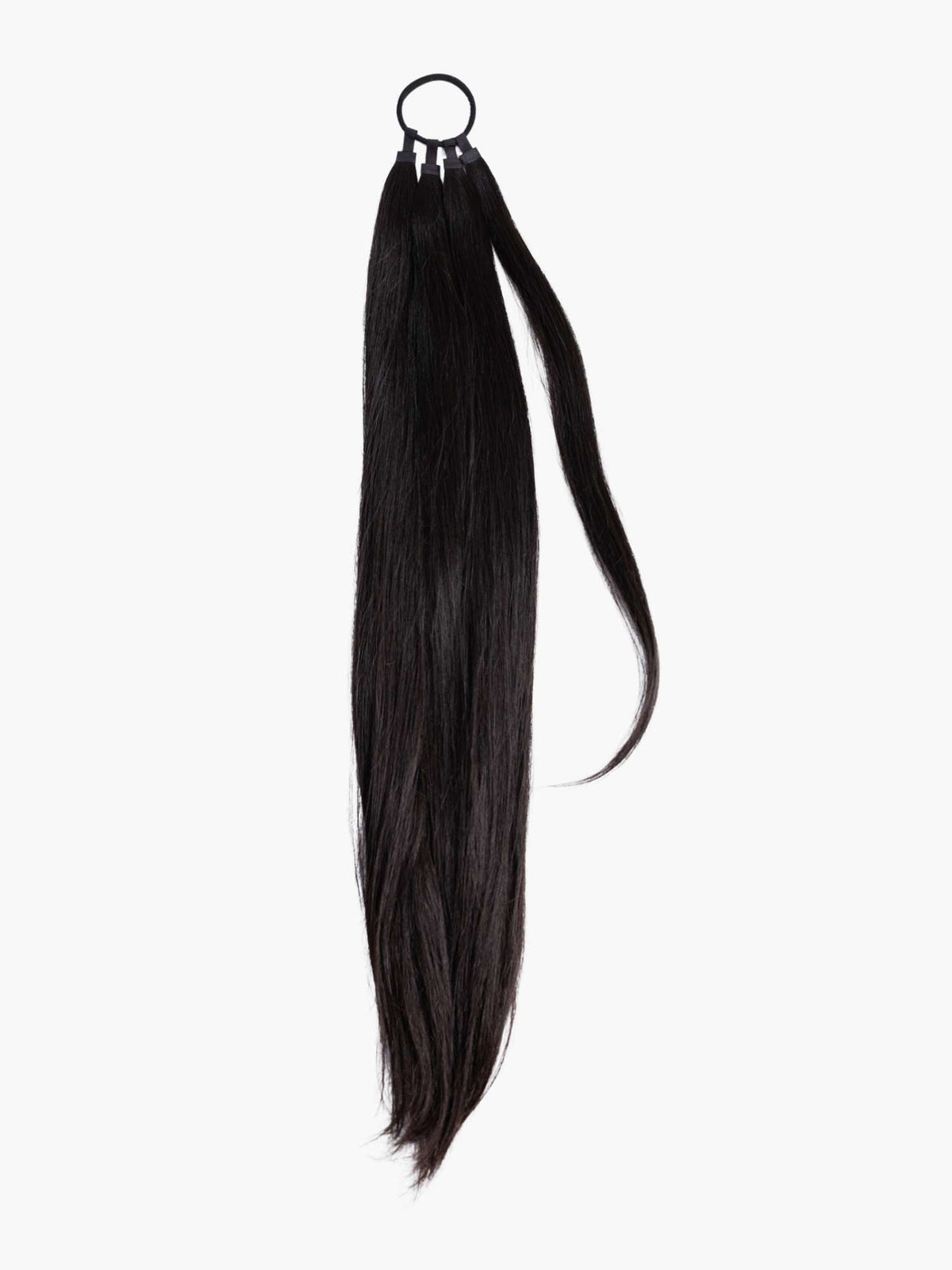
When a join will not hide no matter what you do, the structural answer is a piece whose own construction covers it. The braided ponytail extension does exactly that, because the braid sits over the attachment instead of beside it. That is the last resort, not the first, and the three fixes below are worth trying before you get there.
- What Actually Gives a Join Away
- The Colour Mistake Almost Everyone Makes
- Add Grip Before You Wrap Anything
- Placement, and the Equator Rule
- The Wrap, Done Properly
- The Halo of Short Hairs Around Your Base
- When It Will Not Hide, and What to Do Instead
- How 1 Hair Stop Makes the Choice Easier
- Shop Ponytail Extensions
- Frequently Asked Questions
What Actually Gives a Join Away
Six things, and most people only ever address the last one.
- Colour mismatch at the top of the piece. The only part of an extension anyone sees is the top few centimetres at the join, and that is usually the part that matches worst.
- The piece rotating. Clean, soft, freshly washed hair gives an attachment nothing to hold, so it turns slightly every time you move your head and eventually the fastening comes into view.
- Placement too high. A join sitting on the crown is at eye level for anyone behind you. The same join sitting lower is below most sight lines.
- Bulk. A thick attachment creates a visible lump under the hair even when nothing is technically showing.
- Short broken hairs around the base. A halo of frizz frames the join and draws the eye straight to it.
- A loose or thin wrap. The one everybody writes about.
Work through the first five and the sixth stops mattering very much. Work only on the sixth and you will keep re-pinning a join that was never going to hide.
The Colour Mistake Almost Everyone Makes
This is the single most useful thing on this page, and almost nobody publishes it.
You match an extension to your hair by holding it against your lengths, because that is where most of the hair is. But the lengths are not the part that shows. The only part of a ponytail piece anyone ever sees is the top, right at the join, and that sits against your roots.
Your roots are almost always darker than your lengths. Sun, previous colour, and the simple fact that older hair has been through more all lift the mid-lengths and ends. So a piece matched perfectly to your lengths is a shade too light exactly where it will be seen, and that is what reads as a visible line even when the wrap is tight and nothing is technically exposed.
Match the top of the piece to your root shade, not your length shade. If the piece is noticeably lighter at the top than your roots, a salon can add a shadow root or root smudge to the top few centimetres so it fades into your own hair the way your real roots do. Wearers who have done this describe it as the change that finally made the join disappear after everything else had failed.
Take that comparison photo yourself before you order. Hold a swatch against the hair at your part line, not against your ponytail, and shoot it in daylight from a window rather than under a bathroom light. Bathroom lighting flatters a match that daylight will expose.
Add Grip Before You Wrap Anything
A join that was invisible at eight in the morning and obvious by eleven has not come loose. It has rotated.
Freshly washed hair is soft and slippery, which is exactly the wrong surface for anything to grip. The piece turns a few degrees every time you move your head, and after a couple of hours the fastening has travelled around far enough to show from one side.
Two fixes, both taking seconds.
Texture at the root. A little dry shampoo or texture spray around the base of your ponytail before you attach anything gives the comb and the wrap something to bite into. This is the fix wearers reach for most, and it works on hair that is otherwise too soft to hold a piece at all.
A light backcomb. Just at the root of the ponytail, not up the length. It roughens the surface enough to stop the slide without creating a tangle you have to deal with later.
Day-old hair holds a ponytail piece better than freshly washed hair, which is worth knowing if you have an event and a choice about when to wash.
Four hours is the honest test window. A join photographed straight after fitting tells you nothing, because everything looks good at that point. The difference between hair that gripped and hair that did not only shows once you have been moving around in it, which is exactly why so many people think the piece was faulty.
Placement, and the Equator Rule
There is a simple rule that long-term extension wearers arrive at independently, and it applies just as much to a ponytail piece as to wefts.
Keep the join below the widest point of your head. Picture a line running round your head at its widest, roughly level with the tops of your ears. Above that line, anything you attach is on a curved surface facing outward, so it catches light and sits at eye level for people standing behind you. Below it, the surface curves away and your own hair falls over the join naturally.
A high ponytail puts the join in the worst possible position on both counts. It is the most visible placement and it is the one carrying the most weight, which is also the one most likely to slip. If your priority is that nobody notices, a mid or low ponytail is doing half the work for you before you touch a bobby pin.
That is the photograph to judge it by, because directly behind at eye level is the angle you never check and everybody else has. If it passes there, it passes.
The Wrap, Done Properly
With the first four fixed, the wrap is straightforward.
- Take the strand from underneath. A thin section from the underside of the extension, never from the top. Hair from underneath reads as the shade your own hair looks in shadow, and taking it from there leaves no gap on the visible surface.
- Wrap tightly and stack the turns. Wind it around the base with each turn sitting against the last rather than spiralling down the ponytail. Stacked turns cover the fastening completely. A spiral leaves gaps.
- Cover everything. The elastic, the velcro and the comb should all be under hair when you finish. If any part of the attachment is visible from behind, the section you took was too thin. Undo it and take a thicker one rather than adding pins.
- Pin upward, underneath. Push the pin up into the wrap from below, so the hair above it hides the pin. Use a U-shaped pin rather than a flat one, because a flat pin works its way out under weight.
- Check from behind with a hand mirror. Not straight on in the bathroom mirror. From directly behind, at eye level, in daylight.
The Halo of Short Hairs Around Your Base
Worth its own section because it is the thing people blame on the extension when the extension is not at fault.
If you wear a ponytail most days, especially with a tight elastic, the hair at that spot breaks. It grows back short, and those short hairs stand up in a halo around the base of your ponytail. That halo frames the join, catches light, and makes a perfectly fitted piece look obvious, because the eye goes to the frizz and then finds the seam next to it.
Women describe reaching the point where the breakage band has left a permanent kink, and often not realising the ponytail caused it until someone points it out.
Three things help, in order of how much difference they make.
Move where you tie it. Not the same spot every day. This alone prevents most of it.
Change what you tie it with. A silk scrunchie, a soft nylon tie or a large claw clip instead of a tight elastic. The elastic is what does the damage, and the fix costs almost nothing.
Smooth what is already there. A little oil or a light hold product patted over the halo rather than sprayed at it. Patting lays the short hairs down. Spraying makes them shine and stand out more.
If the breakage is already established, moving your parting to a different spot drops a fresh layer of hair over the damaged section, which hides it while it grows out. More on protecting the front edge in covering a receding hairline without surgery, since sustained tension at the front is the same problem in a more visible place.
When It Will Not Hide, and What to Do Instead
Honest section, because the alternative is you buying something twice.
Some hair genuinely will not hide an attachment. If your own hair is fine enough to be see-through in bright light, there may not be enough of it to lay over a fastening, and no technique changes that. Women in this position describe being in denial about it until a friend mentions it, and ending up with expensive pieces they never wear because hiding them became exhausting.
If that is you, three things work better than persisting.
Go lighter and lower. A smaller, lighter piece worn low creates less to hide in the first place. Our flat clip-in ponytail sits closer to the head than a wrap around and adds far less bulk at the join.
Choose a style that hides structurally. A braid disguises a join better than any wrap, because the crossing sections break up the line where the piece meets your hair. Our braided ponytail extension does this by design. A bun does the same thing, spreading the attachment across a wider area with no single exposed seam.
Cover it deliberately. A decorative clip, a scarf tied at the base or a couple of pins placed as though they are meant to be there. Something that looks like a styling choice reads as a styling choice. Something that looks like it is hiding a problem is the thing people notice.
If you are still choosing which attachment to buy, clip-in vs wrap-around ponytail extensions compares how each one behaves, including which fails by showing and which fails by slipping.
How 1 Hair Stop Makes the Choice Easier
We make what we sell. Every piece is hand-knotted and wefted in our own facility in Hyderabad in 100% human Remy hair with the cuticles aligned in one direction, which is what lets it lie flat against your own hair rather than sitting on top of it.
Trusted by 300,000+ women worldwide | 4.8★ from 14,700+ reviews | 100% Human Remy Hair | Sourced From Temples | Clip-Free | Handmade in our own facility since 2009 | Damage-free application guarantee
"People send us photographs of a join they cannot hide, and nine times out of ten the wrap is fine and the problem is that the top of the piece is a shade lighter than their roots. Nobody matches to their roots, because nobody thinks about which part of the piece other people can actually see. It is the first thing we check now."
Raina Grover and Richa Grover, Co-Founders, 1 Hair Stop
Because it is 100% human hair, the top of any piece can be adjusted by a colourist to sit closer to your root shade, which is not something you can do with synthetic fibre. On a join, that flexibility is worth more than any other feature.
Shop Ponytail Extensions
Do the colour check first, because it is free and it fixes most joins. If it does not, the piece itself is the next lever.
- A join that will not hide, whatever you try: Hide a stubborn join with the Braided Ponytail Extensions, where the braid sits over the attachment instead of beside it. The piece covers its own join, which is what makes it work when wrapping never quite does.
-
Fine hair or a small base: Add length without bulk using the Flat Clip-In Ponytail Extensions, whose base lies flat against the head so it stays hidden on fine hair. Available in four lengths from 8 to 18 inches, so you can pick the drop you actually want.

-
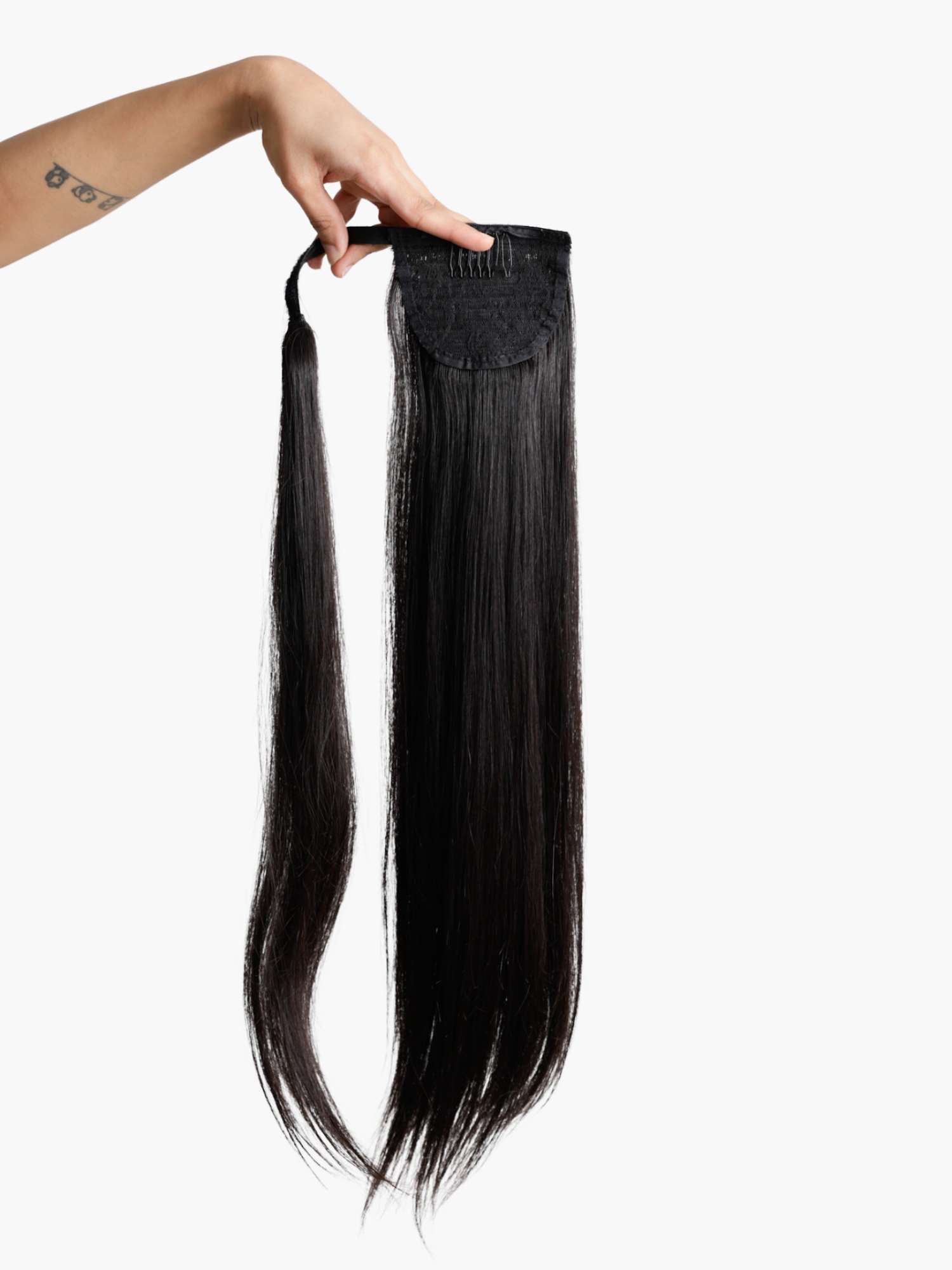
Firm base, most invisible finish: Get the most invisible finish with the Wrap Around Ponytail Extensions, which wrap around your own ponytail and hold with a comb and a velcro fastening rather than clips. Best when your own base is firm enough to keep the piece steady all day.
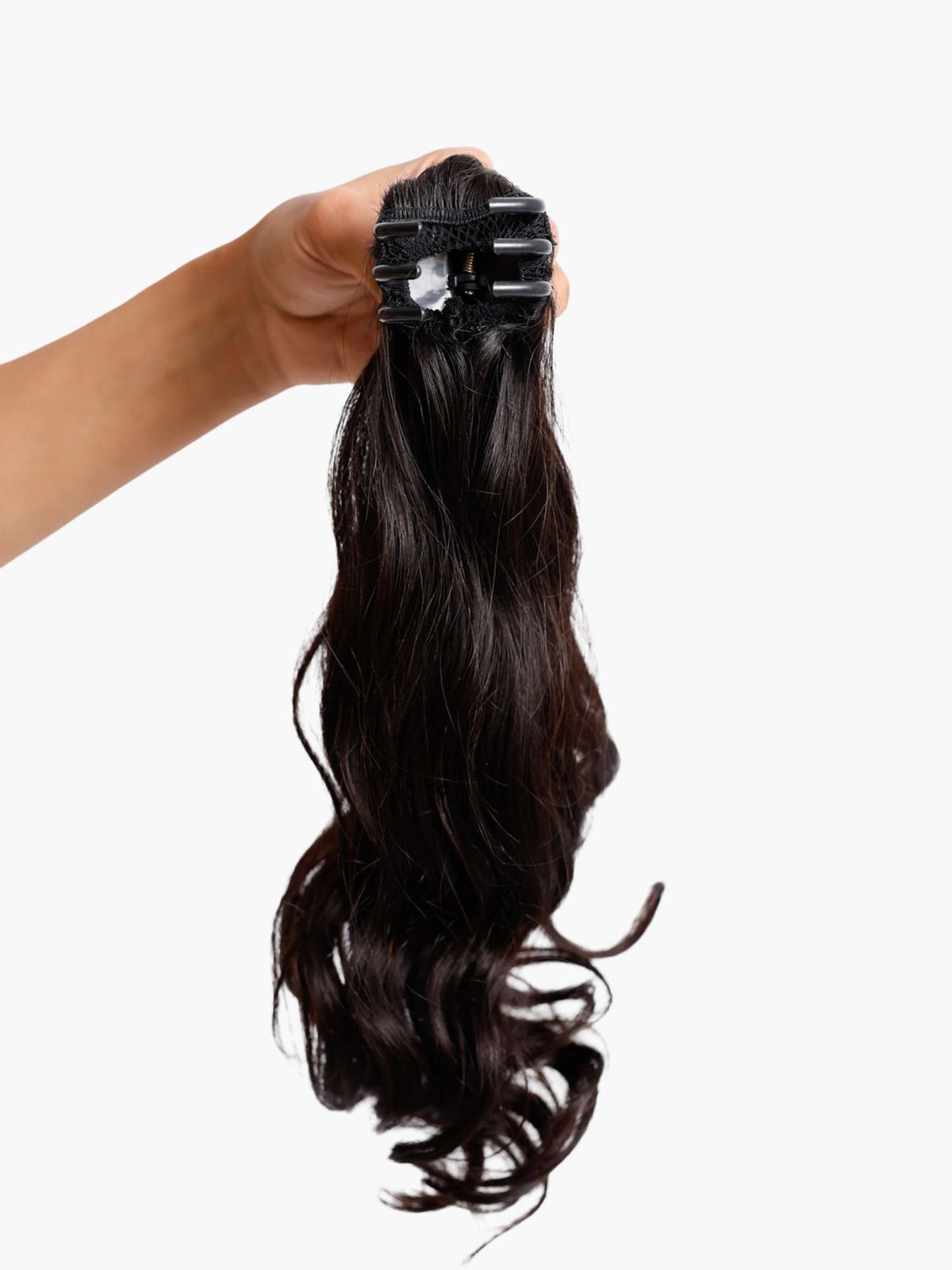
- Short hair or very little to gather: Add a ponytail to short hair with the Mini Clip-In Ponytail Extensions, the smallest and lightest piece we make. Less weight at the base means less strain on hair that is already fragile.
- Not sure which attachment hides best on your hair? Read clip-in vs wrap-around, or book a free video call.
Frequently Asked Questions
Why can people still see my ponytail extension even though I wrapped it?
Usually colour, not the wrap. The only part of the piece anyone sees is the top at the join, and that sits against your roots, which are darker than your lengths. A piece matched to your lengths is a shade too light exactly where it shows. The other common causes are the piece rotating on slippery clean hair, and placement too high on the head.
Should I match a ponytail extension to my roots or my ends?
Match the top of the piece to your roots, since that is the only part that is visible once it is fitted. Hold a swatch against the hair at your part line rather than against your ponytail, and check it in daylight from a window rather than under bathroom lighting. A colourist can add a shadow root to the top of a human hair piece if it sits lighter than your own.
How do I stop my ponytail extension from twisting round during the day?
Give it something to grip. A little dry shampoo or texture spray around the base of your ponytail before you attach anything, or a light backcomb just at the root. Freshly washed hair is too soft and slippery to hold a piece still, which is why a join that looked perfect in the morning has rotated by lunchtime. Day-old hair holds better than clean hair.
Where on my head should the join sit?
Below the widest point of your head, roughly level with the tops of your ears. Above that line the surface curves outward, so the join catches light and sits at eye level for anyone behind you. Below it your own hair falls over the attachment naturally. A high ponytail is both the most visible placement and the one carrying the most weight.
What are the short frizzy hairs around my ponytail and how do I hide them?
Usually breakage from wearing a ponytail in the same place with a tight elastic. They grow back short and stand up in a halo that frames the join and draws the eye to it. Vary where you tie it, switch to a silk scrunchie or a claw clip, and pat a little oil over the halo rather than spraying it. Moving your parting drops a fresh layer over the damaged section while it grows out.
What if my hair is too fine to hide the attachment at all?
Then stop trying to hide it and change the approach. Go smaller and lower, since a lighter piece worn low creates less to conceal. Choose a braided piece or a bun, because both disguise a join structurally rather than relying on a wrap. Or cover it deliberately with a clip or scarf, since something that looks like a styling choice reads as one.


