


Search this and you will get the same list everywhere. Fringe, curtain bangs, side-swept layers, curls, a side-parted bob, maybe a scarf. Then the same warning at the end: do not pull your hair back.
Two problems with that. A fringe is cut from your hairline, so if your hairline is the thin part, you may not have the hair to cut one from. And telling a woman never to tie her hair back is not styling advice, it is a life sentence. This guide sorts the styles by where your loss actually is, tells you when a fringe is the wrong idea, and covers how to wear your hair up without putting the whole thing on display.
Short answer: Three things hide a receding hairline. Hair that falls forward over the temples, volume at the root so the hair sits away from the scalp instead of lying flat against it, and a break in the line so the eye never follows your hairline all the way across. A fringe does all three, which is why everyone recommends it, but only if you have the density at the front to cut one from. If you do not, clip-in bangs give the same effect without cutting anything.
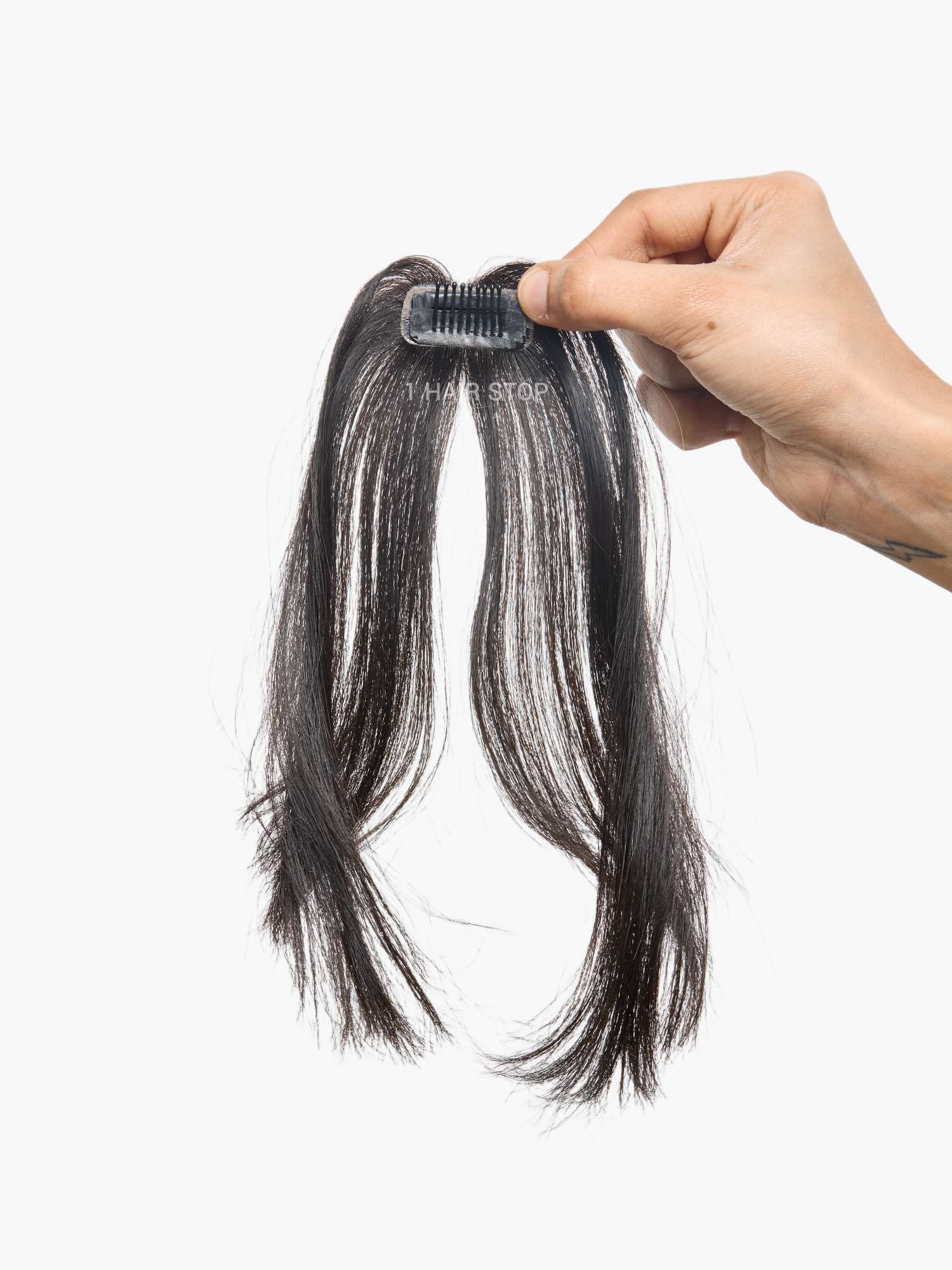
The fastest of every option below is the one in that photograph. Clip-in curtain bangs cover the front hairline in seconds and come off at the end of the day, which is the whole advantage over cutting a fringe you then have to live with. If you want a softer, less structured version, clip-in bangs sit closer to the face.
- What Actually Hides a Hairline
- The Fringe Problem Nobody Mentions
- The Best Styles for Where Your Loss Is
- How to Wear Your Hair Back Without Showing It
- Styles That Make It More Obvious
- Small Tricks That Beat a Haircut
- Keep the Tension Off Your Hairline
- How 1 Hair Stop Makes the Choice Easier
- Shop the Pieces in This Guide
- Frequently Asked Questions
What Actually Hides a Hairline
Every style on every list works through one of three mechanisms. Once you know which one you need, choosing gets much easier than picking a photo you like.
Forward-falling hair. Anything that travels from further back on the head towards the face covers the temples and the front edge without needing density at the hairline itself. Fringes, curtain bangs, side-swept pieces, a brushed-forward crop.
Volume at the root. Flat hair lying against the scalp shows every gap underneath it. Hair lifted at the root casts a shadow instead, and shadow reads as density. Layers, curls, waves, a blow-dry with lift at the crown.
A broken line. The eye follows a continuous line. A deep side part, an asymmetric cut, or a bit of texture at the front interrupts that line so nobody traces your hairline from temple to temple.
Most good styles combine two. A side-swept fringe on a layered bob gives you forward-falling hair, root volume and a broken line at once, which is why it turns up on every list. The lists just never explain why.
The Fringe Problem Nobody Mentions
Here is the thing every guide leaves out. A fringe is cut from the hair at the front of your head. That is the hair a receding hairline has least of.
If your recession is mild and the density behind the front edge is still good, a stylist can start the fringe further back and pull enough hair forward to make it work. That is the standard advice and it is sound.
If your recession is further along, the maths stops working. There is not enough hair at the front to make a fringe that reads as full, and cutting one takes length from the exact area that was already sparse. Women who have been through this describe the same outcome: a thin, see-through fringe that draws attention to the hairline instead of covering it, and months of growing it back out.
So before you book the appointment, ask your stylist one question. Not "will a fringe suit me" but "do I have the density at the front to carry one". A good stylist will tell you honestly, and a lot of the time the answer is no.
When it is no, clip-in bangs do the same job. They sit over your own hairline rather than being cut from it, so they add coverage instead of spending it. Our Invisi-light Curtain Bangs give the soft parted-in-the-middle shape, and the Invisi-Light Front Bangs give a fuller forward fringe. Both come off at the end of the day, which a haircut does not.
The other advantage is that you can try the look before committing to it. A fringe is a four-month decision. Clip-in bangs are a fifteen-second one, so if you have been wondering whether a fringe would suit your face at all, this is the cheap way to find out before a stylist makes it permanent.
The Best Styles for Where Your Loss Is
Recession does not look the same on everyone, and the style that helps depends on where yours actually sits. Find your row.
| Where the loss is | What works | Why it works | What to skip |
|---|---|---|---|
| Temple corners only | Side-swept fringe, face-framing layers, a deep side part | Sweeps hair across the corners without needing a full fringe | A centre part, which puts both temples on show at once |
| Front centre and forehead | Full or curtain fringe, or clip-in bangs if density is low | Forward-falling hair covers the whole front edge | Slicked-back anything |
| One side more than the other | Asymmetric bob, deep side part on the fuller side | Sweeps volume from the dense side across the thin one | A symmetrical cut, which highlights the difference |
| Front edge plus a widening part | Layered lob with root lift, a topper if the part shows | A fringe alone will not fix a part that shows behind it | Long one-length hair, which pulls flat and shows the part |
| Diffuse, front and top together | Shorter layered cut, curls or waves, added coverage | Shorter and textured reads far fuller than long and flat | Long straight styles, and heavy fringes you cannot fill |
One rule that surprises people. If your hair is fine and thinning, cutting it shorter usually makes it look fuller, not thinner. Long hair pulls down under its own weight, lies flat against the scalp and thins out towards the ends. A shorter cut with layers holds lift at the root, where you need it. Plenty of women arrive at this by accident after a chop they were dreading, and then keep it.
How to Wear Your Hair Back Without Showing It
Every guide on this subject ends with "avoid pulling your hair back". For a lot of women that is the one thing they most want to be able to do again, and being told to simply stop is not an answer.
You can wear your hair back. It just has to be built differently.
- Go low, not high. A low bun or a low pony at the nape puts far less tension on the front and does not stretch the hairline backwards the way a high style does. This is the single most common answer from women who have solved it themselves.
- Set the part before you tie. Comb a deep side part first, sweep the front across, and only then gather the rest. The front section stays soft over the temples instead of being pulled flat into the elastic.
- Use a claw clip, not an elastic. A large claw grips the bulk of the hair further down and leaves the hairline alone. Elastics pull from the roots, which is where the tension and the tension headaches come from.
- Leave the front out on purpose. Two soft pieces at the front, or clip-in curtain bangs, turn a pulled-back style into a deliberate look rather than an exposed one.
- Wear a band underneath. A clip-free hairline band sits along the front edge under whatever you are doing with the rest, so the hairline stays covered even when everything else is pulled back. It is the only one of these that solves the problem rather than working around it.
Our Receding Hairline Clipfree Band is built for exactly this, and it holds with an adjustable band rather than clips, so nothing grips the fragile hair at the front. For the low bun route, the Messy Bun Scrunchie and the Curly Hair Clip-in Bun add the bulk a thinning ponytail cannot make on its own.
The order matters. Put the band on first, against your own hairline, then build the style over and behind it. Trying to add it after the bun is up means fighting a set shape, and the join sits worse.
Styles That Make It More Obvious
Not banned, just working against you. Most of these are fine occasionally and only a problem as a daily default.
- The high slicked-back pony or bun. Puts the entire hairline on display and pulls it backwards at the same time.
- A dead-centre part. Splits the hair evenly and exposes both temples at once. A part moved two centimetres to one side changes the whole picture.
- Long, one-length, poker-straight hair. No root lift, and every strand lying flat against the scalp.
- A heavy blunt fringe you do not have the hair for. Covered above, and worth repeating because it is the most common mistake on this list.
- Anything that hurts. If a style gives you a tension headache or you can feel pulling at your temples, it is too tight. That is a comfort signal worth listening to whatever else is going on.
Small Tricks That Beat a Haircut
These take seconds and several of them do more visible work than changing your cut.
Root powder or tinted dry shampoo at the part and temples. The reason a thin patch reads as thin is contrast between dark hair and pale scalp. A tinted powder darkens the scalp underneath so the contrast drops and the gap stops announcing itself. This is the highest-impact thirty seconds available to you.
Lighter colour near the scalp. Same principle in reverse. Highlights or a lighter tone through the front reduce the difference between hair and scalp, so gaps read less sharply than they do on a solid dark shade.
Dry the front forward. Rough-dry the hair at the front pointing towards your face rather than back, then style it where you want it. It sets the direction at the root and gives you coverage that lasts the day instead of falling back within an hour.
Headbands and scarves. Genuinely effective, and the only option on this page that needs nothing bought, cut or learned. A wide band sits over the hairline entirely. The Braid Hairband does the same job while looking like a style choice rather than a cover-up.
Placement is the whole trick with a band. Sat forward over the front edge it covers the area completely and reads as an accessory. Pushed back an inch behind the hairline it does the opposite, framing the exact patch you wanted hidden. If you already own headbands, try moving them forward before buying anything.
Keep the Tension Off Your Hairline
Worth saying plainly, because the styles that hide a hairline best and the styles that are kindest to it are mostly the same styles, and that is lucky.
Sustained pull on the front hairline, day after day, is hard on the hair that is already finest. So vary where you tie it rather than parking it in the same spot every day. Keep it snug rather than tight, and treat any pulling sensation at the temples as a signal to loosen it. Take it down in the evening. And if you are adding weight with a piece, choose the lightest option that gives you the look.
If the change at your hairline came on suddenly, appeared in patches, or comes with itching or soreness, see a dermatologist before you spend time on styling. Coverage is a cosmetic decision and it does not replace a diagnosis.
For the fuller range of options beyond styling, covering a receding hairline without surgery walks through everything including the temporary fixes, and how to style clip-in curtain bangs covers fitting and blending them properly if that is the route you take.
How 1 Hair Stop Makes the Choice Easier
We make what we sell. Every piece is hand-knotted in our own facility in Hyderabad, one strand per knot, in 100% human Remy hair that is ethically temple-sourced in South India and never acid-stripped. On bangs and hairline pieces that matters more than anywhere else, because they sit at eye level where any shortcut shows.
Trusted by 300,000+ women worldwide | 4.8★ from 14,700+ reviews | 100% Human Remy Hair | Sourced From Temples | Clip-Free | Handmade in our own facility since 2009 | Damage-free application guarantee
"Women come in asking for a fringe and sometimes the kindest thing we can say is that a haircut will spend the hair you have rather than add to it. A clip-in fringe sits on top of your hairline instead of being cut out of it. You get the same look, you keep the hair, and you can take it off at the end of the day."
Raina Grover and Richa Grover, Co-Founders, 1 Hair Stop
Because we manufacture rather than resell, the bangs, the hairline band and the toppers are all made in the same hair, so you can combine them without the colour or texture shifting between pieces. That matters at the front of the head, where two slightly different shades sitting next to each other is the thing people actually notice.
Shop the Pieces in This Guide
Every style above works better with the right piece behind it. These are the ones doing the covering.
-
Soft, face-framing cover: Soften and cover the front hairline with Clip-In Curtain Bangs, two face-framing pieces that clip in at the top of the head in seconds. They come off again at the end of the day, so you get the look of a fringe without committing to the cut.
-
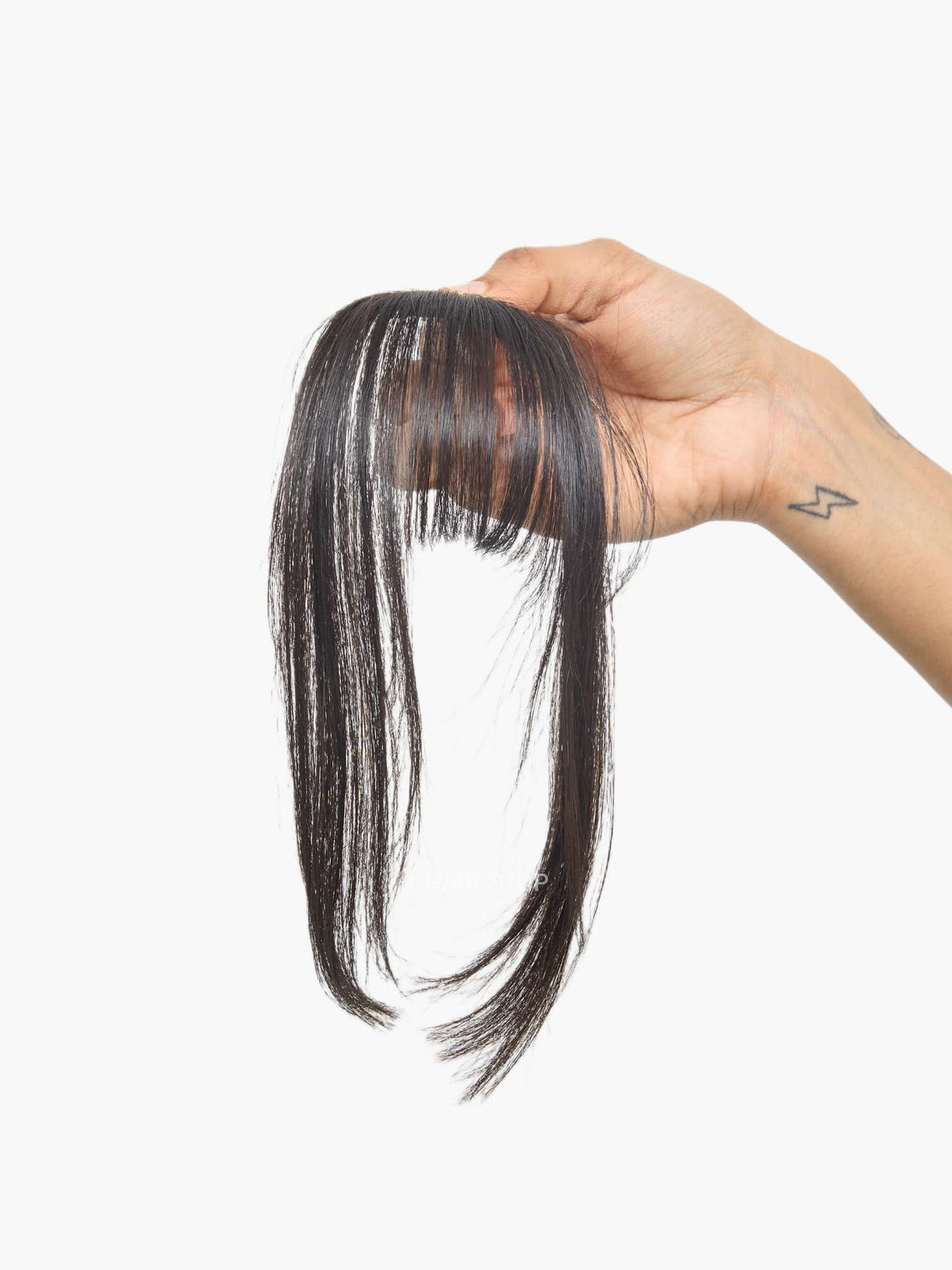
Straight-across fringe: Cover the whole front edge in one piece with Clip-In Bangs, a straight-across fringe that takes less blending than curtain bangs. Put it in for the day, take it out at night, and nothing about your own hair has changed.
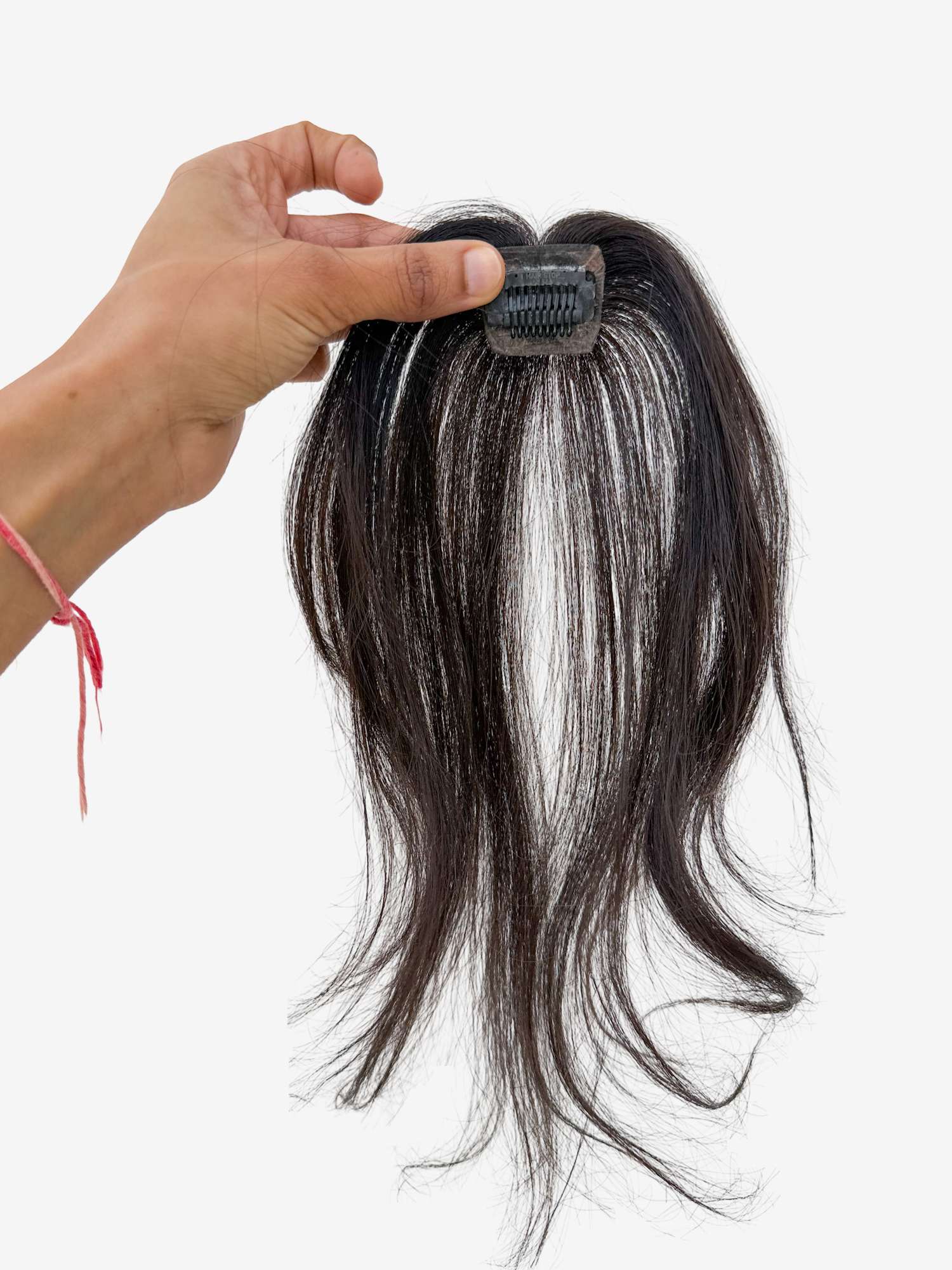
- Clip-free bangs, to pair with any topper: Achieve a naturally blended hairline with SkinJect Clip-In Bangs, whose skin-like top makes the point where the fringe starts read as scalp rather than as a base. Available as curtain bangs and front bangs, so you can pick the shape that suits your face.
-
Covering the hairline itself, clip-free: Cover a receding front hairline in seconds with the Receding Hairline Clipfree Band, which holds with a soft velvet undergrip and an adjustable band instead of clips. Because nothing grips the hair it is covering, it is built to be worn daily on a hairline that is already fragile.

- Not sure which one you need? Read hairline band vs topper vs wig, or book a free video call.
Frequently Asked Questions
What is the best hairstyle for a receding hairline in women?
There is no single best one, because it depends on where your loss sits. Temple recession suits a side-swept fringe and a deep side part. Front centre recession suits a full or curtain fringe. Uneven loss suits an asymmetric bob. If the part is widening behind the hairline as well, a fringe alone will not solve it and you need root volume or added coverage on top.
Should I get bangs if my hairline is receding?
Only if you still have enough density at the front to cut them from. A fringe is made from hairline hair, so if that is the thin area you can end up with a see-through fringe that draws attention rather than hiding anything, plus months of growing it out. Ask your stylist directly whether you have the density to carry one. If the answer is no, clip-in bangs give the same look without cutting anything.
Can I still wear my hair up with a receding hairline?
Yes, if you build it differently. Wear it low rather than high, set a deep side part and sweep the front across before you gather the rest, use a large claw clip instead of an elastic, and leave two soft pieces out at the front. A clip-free hairline band worn underneath covers the front edge while the rest is pulled back.
Does short hair or long hair look better with thinning at the front?
Usually shorter. Long hair pulls flat under its own weight, lies against the scalp and thins towards the ends, which makes fine hair look finer. A shorter layered cut holds lift at the root, and root lift is what casts shadow and reads as density.
What is the fastest way to make my hairline look fuller today?
Tinted root powder or a tinted dry shampoo along the part and temples. Thin areas look thin because of the contrast between dark hair and pale scalp, and darkening the scalp underneath drops that contrast in about thirty seconds. Drying the front hair forward rather than back is the second fastest thing.
Do headbands and scarves actually help or do they draw attention?
They help, as long as the band sits over the hairline rather than behind it. A wide band or scarf covers the front edge completely and reads as a deliberate style choice. A thin band pushed back from the hairline does the opposite and frames the area you were trying to cover.


