


Before you can choose between these three, there is a naming problem to clear up, because it is currently costing people money. Search "hairline band" and you will find two completely different products sharing the name. One is a grip that holds a wig on your head and contains no hair at all. The other is a strip of real hair that covers your front hairline. Buy the first when you meant the second and you have spent money on something that covers nothing.
Once that is sorted, the rest is a straightforward question of how much of your head needs covering and whether your own hair can still hold a piece on. Most comparison guides only answer the first half. The second half is what decides whether you are still wearing the thing in six months.
Short answer: A hairline band that carries hair covers your front edge and temples only, and suits recession at the front when the rest of your hair is healthy. A hair topper covers the part, crown or whole top, and suits a widening part with good hair at the sides and back. A full wig covers everything and suits loss too advanced or too spread out to blend with. The question nobody asks is whether your remaining hair can still take a clip. If it cannot, you need a clip-free version at whichever coverage level you land on, not a bigger piece.
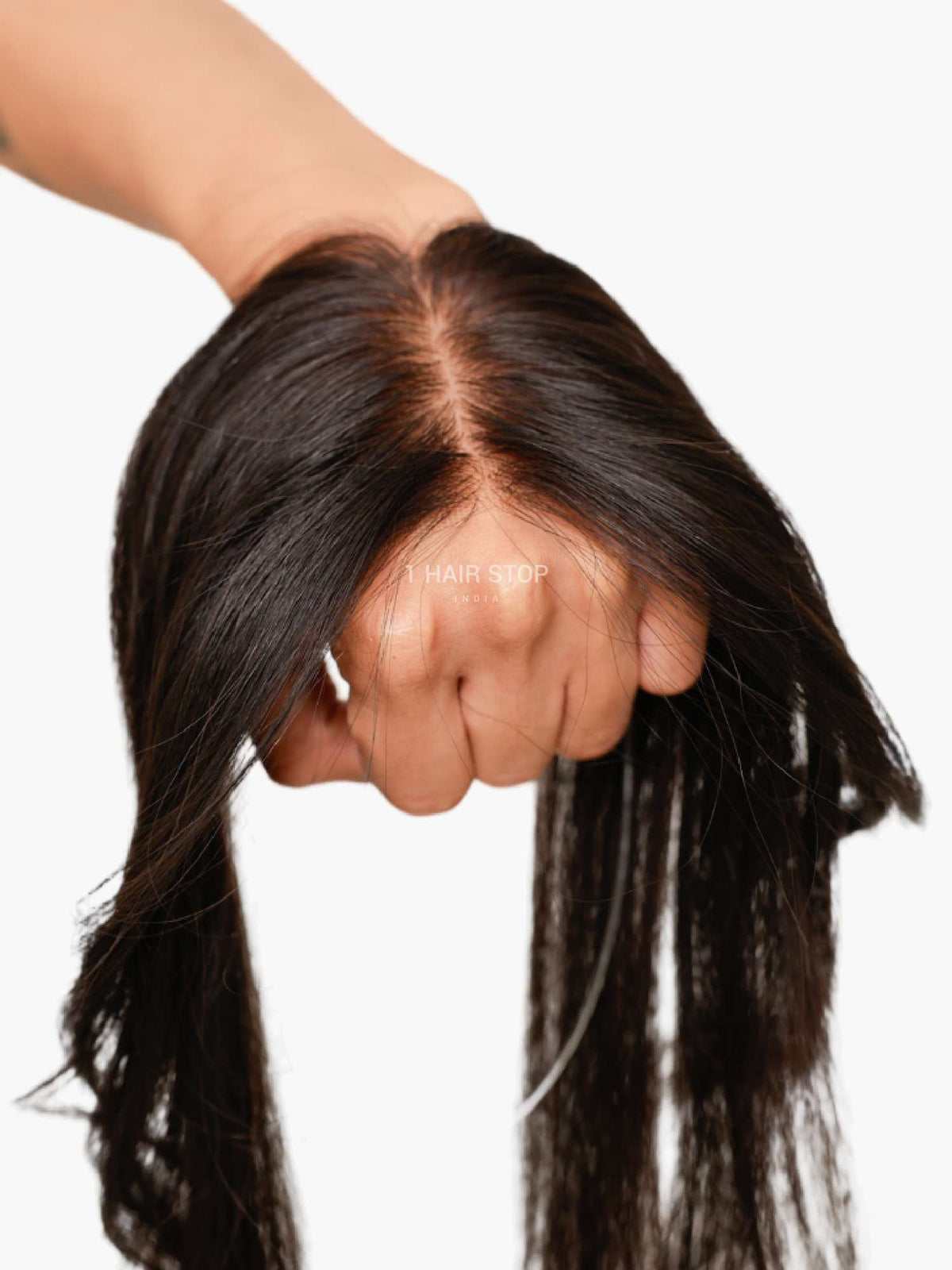
The piece in that photograph is the Receding Hairline Clip-free Band, and it is the product most women in this search actually need. It covers the front hairline and the temples without a single clip, which matters because the hair at the front is usually the most fragile hair on the head. If you want the full range first, the Hairline Series is where it sits.
- Two Different Things Are Called a Hairline Band
- What a Hairline Band Covers
- What a Hair Topper Covers
- What a Full Wig Covers
- The Three Compared at a Glance
- The Question That Actually Decides It
- Which One Do You Need
- Moving Between Them Over Time
- How 1 Hair Stop Makes the Choice Easier
- Shop the Hairline Series
- Frequently Asked Questions
Two Different Things Are Called a Hairline Band
This confusion is widespread enough that even automated summaries of the term get it wrong, so it is worth being precise.
A wig grip, sometimes sold as an band: A fabric or silicone band worn around the head underneath a wig. It has no hair on it. Its only job is friction, so the wig does not slide. If you are not wearing a wig, it does nothing for you.
A hairline band that carries hair: A narrow strip of hand-knotted human hair on a lace base, worn along your own front hairline. It adds hair where your hairline has receded. This is the product people mean when they search for a band to cover a receding hairline, and it is the one compared against toppers and wigs on this page.
Everything below refers to the second one. If a product listing does not clearly show hair on the band itself, it is the first one, and it will not cover anything.
What a Hairline Band Covers?
A hairline band sits along your front hairline and nowhere else. It covers the forehead edge and the temples, then disappears into your own hair behind it. Nothing else on your head is covered.
It is the right choice when the recession is genuinely at the front. If you part your hair and the part still looks dense, but the corners above your temples have crept back and your forehead reads higher than it used to, a band solves exactly that and nothing more.
Because it covers so little it is by a wide margin the lightest and coolest of the three, and the least expensive way into human hair coverage. The trade-off is that it does nothing for a widening part. If your scalp shows when you part your hair, a band will not fix it, and buying one to find out is the most common wasted purchase in this category.
Our Receding Hairline Clipfree Band comes in a 7 inch forehead width and an 11 inch ear to ear width, in 100% human hair, and secures with an adjustable band rather than clips.
The band is hand-knotted on lace so the front edge reads as individual baby hairs rather than a blunt line. The 7 inch width sits across the forehead only. The 11 inch version carries round to the temples, which is the one to pick if your recession has gone back at the corners rather than straight up.
What a Hair Topper Covers?
A hair topper covers the top section of your head. Depending on the base size that means the part line, the crown, or the whole top from front hairline to the back of the crown. Your own hair at the sides and back stays visible and does the blending.
This is the right choice for the most common pattern of female thinning, where the part widens and the scalp starts showing under bright light while the sides and back stay reasonably full. A topper puts density back exactly where you lost it and leaves the rest alone.
Sizes run from small starter pieces to large hybrid ones. A 1.5 by 3 inch silk topper handles a narrow part. The Receding Hairline Hybrid Topper covers the front hairline and the top together, which is the pattern most women actually have once recession and part-widening arrive at the same time.
Base size is the decision, not hair length. Measure the area where scalp actually shows and add roughly half an inch each side. Most women size up out of caution and end up with a piece wider than their thinning, and that overhang is what makes a topper look like a topper. Our guide to choosing a hair topper covers sizing properly, and silk vs lace toppers covers the base decision.
What a Full Wig Covers?
A full wig covers your entire head, from the front hairline to the nape. It replaces all visible hair rather than adding to it, so it needs none of your own hair to blend with or attach to.
It is the right choice when there is no longer enough hair to work with. That means loss spread across the whole scalp rather than one area, loss that has moved past the sides and back, or hair that has become too fine to hold a piece securely. It is also the right choice when you have simply had enough of managing two sets of hair every morning, which is a real reason that almost nobody writes about honestly.
Two things to know first. A wig is warmer than a band or a topper, because more cap sits against your scalp. And moving to a wig is a bigger adjustment than moving between topper sizes, so it is worth trying one before committing, and worth not shaving your head until you are certain it suits you.
We make half and full wigs to your own measurements after a consultation rather than selling them off a shelf, so they are not listed as a standard collection. If a wig is where you have landed, message us on WhatsApp and we will start with measurements and texture matching.
The Three Compared at a Glance
| What you are comparing | Hairline Band | Hair Topper | Full Wig |
|---|---|---|---|
| Area covered | Front hairline and temples only | Part, crown or the whole top | Entire head, hairline to nape |
| Your own hair needed | Yes, everything behind the front | Yes, at the sides and back | None |
| Best for | Receding edges, high forehead | Widening part, thinning crown | Spread out or advanced loss |
| Heat and weight | Lightest, coolest | Light, most of the scalp still open | Warmest, full cap |
| Time to put on | Under a minute | Two to three minutes | Five to ten minutes |
| Colour matching | Critical, it sits at eye level | Critical, it sits next to your hair | Not required, nothing to match |
| What we make for it | Receding Hairline Clipfree Band | Silk, lace and hybrid toppers | Custom, made to your measurements |
One thing the comparison articles will skew for you. The prices quoted on this question tend to come from the top of the market, which makes the whole category look like a several thousand pound decision. The actual range is far wider than that, particularly at the band and small topper end. Look at real ranges before you rule anything out.
The Question That Actually Decides It:
Every comparison sorts this by one thing, which is how much area needs covering. That is only half the question, and it is the half that women who have actually worn these pieces do not talk about.
Read enough real discussion among long-term wearers and the same pattern appears again and again. People rarely abandon a topper because they picked the wrong coverage. They abandon it because of the clips. The clips hurt. They irritate the scalp over a full day. And they pull on hair that was already fragile, which is the exact hair you were trying to protect.
The second recurring theme is fatigue. A clipped piece means managing two sets of hair every day, matching colour and texture, blending the join. Some women reach a point where they would rather cover everything than keep doing that, and a few shave their heads to escape it. Not all of them are glad they did. Moving up a coverage level to escape a clip problem is solving the wrong variable.
So the real decision has two axes, not one:
- How much area needs covering: Front edge only, the top, or everything.
- Whether your remaining hair can hold a clip without pain or damage: If your hair is fine, fragile, or already thinning at the anchor points, the answer is usually no.
These are independent. Fragile hair does not mean you need more coverage. It means you need a different attachment. That is why our entire hairline range is clip-free, and why the Skinject Clip-Free Topper exists at all. It lets you stay at the coverage level you actually need instead of escalating for the wrong reason.
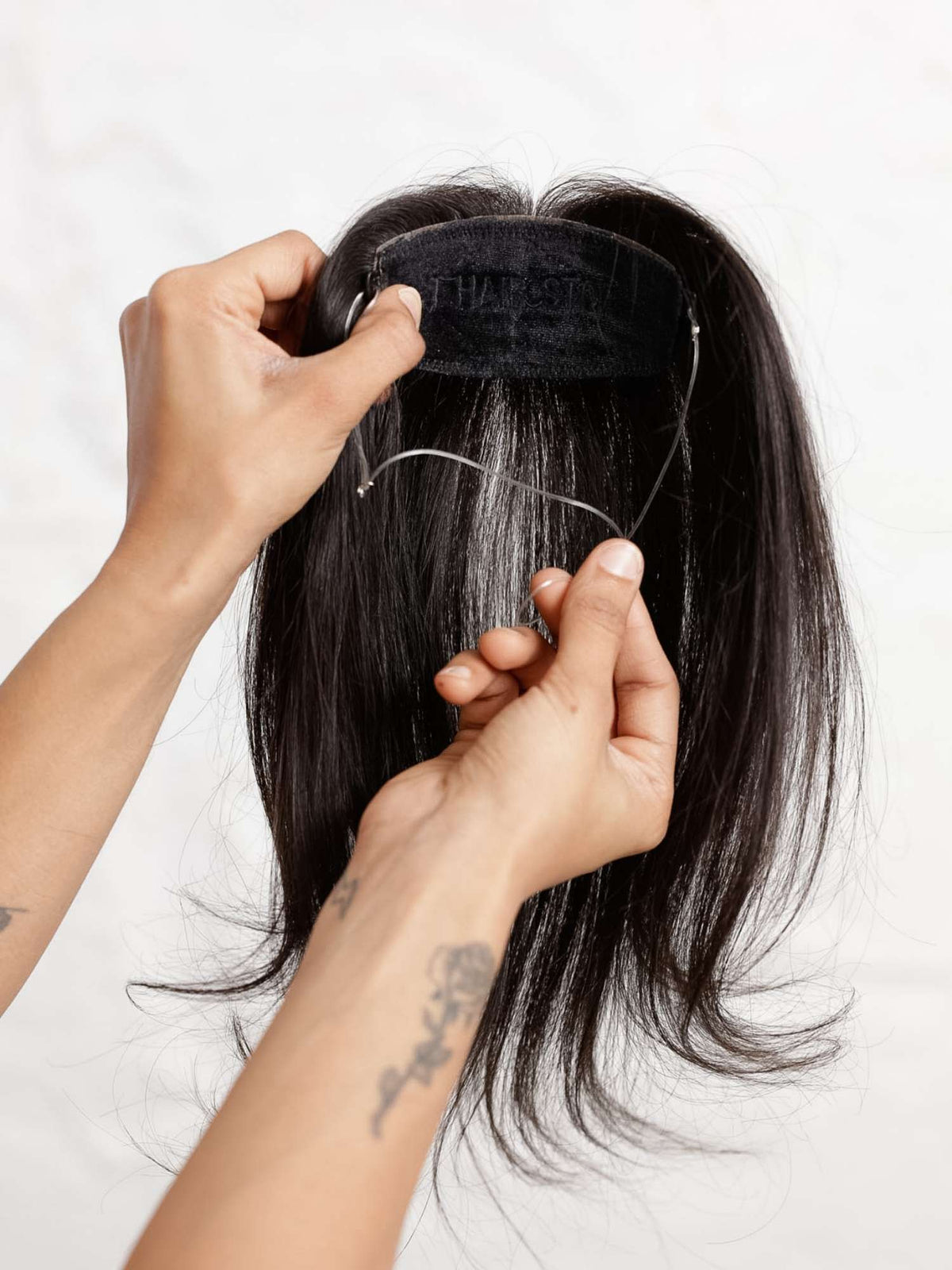
A clip-free piece holds with a velvet undergrip and an adjustable band, which spreads the hold across the whole base instead of loading it onto four points. Nothing grips individual strands, so there is nothing to pull. It is the same coverage as a clipped piece of the same size, attached differently.
"Half the confusion on this question is that the word band means two different products, and the other half is that everyone compares by size when the thing that decides it is what the piece is holding onto. The front hairline is the least able to take tension of anywhere on the head, and on a thinning scalp it is usually already the weakest. That is why we went clip-free across the whole hairline range."
Raina Grover and Richa Grover, Co-Founders, 1 Hair Stop
Which One Do You Need?
Work through these in order and stop at the first that describes you.
- Your part still looks dense, but your forehead reads higher and the temple corners have gone back: You need a hairline band that carries hair. Nothing more.
- Your scalp shows when you part your hair, or under bright overhead light, but the sides and back are fine: You need a topper. Size it to the area that shows, not to the whole head.
- Both are true, the front has receded and the part has widened: You need a hybrid piece covering hairline and top as one unit, not two separate pieces fighting each other at the join.
- The thinning has spread past the top into the sides or back, or your hair is now too fine to hold anything securely: You need a wig.
- Any of the above is true AND clips hurt, pull, or are not holding: Stay at that coverage level and go clip-free. Do not escalate.
If the change came on suddenly, appeared in distinct patches, or comes with itching or soreness, see a dermatologist before you buy anything. Coverage is a cosmetic decision and it does not replace a diagnosis.
Moving Between Them Over Time:
Most women do not stay in one category forever, and the sequence usually runs band to topper to wig over several years. Three things make that easier.
Do not skip a level to get ahead of it: Buying a wig while a topper would still work is a common and expensive mistake, and going back down is harder than going up because you have usually cut or shaved in the meantime.
Match texture before colour: Colour can be adjusted at a salon. Texture cannot. If your own hair is curly, a piece knotted in curly texture blends at every level, and a straight piece never quite sits right however well the colour matches. We knot curly texture across the range rather than adding it afterwards, for exactly this reason.
Keep the attachment method constant when you change level: If clip-free works at band level, stay clip-free at topper level. Changing coverage and attachment at once makes it impossible to tell which change caused a problem.
If your pattern is crown loss rather than the front, hair toppers for a thinning crown goes deeper on sizing. If you are covering a defined patch, how to cover a bald spot is the closer fit. And for front recession specifically, covering a receding hairline without surgery covers the full range including temporary options.
How 1 Hair Stop Makes the Choice Easier?
We make what we sell. Every piece is hand-knotted in our own facility in Hyderabad, one strand per knot, in 100% human Remy hair that is ethically temple-sourced in South India and never acid-stripped. A single piece takes between 84 and 320 hours of hand-knotting depending on size and base.
Trusted by 300,000+ women worldwide | 4.8★ from 14,700+ reviews | 100% Human Remy Hair | Sourced From Temples | Clip-Free | Handmade in our own facility since 2009 | Damage-free application guarantee
Because we manufacture rather than resell, we can build to your measurements instead of asking you to fit a standard size. That matters most at the two ends of this decision: hairline pieces, where a few millimetres of placement decides whether it reads as natural, and wigs, which we make to measurement after a consultation.
Shop the Hairline Series:
Start at the coverage level that matches what you can actually see today, not what you are worried about for later.
-
Front hairline and temples only: Cover a receding front hairline in seconds with the Receding Hairline Clipfree Band, which holds with a soft velvet undergrip and an adjustable band instead of clips. Because nothing grips the hair it is covering, it is built to be worn daily on a hairline that is already fragile.

- Front hairline plus the part line: Close the gap where the hairline meets the parting with the Frontal Fix Clipfree Topper, made for the stage when both have started to open up at once. The clip-free build spreads the weight across a band, so no single section of hair carries the load.
-
Thinning that reaches back into the crown: Get front coverage and crown coverage in a single piece with the Receding Hairline Hybrid Topper, for thinning that begins at the hairline and carries backwards. It is the natural step up once a band alone stops reaching far enough.

- Most natural looking parting: Keep the parting convincing at close range with the SkinJect Clipfree Topper, whose skin-like base reads as scalp rather than as a hair piece. This is the one to choose if people will be looking down at your parting.
-
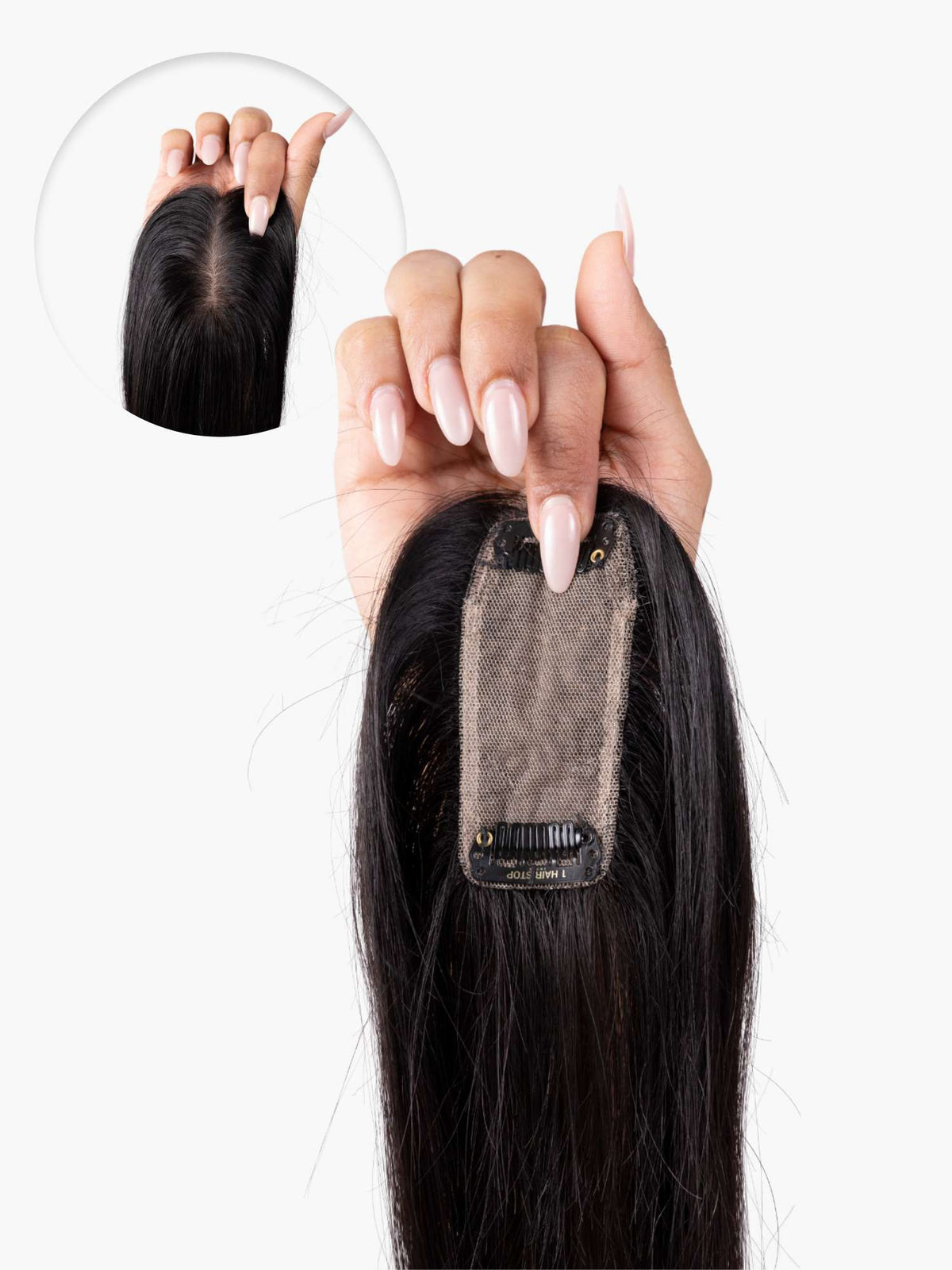
Smallest area, or a first piece: Cover a single thin patch with the Starter Silk Hair Topper, a 1.5 by 3 inch silk base and the smallest piece we make. The silk base hides the knots underneath, so the parting looks like it grows from your own scalp.
- Full coverage or a custom wig: message us on WhatsApp. Our wigs are made to order, so we start by taking your measurements.
- Not sure which one you are? Read how to tell if your hairline is receding, or book a free video call.
Frequently Asked Questions?
Is a hairline band the same as a wig grip?
No, and this is the most common mix-up on this subject. A wig grip, sometimes called an iBand, is a plain band worn under a wig to stop it slipping. It carries no hair and covers nothing on its own. A hairline band in the sense used here is a narrow strip of real hair on a lace base, worn along your own hairline to cover recession at the front. If a listing does not show hair on the band, it is the grip.
Which one should I buy first if I am not sure?
Buy the smallest coverage that fixes what you can actually see today, not what you are worried about in two years. Sizing up later is easy because your own hair is still there to blend with. Sizing back down is much harder, especially if you have cut or shaved in the meantime. If you cannot tell which level you are at, a video consult costs nothing and takes ten minutes.
Do I need a wig, or will a topper still work?
A topper works as long as you have enough hair at the sides and back to blend with and secure to. Once the thinning has spread past the top of your head, or your remaining hair is too fine to hold a piece, a wig is the more comfortable answer. If the only problem is that clips hurt, that is not a reason to move to a wig. Move to a clip-free piece at the same coverage level.
Will clips damage hair that is already thinning?
Clips concentrate tension on a small number of anchor points, and on fine or already-thinning hair that tension can cause breakage and soreness over time. Long-term wearers report scalp irritation and pulling as the most common reason they stop wearing a clipped piece. If your hair is fragile, choose a clip-free attachment from the start rather than waiting to see whether it becomes a problem.
Which is coolest to wear in hot weather?
A hairline band by a clear margin, because almost none of your scalp is covered. A topper is next, since the sides and back stay open. A full wig is warmest because the cap covers the whole head. If heat is your main concern and your loss is confined to the top, do not move up to a wig.
Do you sell wigs?
Yes, as custom pieces. We make half and full wigs to your own measurements after a consultation rather than selling them in standard sizes, so they are not listed as a shop collection. Message us on WhatsApp and we will start with measurements, texture and colour matching.


