


Most women do not notice a hairline changing. They notice a photograph. Something about the light, or the angle, or the way the hair was pulled back that day, and suddenly the forehead looks higher than it did in your head. Then you start checking in every mirror you pass, you ask someone, and they tell you it looks fine. Someone else says it does not. Your stylist says it is just the shape your hairline has always been. And you are no closer to knowing than when you started.
That question is answerable, but not by collecting opinions. It is answerable by looking at three specific things and photographing them the same way twice. This page shows you how to do that. It does not tell you what is causing anything, because that is not a question a website can answer about your head.
Short answer: Look at three things. The corners above your temples, where recession usually shows first. The density right along the edge, where full-strength hairs get replaced by shorter, finer, wispier ones. And the distance from your brow to where the hair actually starts. One look tells you nothing on its own. Two photos taken the same way, a few months apart, tell you whether anything is actually moving.
If what you find at the end of this guide is a front hairline that has moved, the Receding Hairline Clipfree Band is the coverage option that does not add strain to the area you are already worried about. It attaches with a velvet undergrip and an adjustable band, no clips anywhere. Nothing here is a reason to buy before you have actually looked, which is what the rest of this article is for.
- What Actually Changes First at the Hairline
- The Photo Test That Settles It
- Three Things That Look Like Recession and Are Not
- Why Everyone Gives You a Different Answer
- It Does Not Always Keep Going
- What This Page Cannot Tell You
- What to Bring to That Appointment
- Covering It While You Wait
- How 1 Hair Stop Makes the Choice Easier
- Shop Clip-Free Coverage
- Frequently Asked Questions
What Actually Changes First at the Hairline
Recession does not usually arrive as a straight line moving backwards. It shows up in three separate ways, and they do not always appear together.
The temple corners. The two corners above your temples, where the hairline turns to run down the side of your face, are almost always where it shows first. Look at whether those corners sit further back than the centre of your hairline, and whether that gap has widened.
The density along the edge. This is the one most women miss, because the line itself can stay exactly where it is while the hair along it gets thinner. Look at the front centimetre of your hairline in bright light. Full-strength hair looks like the hair further back on your head. What replaces it looks shorter, finer, softer and often lighter in colour, and it does not grow to the same length.
The distance from brow to hairline. Useful only as a comparison against yourself, never against anyone else. Hairlines vary enormously between people and there is no normal number.
Look at all three, not one. A high hairline with dense full-strength hair along the edge is just a high hairline. An unchanged hairline position with visibly finer, shorter hair along the front centimetre is the more meaningful observation of the two, and it is the one that gets missed.
The Photo Test That Settles It
A mirror cannot answer this question. Your eyes adjust, your parting moves, the bathroom light changes with the weather, and your memory of last year is not evidence. Photographs taken the same way twice are the only reliable way to see whether anything is moving.
Take four shots. Straight on with your hair down and how you normally wear it. Straight on with your hair pulled back off the face. One at each temple, turned about forty five degrees. Then keep every one of these constant so the next set is comparable:
- Light. Daylight from a window, facing the window, no overhead light. Overhead light casts scalp shadow and exaggerates everything.
- Parting. Same side, same place. A parting moved by a centimetre changes the whole picture.
- Distance and height. Arm's length, camera at eye level. Held higher, your forehead always looks bigger.
- Hair state. Dry, unstyled, no product. Wet hair reads as far thinner than it is.
- Date. Write it down. Put the four shots in one album on your phone.
Repeat in three months. Not three weeks. Hair grows slowly enough that anything shorter than a season is noise, and checking every few days is how you convince yourself of movement that is not there.
If you have older photographs already, dig them out now rather than waiting three months. A holiday picture from three years ago taken in daylight is imperfect evidence, but it is real evidence, and it beats anything anyone can tell you from memory. People who settle this question usually settle it by finding an old photo, not by asking someone.
Three Things That Look Like Recession and Are Not
Several things change how a hairline looks without the hairline itself receding. Only a dermatologist can tell you for certain which one you are looking at, but here is what visibly differs.
| What you might be seeing | What it tends to look like | What recession tends to look like |
|---|---|---|
| A naturally high or M-shaped hairline | Same shape in photos from years ago, with full-strength hair right up to the edge | Shape has changed against your own older photos |
| Short new hairs along the front | Lots of short hairs of a similar length, standing up, but dense and full-strength rather than wispy | Fewer hairs, and the ones there are look finer and softer as well as shorter |
| Breakage at the edge | Hairs snapping at a similar length, often where tension sits, with the hairline itself in the same place | The line or the corners have actually moved back over time |
The M-shape one catches a lot of people out. Plenty of women have had a slight recession at the temple corners since childhood, and it is simply the shape of their hairline rather than anything that has happened to it. Old photographs settle that in seconds, which is why they matter more than any opinion you can collect.
Why Everyone Gives You a Different Answer
Ask five people and you will get five answers, and it is worth understanding why before you weigh any of them.
Your stylist is not a neutral witness. Not because they are dishonest, but because their job is partly to make you feel good in that chair, and almost nobody's instinct is to tell a client sitting in front of a mirror that they are losing hair. A stylist saying it is just your natural shape may be right, and they see more hairlines in a week than you will see in a lifetime, but treat it as one input rather than the verdict.
Friends and family are worse. They have known your face for years, so they are the least likely people alive to notice gradual change, and the most motivated to reassure you.
Strangers online will contradict each other. Post the same photo twice and you will get told you are fine and that you are losing it, sometimes in the same thread. They are looking at one image, in one light, with no idea what you looked like before.
And you are the least reliable of all. You are the only person examining it daily, from six inches away, in the worst possible lighting, with a perfect memory of how it used to look. Nobody else carries that reference image in their head, which is why other people genuinely do not see what you see.
None of these people is lying to you. They are all answering a different question from the one you asked. A dated photograph is the only witness with no opinion, which is why the whole method above rests on it.
It Does Not Always Keep Going
Worth saying because almost nothing written on this subject says it, and the assumption that it only moves one way is what makes the question frightening rather than practical.
A hairline that has moved has not necessarily started a process that continues indefinitely. Plenty of people describe a hairline that shifted over a few years, settled at a new position, and then stayed exactly there for decades afterwards. Recession is not automatically the first chapter of something.
That is not a promise, and it is not a reason to skip the dermatologist. It is a reason not to make large decisions from a place of panic. Cutting or shaving because of where you assume this ends, rather than where it actually is, is a decision people regret more often than the recession itself.
Take the photographs, book the appointment, and let three months of real evidence tell you which of those you are dealing with.
What This Page Cannot Tell You
Everything above is about what to look at. None of it tells you what is causing it, and we are not going to guess, because the causes are genuinely medical and they are not distinguishable from a photograph.
See a dermatologist, and treat that as the actual next step rather than something to do if it gets worse. Book it sooner rather than later if any of the following are true:
- The change came on quickly, over weeks rather than years.
- There is itching, soreness, burning, redness, flaking or tenderness along the hairline.
- You are also losing hair from your eyebrows or eyelashes.
- The scalp where hair has gone looks smooth, shiny or different in texture from the rest.
- Hair is coming out in patches with defined edges rather than thinning evenly.
Some causes of hairline change are time-sensitive, and a few are the kind where waiting costs you follicles you do not get back. That is not something to work out from a blog post, ours included. If a dermatologist is months away where you are, ask your GP to refer you and get on the list now, then keep taking the photos while you wait.
What to Bring to That Appointment
Appointments are short and most women arrive with nothing usable. Your phone photos are the most valuable thing you can bring, and they are worth more than any description you can give from memory.
Bring the dated photo sets, ideally more than one round, plus any older photographs you found. Bring a note of roughly when you first noticed the change and whether it has been steady or came in bursts. Bring a list of anything you have been taking, since that is a question you will be asked and it is easier to answer from a list than from memory. And bring the specific things you have noticed, in the language of what you saw rather than what you concluded.
Do not style over it for the appointment. Wear your hair the way you photographed it, and let them see the actual edge.
Covering It While You Wait
Getting a diagnosis and covering the front are separate decisions, and doing one does not stop you doing the other. If the wait is long and you would rather not spend it self-conscious, there are ways to cover a front hairline that add nothing to it and take nothing away.
The one thing worth being careful about is tension. Anything that grips a fragile front edge, whether that is a clip, a tight style or an adhesive, is the wrong choice on a hairline you are already worried about. Our Receding Hairline Clipfree Band and the rest of the clip-free hairline series are built for exactly this, because they hold with an adjustable band rather than gripping individual strands.
The band is hand-knotted on lace so the front reads as individual baby hairs rather than a hard line. It sits over the existing hairline without clipping into it, which means nothing is pulling on the hair you are trying to keep. It also comes off in seconds, so it does not interfere with your photo set or with what a dermatologist needs to see.
If you want the fuller picture of what is available, covering a receding hairline without surgery walks through every option including the temporary ones, and choosing a hair topper covers sizing if the thinning turns out to reach further back than the front edge.
How 1 Hair Stop Makes the Choice Easier
We are not doctors and we do not diagnose anything. What we do have is a long habit of looking at hairlines up close, every day since 2009, because we hand-knot every piece in our own facility in Hyderabad, one strand per knot, and the hairline is the hardest part of the work to get right.
Trusted by 300,000+ women worldwide | 4.8★ from 14,700+ reviews | 100% Human Remy Hair | Sourced From Temples | Clip-Free | Handmade in our own facility since 2009 | Damage-free application guarantee
"We have looked at a great many hairlines up close, and the thing that surprises people most is how often what they see in the mirror is worse than what is actually there. That is why we ask for photographs before we ask for anything else. It is also why we made the front-edge pieces clip-free. When someone is already worried about a hairline, the last thing it needs is something gripping it."
Raina Grover and Richa Grover, Co-Founders, 1 Hair Stop
Because we manufacture rather than resell, a hairline piece can be built to your own measurements. On the front edge, where a few millimetres of placement decides whether it reads as natural, that is the difference between a piece you wear and a piece that sits in a drawer.
Shop Clip-Free Coverage
If you have looked properly and the front has moved, these are the pieces built for a hairline that cannot take a clip.
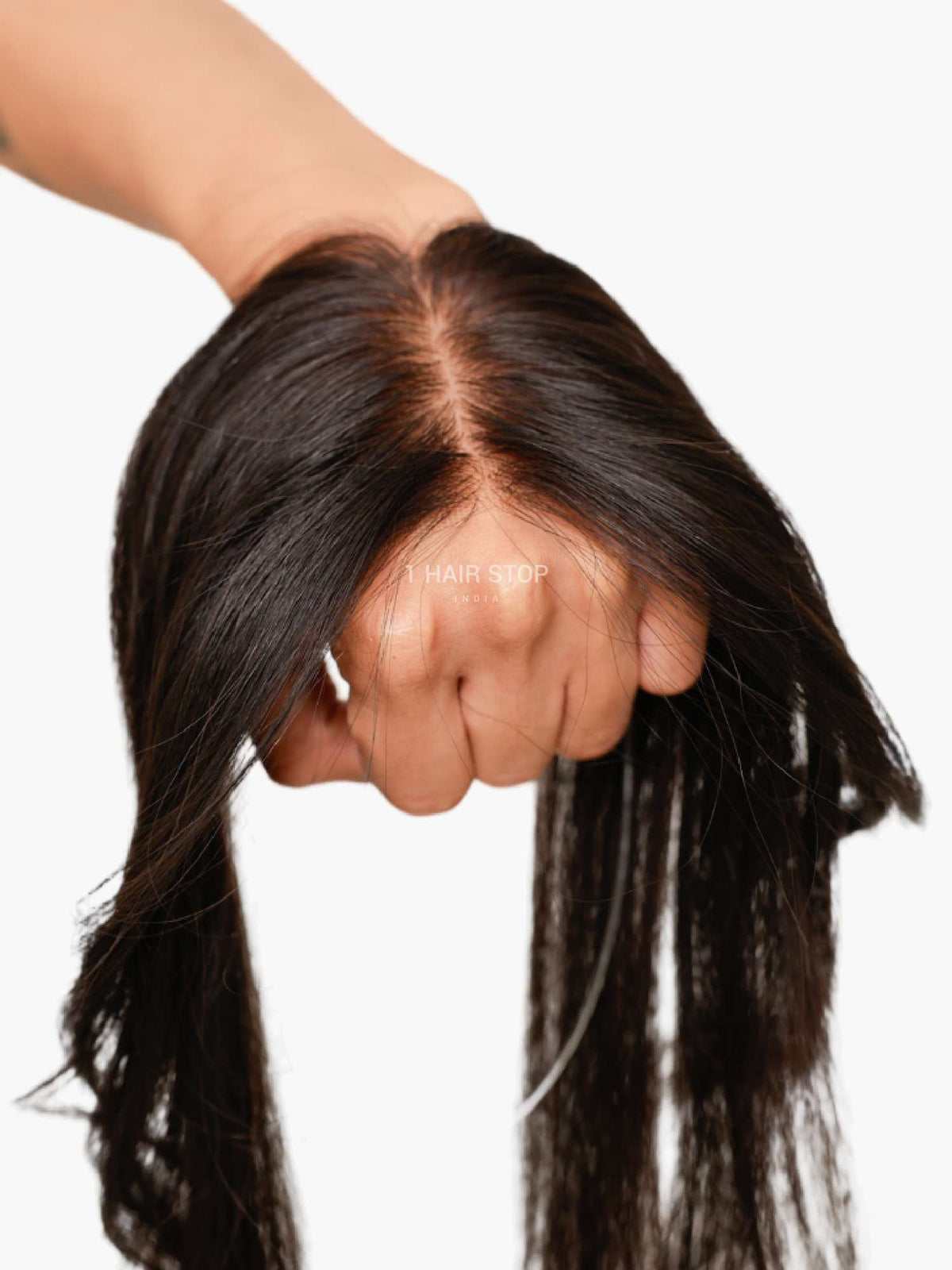
- Front hairline and temples only: Cover a receding front hairline in seconds with the Receding Hairline Clipfree Band, which holds with a soft velvet undergrip and an adjustable band instead of clips. Because nothing grips the hair it is covering, it is built to be worn daily on a hairline that is already fragile.

-
Front hairline plus the part line: Close the gap where the hairline meets the parting with the Frontal Fix Clipfree Topper, made for the stage when both have started to open up at once. The clip-free build spreads the weight across a band, so no single section of hair carries the load.
-
Thinning that reaches back into the crown: Get front coverage and crown coverage in a single piece with the Receding Hairline Hybrid Topper, for thinning that begins at the hairline and carries backwards. It is the natural step up once a band alone stops reaching far enough.

-
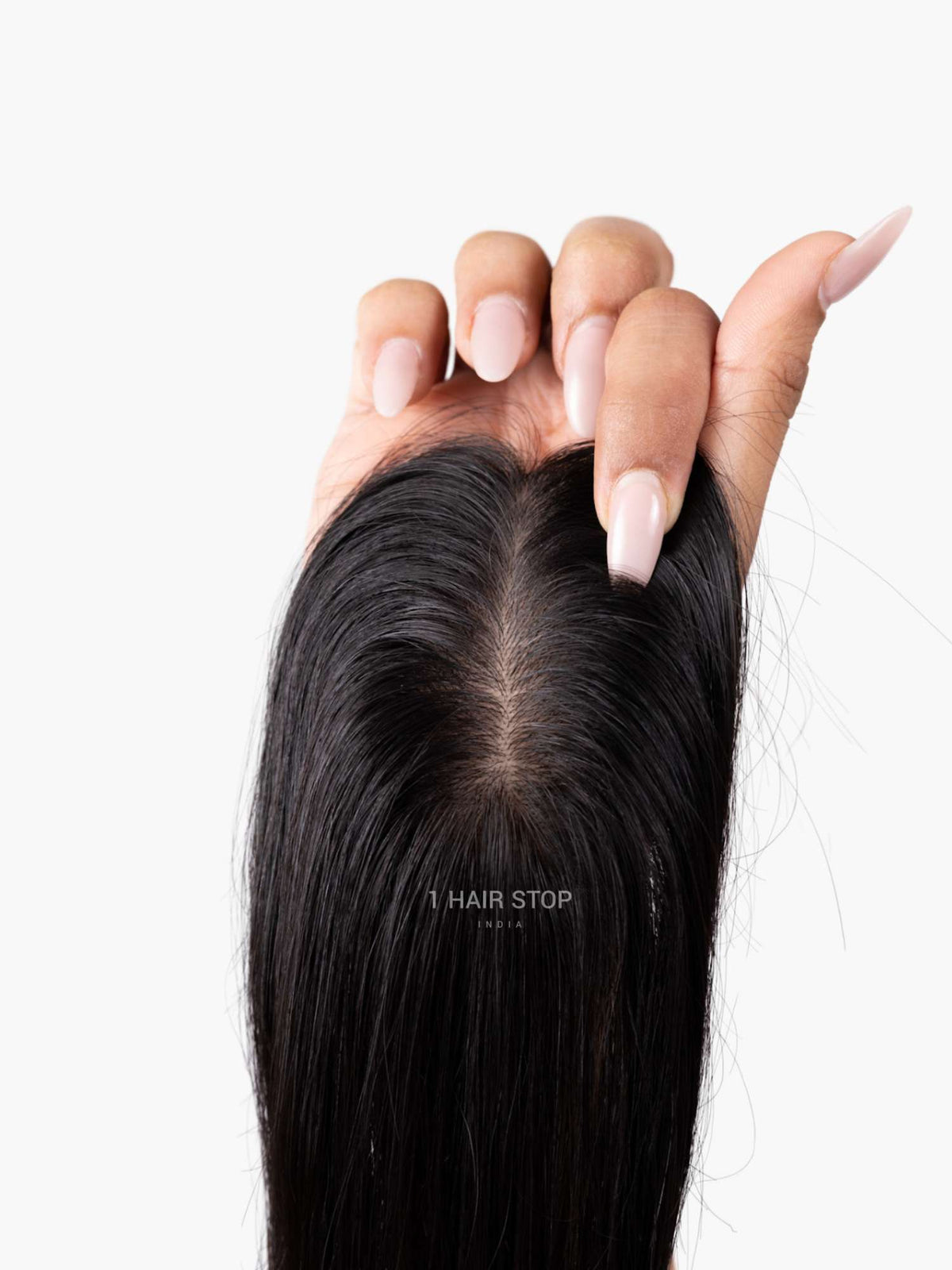
Smallest area, or a first piece: Cover a single thin patch with the Starter Silk Hair Topper, a 1.5 by 3 inch silk base and the smallest piece we make. The silk base hides the knots underneath, so the parting looks like it grows from your own scalp.
- Would rather not buy anything yet? Read hairstyles that cover a receding hairline.
- Not sure which size you need? Read hairline band vs topper vs wig, or book a free video call.
Frequently Asked Questions
How do I know if my hairline is receding or just naturally high?
Compare against your own older photographs rather than against anyone else. A naturally high hairline looks the same shape in photos from years ago and has full-strength hair right up to the edge. Recession shows as a shape that has changed against your own past, usually starting at the temple corners, along with shorter and finer hairs along the front edge.
My hairstylist says it is just a natural M shape. Should I believe them?
Treat it as one useful input rather than the answer. A stylist sees more hairlines in a week than you will see in a lifetime, so their read on shape is worth having, and plenty of women genuinely have had a slight temple recession since childhood. But nobody sitting behind your chair wants to tell you that you are losing hair, so the incentive runs one way. Old photographs settle it without anyone's opinion attached.
How long do I need to wait before comparing photos?
Three months minimum. Hair grows slowly enough that anything shorter is noise, and checking every few days is how you talk yourself into seeing movement that is not there. Keep the light, parting, distance and camera height identical between sets, or the comparison tells you nothing.
If my hairline has receded, will it keep receding?
Not necessarily. Plenty of people describe a hairline that moved over a few years, settled at a new position and then stayed there for decades. It can also continue. That is exactly what a dermatologist is for, and it is the reason not to make a big decision about cutting or shaving based on where you assume this ends rather than where it actually is.
Why does my hairline look worse in some photos than others?
Overhead light casts shadow onto the scalp and makes any gap look larger. A camera held above eye level lengthens the forehead. Wet or slicked hair reads as far thinner than dry hair. Pulling the hair back exposes the edge in a way you never normally show it. This is why a fixed setup matters more than any single photo.
Should I see a doctor, or is this just cosmetic?
See a dermatologist. A page like this can tell you what to look at, but nothing you read online can tell you what is causing a change at your hairline, and some causes are time-sensitive. Go sooner if the change came on over weeks, if there is any itching, soreness or redness, if your eyebrows or eyelashes are affected, or if the skin where hair has gone looks smooth or shiny.


