


Somewhere on a hair forum there is a post from a hairstylist that begins by saying the place gives her anxiety, and then gives a quick tutorial on cutting bangs. Six hundred and sixty two people upvoted it. She did not write it because the topic was interesting. She wrote it because she had watched too many women cut their own fringe and had to say something.
A few posts down, somebody asks a question that tells you everything about this haircut. Has anyone here successfully made bangs work. Two hundred and twenty people replied.
Short answer: Bangs are not a haircut, they are a standing commitment. A trim every three to four weeks, five to ten minutes of styling every morning, and eight to twelve months to grow out if you change your mind. Before you cut, check one thing almost nobody checks: whether you have a cowlick at your front hairline. If you do, a blunt fringe will split and part no matter who cuts it. Everything else is preference. That one is physics.
That piece is at the top of this article because of what the forums are full of. Women cutting bangs on impulse, then spending a year growing them out. Clip-In Curtain Bangs take about ten seconds to put in and come out at the end of the day. Wear them for a week before anybody picks up scissors and you will know the answer for certain.
- Why Bang Regret Is So Predictable
- Four Checks to Run Before You Cut
- The Types, Described by What They Demand
- What to Actually Say in the Chair
- The Real Cost of Bangs
- Growing Them Out, Month by Month
- Bangs and Everything Else You Wear
- Try Them Before You Cut Them
- How 1 Hair Stop Makes This Easier
- Shop Bangs You Can Take Off
- Frequently Asked Questions
Why Bang Regret Is So Predictable
Read the forums rather than the magazines and the pattern is not subtle.
The single most upvoted bang post on one board, at 905 upvotes and 137 comments, is a woman showing bangs she had just given herself and asking for thoughts. Another, at 155 upvotes, says she got bangs and some layers on impulse and cannot decide whether she likes it. Another, at 360 upvotes, asks for tips on styling curtain bangs with thinner hair and then adds the real question at the end: is this cut flattering or should I grow out.
These are not women with bad taste. They are women who made a decision without the information required to make it, because the information does not exist anywhere they looked.
Every article on this subject is a list of bang types with photographs. That is not useless, but it answers a question nobody is stuck on. Almost nobody struggles to identify which fringe looks nice in a photograph. What they cannot work out is whether it will do that on their own head, in their own bathroom, on a Tuesday, in eight weeks.
Three things cause nearly all of it, and all three are knowable in advance.
- A physical feature that makes the chosen fringe impossible: Usually a cowlick, occasionally a very high or very low hairline, sometimes not enough hair at the front to cut a fringe from without thinning what is left.
- An underestimate of the daily work: The fringe is the only part of your hair that has to be styled every single day, including the days you would otherwise have put it up and left the house.
- A conversation with a stylist that went wrong: One woman posted that she asked for blunt, straight across bangs and said she liked them thick, and then showed what she actually left with. This happens constantly and it is almost always a vocabulary problem rather than a skill problem.
The rest of this article is those three, solved.
Four Checks to Run Before You Cut
Five minutes with a mirror. None of this is about your face shape and all of it is about whether the fringe will physically behave.
| What to check | How to check it | What it changes |
|---|---|---|
| A cowlick at the front hairline | Push your hair straight back off your face with wet hands and let it dry a little. Look for a spot at the hairline where the hair spirals or lifts away instead of lying flat | The single biggest predictor of failure. A front cowlick pushes a blunt fringe apart into a permanent gap. Curtain bangs or side-swept work with it. Blunt does not |
| The height of your forehead | Fingers laid flat between your hairline and your eyebrows. Two or fewer is a low forehead, three or more is a high one | A high forehead takes almost any fringe. A low one needs a fringe that is longer, softer or parted, because a short blunt one leaves no visible forehead at all |
| Density at the front of your head | Part your hair at the very front and look at how much scalp shows in the first few centimetres | A fringe is cut from the hair you already have. If the front is sparse, cutting a fringe from it thins both the fringe and the hair behind it. This is the check that matters most on fine hair |
| How fast your roots go oily | Think about when your parting starts to look flat. Same day, second day, third day | The fringe sits directly on skin, so it takes oil first and fastest. If your roots go by the second day, your fringe will go by lunchtime on day one |
The first row is the one worth reading twice, because it is the one nobody publishes and it is the one that produces the most miserable outcomes.
A cowlick is a patch where the hair grows out of the scalp at an angle rather than straight down. Most people have one somewhere. If yours is at the front hairline, a blunt fringe cut across it will split into two pieces and part in the middle within an hour of drying, every day, forever. No styling product fixes it and no amount of blow-drying trains it out permanently. Wet it and it comes back.
This is not a reason not to have a fringe. It is a reason to have a different one. Curtain bangs, which are parted in the middle anyway, work with a front cowlick instead of against it. Side-swept bangs, cut with the growth direction rather than across it, do the same. The problem is only ever blunt.
Three frames answer the question that two hundred and twenty people were arguing about. This is the most useful image in the article and it does not exist anywhere in this category.
The Types, Described by What They Demand
The names are everywhere and the descriptions are always about how they look. Here is the same list described by what each one costs you and who it fails on, because that is the part that decides whether you still like it in month three.
| Type | Daily work | Trim rhythm | Who it fails on |
|---|---|---|---|
| Blunt, cut straight across | High. Needs drying flat every wash and usually a flat iron | Two to three weeks | Front cowlicks, curly or strongly wavy hair, fine hair with sparse front density |
| Curtain, parted in the middle | Low to medium. Dries in the right direction with fingers | Six to eight weeks | Almost nobody, which is why it is the most requested. Fine hair needs it cut thinner than you think |
| Wispy or textured | Low. Designed to sit softly rather than lie flat | Four to six weeks | Very thick coarse hair, where thinned ends can look ragged rather than soft |
| Side-swept | Low. Blow-dried across in one direction | Six to eight weeks | Nobody much, though it needs enough length to actually sweep |
| Micro, above the eyebrow | Medium, but unforgiving. There is no length to hide behind | Two weeks | Anybody who is not certain. It is the hardest to reverse because there is nothing to pin back |
| Bottleneck, shorter in the centre | Medium. Needs shaping while drying | Four to six weeks | Very fine hair, where the shape relies on having enough hair to build a curve |
| Curly | Low once cut correctly, high if cut wrong | Eight to ten weeks | Anybody whose stylist cuts it wet. Curly fringe springs up dramatically as it dries |
Two things in that table deserve saying out loud.
The trim column is not optional: Hair grows roughly a centimetre a month, which does nothing noticeable to length but takes a blunt fringe from eyebrow to eyelash in about six weeks. That is why the interval for blunt is two to three weeks and the interval for curtain is six to eight. You are not choosing a look. You are choosing how often you go back.
Curly hair is the row people get wrong: Cut wet and measured wet, a curly fringe lands where it was measured and then shortens by an enormous amount as it dries. If your hair curls at all, say so before the appointment starts and ask for it to be cut dry. This is the same rule that governs curly cuts generally, and it is covered in our guide to bob haircuts for women, where the consequences are equally permanent.
One point of vocabulary, since it causes real confusion. In America they are bangs. In Britain and India they are a fringe. Same thing, and both words mean hair cut short to sit on the forehead. If a stylist uses one and you use the other, nothing has been lost.
What to Actually Say in the Chair
There is a post where a woman explains that she told her stylist she wanted blunt, straight across bangs, and that she likes them thick, and then shows the result she left with. The comments are sympathetic and nobody quite identifies the problem.
The problem is that she described a look, and a fringe is defined by measurements. Four of them, and a stylist can execute any combination once she has them.
- Where it finishes: Name a landmark on your face, not a length. Above the eyebrow, at the eyebrow, at the top of the eye, at the eyelash, at the cheekbone. This is the single most important number and the one most often left vague.
- How far back it is taken: The fringe is cut from a triangle of hair at the front, and how far back that triangle goes decides how thick the fringe is. Shallow gives you a light fringe you can see through. Deep gives you a solid one. Say thick or fine, and then point at your head.
- How wide it is: Where it stops at the sides. To the outer corner of the eye is narrow. To the temple is standard. Past the temple starts blending into face framing rather than a fringe.
- Whether the edge is solid or broken: Cut straight across gives a hard line. Point cut, which means the scissors go into the ends vertically, gives a softer broken edge. This is what people mean when they say a fringe looks harsh, and it is a thirty second change.
Say those four things and you will get what you meant. Say the word blunt on its own and you are leaving three of the four to somebody who has not seen your head before.
One more sentence worth adding. Ask where your cowlick is and whether it will affect the fringe you have just described. A stylist who has already noticed it will tell you immediately. A stylist who has not is worth a second thought.
The Real Cost of Bangs
Nobody writes this part down, so here it is in full.
The trim: Three to four weeks for most fringes, two for blunt and micro. Many salons trim a fringe free between appointments, which is worth asking about at the time of cutting rather than discovering later. Across a year this is somewhere between twelve and twenty five visits for a piece of hair the size of your palm.
The morning: Five to ten minutes, every day, and this is the cost people genuinely do not anticipate. A fringe cannot be slept on and revived with a hair tie. It has to be wet down or washed and dried in the direction it is meant to sit. There is a documented version of this complaint from a woman writing about having long hair and a fringe while backpacking, which is the situation that makes the daily tax impossible to ignore.
The oil: Your forehead produces oil and your fringe is lying on it. Fine hair that goes flat by day two at the roots will have a separated greasy fringe by the afternoon of day one. Dry shampoo at the roots of the fringe only, worked in with fingertips, is the standard fix and it is a daily habit rather than an occasional one.
The exit: Eight to twelve months from a full blunt fringe to a length that blends into the rest of your hair. There is no shortcut. This is dealt with properly in the next section because it is the part that decides whether the whole thing was a good idea.
None of that is an argument against a fringe. A fringe suits an enormous number of people and is the fastest way to change how you look without changing your length. It is an argument for going in with the number in your head, because a woman who knows it is a daily commitment and chooses it anyway almost never posts asking whether she should grow it out.
Growing Them Out, Month by Month
The reason this stage is so hard is that it has a specific ugly middle, and nobody photographs it.
Months one to three: The fringe passes through the eyes. This is the worst part and it is worse than people expect, because the hair is now long enough to be in your vision and too short to go anywhere else. Almost all the regret posts are written during this window.
Months four to six: It reaches the cheekbone. It can now be tucked behind an ear or pinned, and it starts to read as face framing rather than as a grown out fringe. This is the stage where most people stop minding.
Months seven to twelve: It reaches the jaw and below, and blends into the front layers. At this point it is simply short face framing pieces, which is a deliberate haircut that many people pay for.
Three things make the middle survivable, and two are free.
- Get it shaped, not cut: Counterintuitive, but the fastest way through is to have the fringe angled and blended into the sides every few months rather than left as a blunt block. It grows at the same speed and it looks deliberate the whole way.
- Move your parting: A deep side parting sweeps the growing fringe across and into the length, which converts an awkward stage into a side-swept one overnight.
- Pin at the temple, not at the top: Clipping a growing fringe straight back at the crown announces it. Twisting it back to the temple and pinning it there reads as a style.
Four frames of a real grow-out is the thing every woman in those threads is asking for and no publisher in this category supplies. Salons post the day the fringe is cut. Nobody posts month three.
The fourth option is not to grow it out at all. Cut it off, go back to no fringe immediately, and clip one in on the days you want it. That is a legitimate answer rather than a compromise, and it is what a surprising number of women end up doing once they have tried it.
Bangs and Everything Else You Wear
This is the practical section, and it exists because somebody asked how you style face framing pieces while pulling your hair back, and nobody gave her a proper answer.
A fringe changes every other hairstyle you own, and mostly for the better once you know how.
With a ponytail: The best pairing there is. A fringe softens the severity of pulled back hair, which is why it reads as polished rather than as scraped. The rule is to gather the ponytail high enough that it does not fight the fringe, and to leave the fringe completely alone rather than trying to blend the two.
With a bun or an updo: Same principle. A fringe is what stops an updo looking formal when you did not want formal. Leave a few pieces at the temple loose so there is a transition rather than a hard edge between the fringe and the pulled back hair.
With half up styles: The one combination that needs care. Taking the top section back from behind a fringe can expose the point where the fringe was cut from, particularly on fine hair. Take the half up section from further back than feels natural and the join disappears.
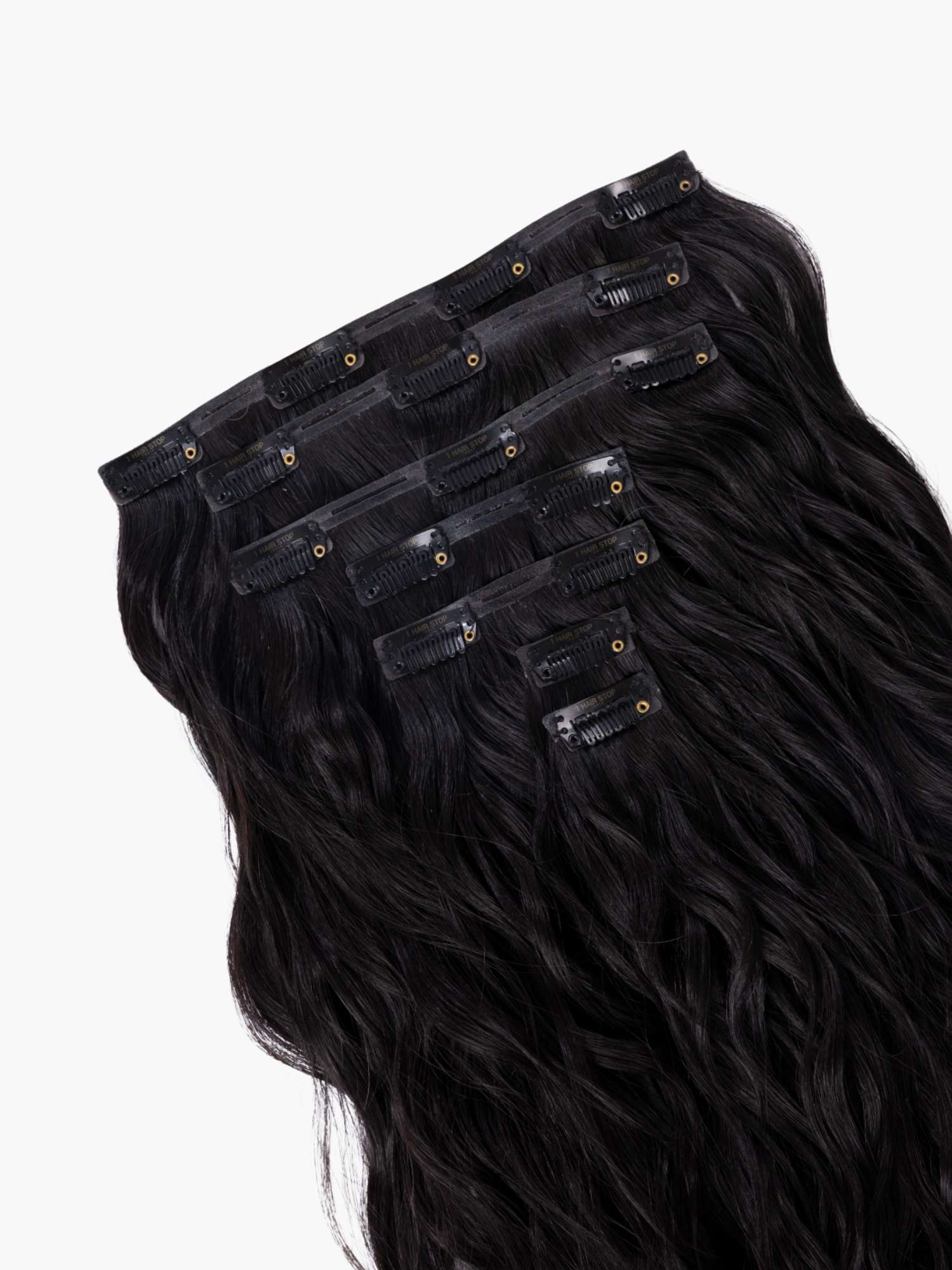
With extensions or a topper: Worth saying clearly, because it is the thing we get asked most. A fringe and added length work together extremely well, because the fringe hides the front hairline entirely and that is the hardest area to blend. Several of our own pieces are made with the fringe built in for precisely this reason, which is covered in our guide to hair toppers with bangs.
With long layers: Curtain bangs are effectively the shortest layer in a layered cut, which is why the two are almost always cut together. If you are considering both, do them in one appointment and let the fringe be cut as part of the layering rather than added afterwards, as set out in long layered haircuts for women.
Try Them Before You Cut Them
Everything above is knowable in advance. Only one thing is not, and it is the thing that actually decides it. Whether you like seeing your own face with hair on the forehead.
No amount of looking at photographs of other women answers that. A filter does not answer it either, because a filter changes pixels and tells you nothing about how you feel catching sight of yourself in a shop window.
A clip-in fringe answers it in about four days, and there are four specific things it tells you that nothing else can.
- Whether you like your face with it: In daylight, in a lift mirror, in a photograph taken by somebody else without warning. This is the real question and it takes days rather than minutes.
- Which length is yours: Wear it at eyebrow length, then trim it slightly and wear it at eyelash length. You now know your number before anybody cuts your own hair to find out.
- Whether you can be bothered: Four mornings of styling a fringe is a completely honest simulation of the daily cost, and it is where a meaningful number of people quietly decide against it.
- What your cowlick does to it: A clip-in sits on top of your own hair rather than growing from it, so a cowlick underneath will not split it. That is useful information in itself, because if you love the look but your hairline fights it, the clip-in is not a test any more. It is the answer.
That last point is the one we would underline. A front cowlick is permanent and a clip-in fringe simply does not care about it. For a real number of women the correct outcome of this whole process is a fringe that goes on in the morning and comes off at night, and that is not a lesser version of the haircut. On fine hair it is frequently the better one, because cutting a fringe out of sparse front density thins the fringe and the hair behind it at the same time. Our guide to styling clip-in curtain bangs covers the fitting and blending in detail.
How 1 Hair Stop Makes This Easier
We do not cut hair. We make it, which means the women who reach us are usually at one of three points. Deciding whether to cut a fringe, halfway through growing one out, or discovering that their front density will not support one.
Trusted by 300,000+ women worldwide | 4.8★ from 14,700+ reviews | 100% Human Remy Hair | Sourced From Temples | Clip-Free | Handmade in our own facility since 2009 | Damage-free application guarantee
"A fringe is the only haircut we get asked to reverse. Nobody writes to us about a bob they regret, because a bob grows into something else within weeks. A fringe takes the better part of a year, and for that whole year it is the first thing she sees in the mirror. That is why we make a fringe you can take off. It is not a substitute for the haircut. For a lot of women it is the better version of it."
Raina Grover and Richa Grover, Co-Founders, 1 Hair Stop
Every piece is hand-knotted or wefted in 100% human Remy hair in our own facility in Hyderabad. Because it is human hair, a stylist can cut a clip-in fringe to your exact length and shape it to your face, the same way she would cut your own. Ours are heat resistant and can be re-coloured.
The honest limitation is that a clip-in fringe sits on top of your hair rather than growing from it, so it needs a small amount of your own hair left down over the base at the front. On hair pulled back extremely tightly it is the wrong choice, and a piece with the fringe built into it is the right one.
Shop Bangs You Can Take Off
All of these are 100% human hair and all of them come out at the end of the day. Choose by what your own hairline is doing, not by the name.
-
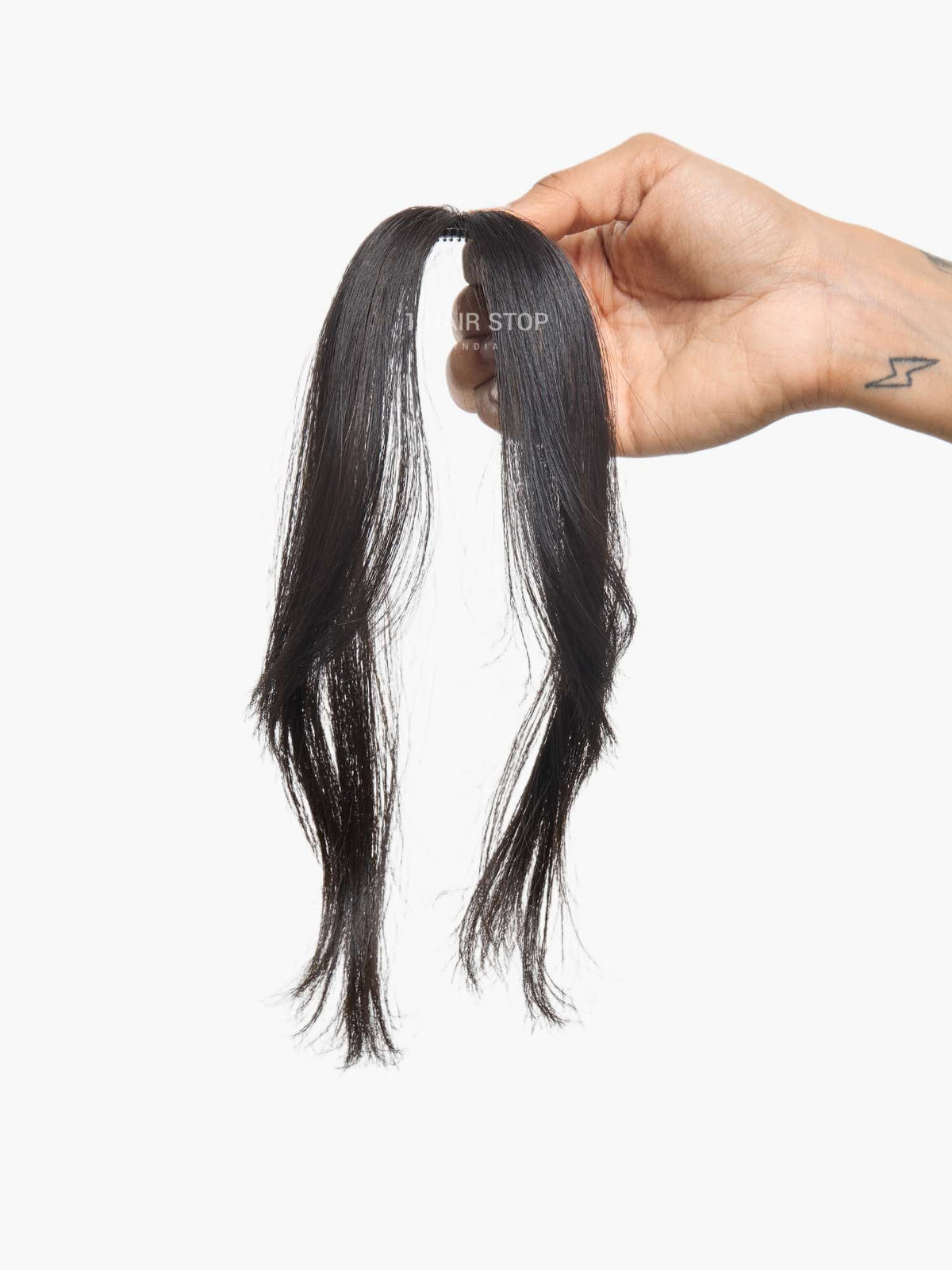
The one to start with: Test the most requested fringe of the last five years with Clip-In Curtain Bangs, two soft parted pieces that clip in at the top of the head in seconds. Being parted rather than solid, they are also the version that works with a front cowlick instead of fighting it.
-
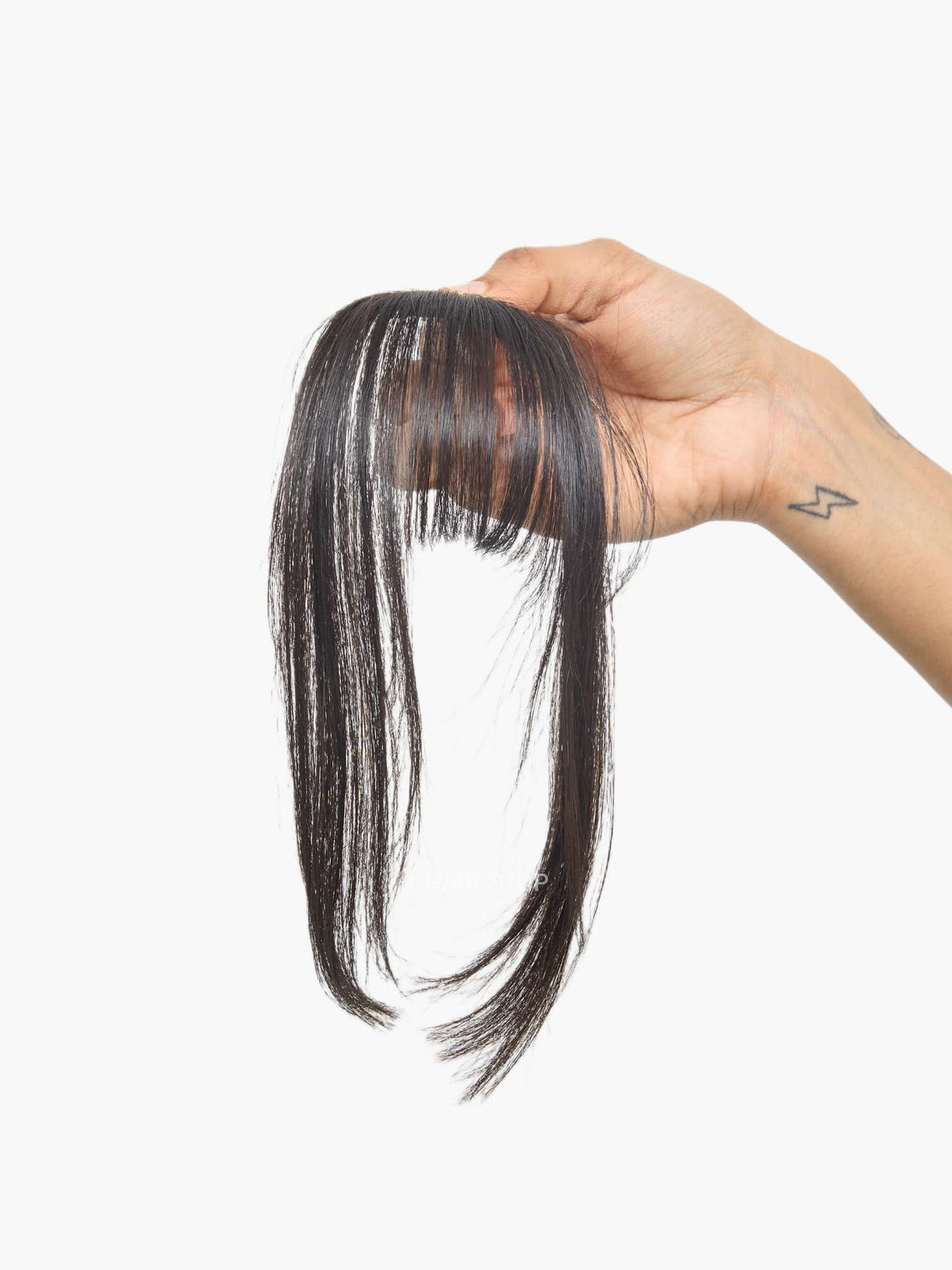
For a solid straight-across fringe: Get the blunt look without the two-week trim cycle using Invisi-Light Front Bangs, made in 100% virgin Remy hair and light enough to sit flat on the forehead. It is heat resistant, so it can be straightened to the same finish you would blow-dry your own fringe to.
-
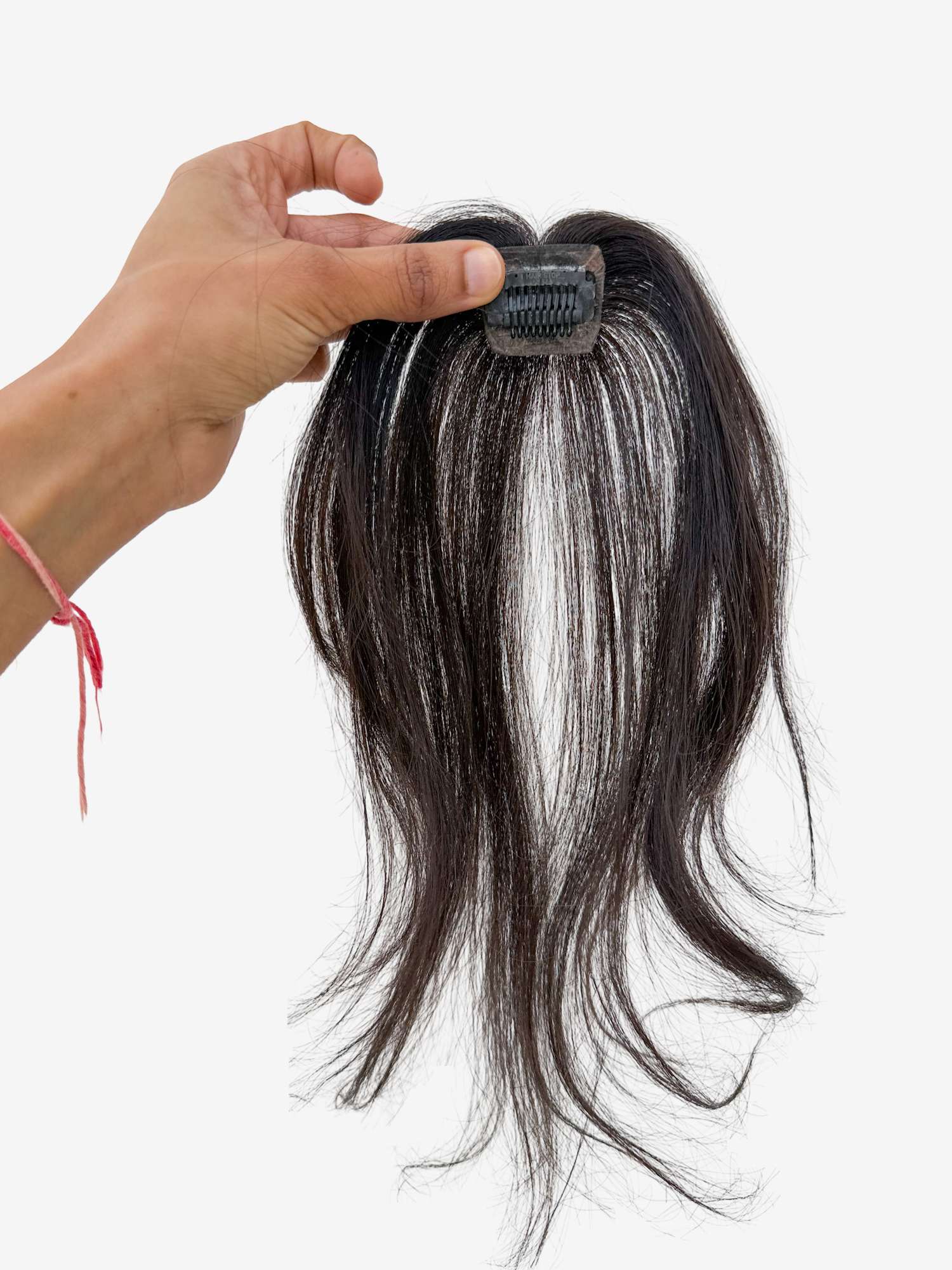
When the base would otherwise show: Hide the point where the fringe starts with SkinJect Clip-In Bangs, whose skin-like top reads as scalp rather than as a base. It comes as either a curtain or a front fringe, and it is the one to choose if your front density is light enough that a clip might otherwise be visible.
-
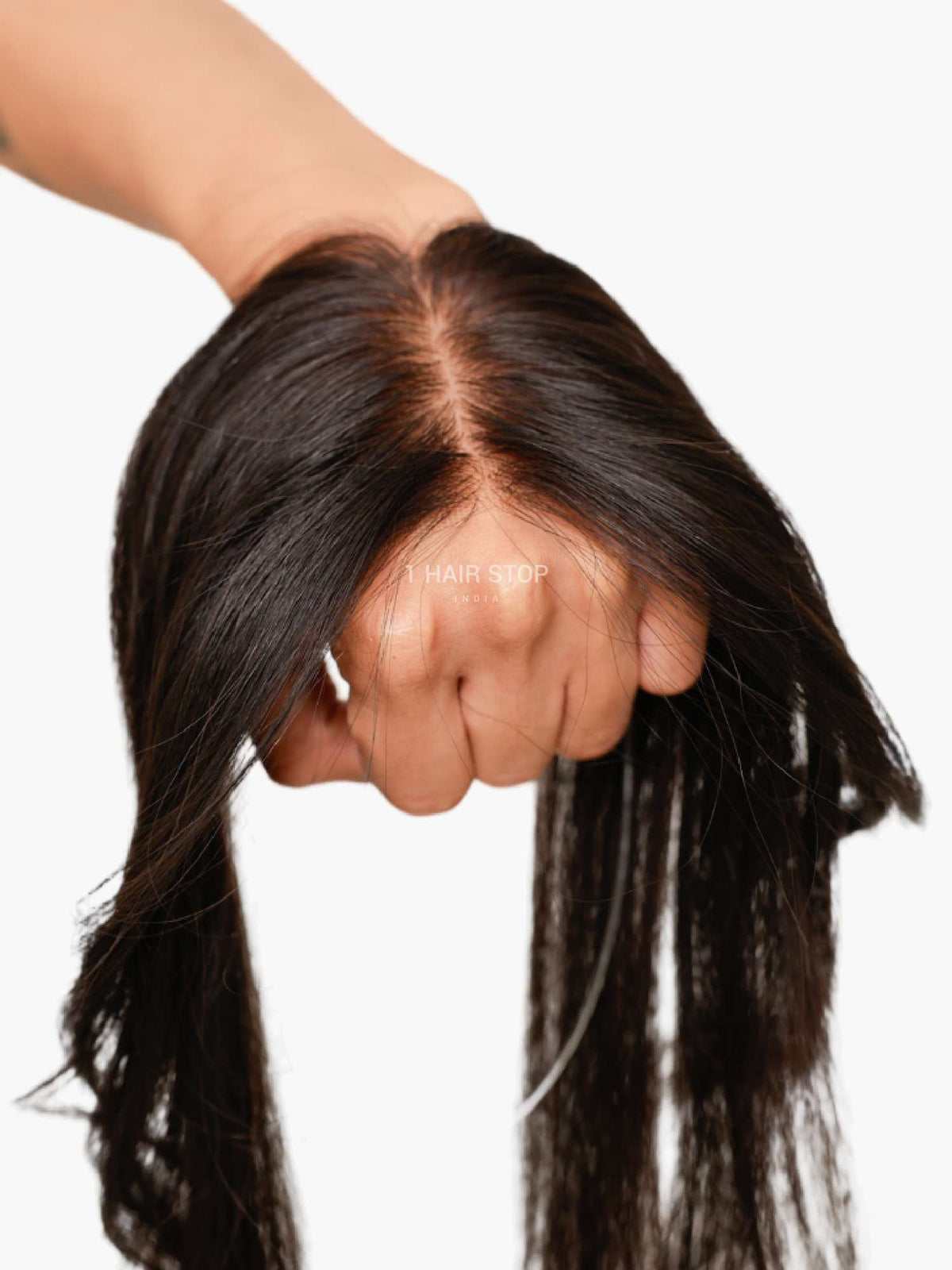
When there is not enough hair at the front to cut from: Add coverage and a fringe in one piece with the Frontal Fix Clip-Free Hairline Topper, built on a silk part that looks like real scalp and finished with layered curtain bangs. It holds on an adjustable band with no clips and no glue, so nothing pulls on thinning hair at the hairline.
-
A fringe with your hair pulled back: Pair a fringe with the style it flatters most using Flat Clip-in Ponytail Extensions, which sit close to the head on a hidden comb rather than bulking out at the gather. A fringe is what stops a pulled back style reading as severe.

-
For thin hair behind a curtain fringe: Build the density a fringe needs to sit against with the Seamless 7 Set Clip-in Extensions, whose flat wefts stay hidden on fine hair. Cutting a fringe from sparse front hair thins what is left, and this is how you put it back.
- Not sure which fringe is yours? Read how to style clip-in curtain bangs for the fitting and blending or book a free video call and we will look at your hairline with you.
Frequently Asked Questions
How do I know if bangs will suit me?
Run four checks in a mirror rather than looking at photographs. Push your hair back and look for a cowlick at your front hairline, because that decides whether a blunt fringe is possible at all. Measure your forehead in finger widths between hairline and eyebrows. Part the hair at the very front and see how much scalp shows. Then think about how fast your roots go oily, because the fringe takes oil first. A cowlick means curtain or side-swept rather than blunt. A low forehead means longer or parted rather than short.
What is a cowlick and why does it ruin bangs?
A cowlick is a patch where hair grows out of the scalp at an angle instead of straight down. If yours sits at the front hairline, a blunt fringe cut across it will split into two pieces and part in the middle within an hour of drying, every day. No product or blow-drying fixes it permanently. Curtain bangs, which are parted anyway, work with it. Side-swept bangs cut along the growth direction do the same. Only blunt is a problem.
How often do bangs need trimming?
Every two to three weeks for a blunt or micro fringe, four to six for wispy or bottleneck, six to eight for curtain and side-swept, and eight to ten for curly. Hair grows about a centimetre a month, which is invisible on your length and takes a blunt fringe from eyebrow to eyelash in roughly six weeks. Many salons trim a fringe free between appointments, which is worth asking about when it is first cut.
How long does it take to grow out bangs?
Eight to twelve months from a full blunt fringe to a length that blends with the rest of your hair. Months one to three are the hardest, because the hair falls in your eyes and cannot be pinned anywhere useful. By month four to six it reaches the cheekbone and can be tucked behind an ear. Having it angled into the sides every few months rather than left blunt makes the whole process look deliberate, and a deep side parting helps immediately.
What should I say to my stylist when asking for bangs?
Give four measurements rather than a style name. Where it finishes, named against a landmark on your face such as the eyebrow or the top of the eye. How far back the section is taken, which decides how thick it is. How wide it goes at the sides. And whether the edge should be cut solid or point cut for a softer finish. Saying only that you want blunt bangs leaves three of those four to somebody who has not seen your head before.
Can I get bangs if I have fine or thinning hair?
Yes, with one caution. A fringe is cut from the hair already at the front of your head, so if that area is sparse, cutting a fringe thins both the fringe and the hair behind it. Wispy or curtain bangs cut from a shallower section are the safer choice. A clip-in fringe avoids the problem entirely, and a topper with the fringe built in solves it if the front hairline is where the thinning actually is.
Do clip-in bangs look real?
Yes, when the base is hidden and the piece is human hair that can be cut and styled to your own face. The two things that give a clip-in fringe away are a visible base at the front and a length that was never adjusted to you. Leave a little of your own hair down over the join, and have the piece trimmed to your face the same way you would a cut fringe. A skin-like top helps on light front density, where a clip might otherwise show.


