


A woman posts asking other women with fine hair to show her what they do with theirs. She says she is starting to despair that they are limited in terms of cuts and styles, then corrects herself and suggests she might just be bad at hair. The last line of her post asks for tips for making the most of what she calls our disadvantage.
Twenty four women reply. They disagree with each other completely. Half say the only thing that ever worked was cutting it short. Half say the longer the better and that short made it look flat and boring. Both groups are certain, and both groups are right.
Short answer: Fine, thin and thinning are three different things and almost every article treats them as one. Fine means each strand is narrow. Thin means there are fewer strands. Thinning means the number is going down, and that is the only one of the three that is a question for a doctor rather than a hairdresser. Work out which you have before choosing anything, because the advice for fine dense hair and for sparse coarse hair is opposite.
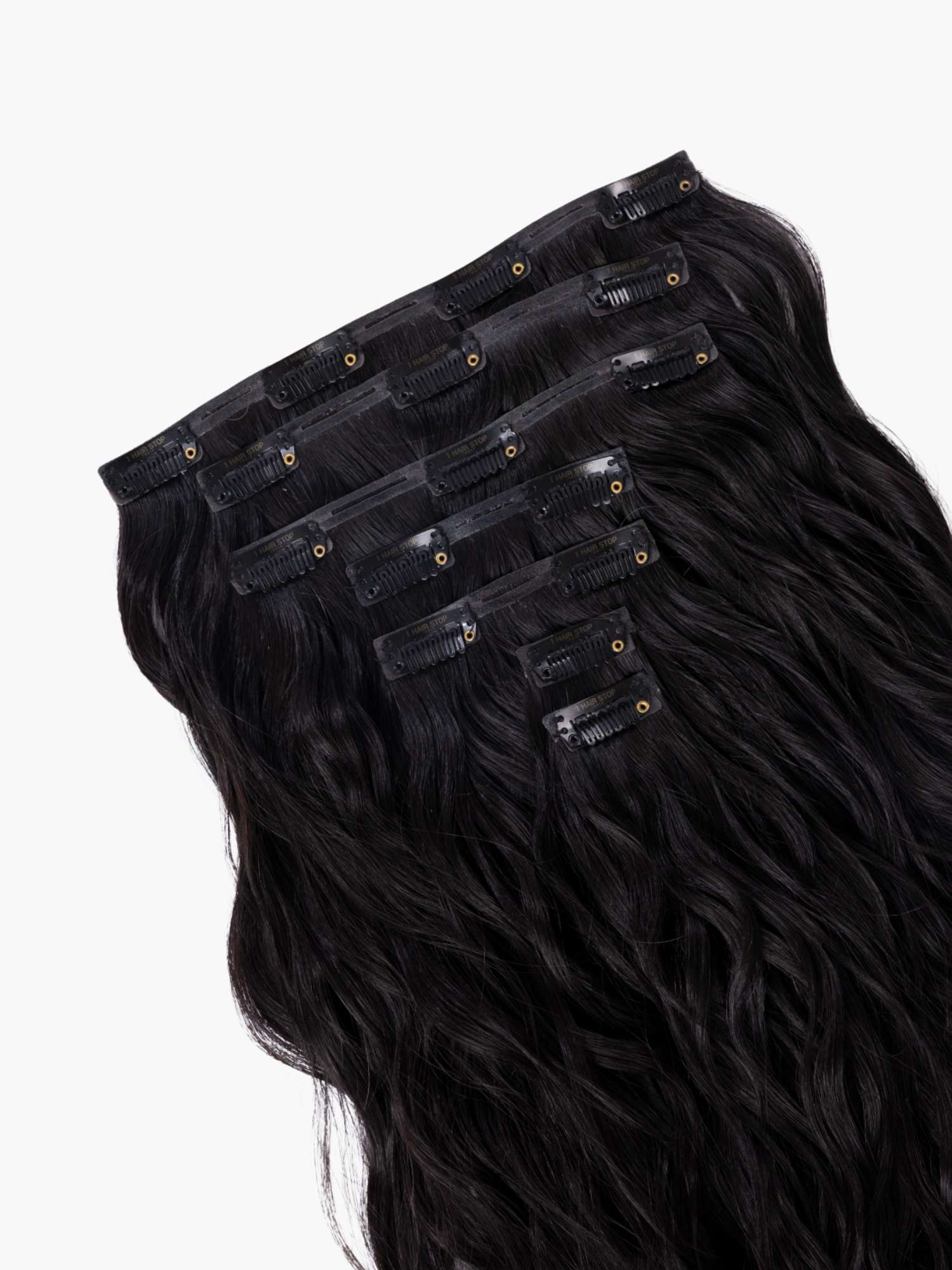
That piece is at the top of this article because of the one thing fine hair cannot hide. A thick weft has nothing to disappear under. The Seamless 7 Set Clip-in Extensions is built on a flat weft for exactly that reason, so the join sits against the scalp instead of forming a ridge you can feel through your own hair.
- Fine, Thin and Thinning Are Three Different Things
- Which One You Have, in Two Minutes
- Why Everybody Argues About Long Versus Short
- The Taper, and Why Blunt Ends Work
- Volume Decay, the Metric Nobody Measures
- Why Backcombing Fails on the Finest Hair
- The Cuts, by Which Problem They Solve
- Adding Hair to Fine Hair
- How 1 Hair Stop Makes This Easier
- Shop Pieces Built for Fine Hair
- Frequently Asked Questions
Fine, Thin and Thinning Are Three Different Things
This is the whole article and it takes one table.
| Term | What it actually means | What it means for you |
|---|---|---|
| Fine | Each individual strand has a small diameter. It is about the hair, not how much of it there is | Largely permanent and largely genetic. It affects how hair behaves, holds a style and reflects light. It is not a loss of anything |
| Thin, or low density | Fewer hairs per square centimetre of scalp. It is about the count, not the strand | Some people have always had it. It decides how much scalp shows and how much weight your hair can carry |
| Thinning | Density that is going down over time. It is a change rather than a state | The only one of the three that is a question for a doctor. A haircut does not address a change and no styling advice should be treated as though it does |
Those three combine, which is where nearly all the confusion comes from. You can have fine strands and high density, which means a great deal of hair that will not hold a style for an hour. You can have coarse strands and low density, which means visible scalp but strong individual hairs. Those two women need opposite advice and every article gives them the same list of haircuts.
The women who use these words carefully already know this. One describes herself in a forum post as thirty one, with fine hair and medium density, in the same breath. She is being precise because the two are separate facts about her head. There are even separate communities, one for fine hair and one for fine and thin hair, because the people in them worked out that they are not the same problem.
The line that matters, stated plainly: If your hair has been the way it is for as long as you can remember, this is a styling question and the rest of this article is for you. If your parting has widened, your ponytail has got noticeably smaller, or you are seeing more scalp than you used to, that is a change rather than a texture, and it is worth a doctor's appointment rather than a haircut. We make hair, we do not treat it, and we are not going to guess at why yours is changing. Go early. Styling comes after that, not instead of it.
Which One You Have, in Two Minutes
Two tests, both free, and between them they place you.
The strand test, for fine against coarse: Pull one hair from your head and roll it between finger and thumb. If you can barely feel it, it is fine. If you can clearly feel a thread, it is medium. If it feels like a piece of cotton, it is coarse. Compare it to a sewing thread if you want a reference: finer than the thread is fine hair.
The parting test, for density: Part your hair down the middle in daylight and look at the width of the scalp line. Then part it in three or four other places across your head. A parting that stays narrow everywhere is high density. A parting that widens noticeably at the crown while staying narrow at the sides is the pattern worth taking to a doctor rather than a stylist.
Put the two results together.
- Fine and dense: Plenty of hair that goes flat and will not hold anything. Your problem is grip and weight, not quantity. Blunt cuts and shorter lengths work, and every extra centimetre of length costs you volume.
- Fine and sparse: The combination this article is mostly written for. Both weight and quantity are constraints, ends look see-through, and the fixes are blunt perimeters, kept length, and added density.
- Coarse and sparse: Individual strands are strong but there are not many. Volume is rarely the issue. Scalp visibility at the parting is, and that is a coverage question rather than a styling one.
A photograph of a parting with something in it for scale is the most useful image this category could publish and it does not exist. Every woman looking at this question is looking at her own parting and has nothing to compare it to.
Why Everybody Argues About Long Versus Short
Go back to that thread and watch the disagreement happen.
One woman says the only thing that has ever worked consistently for her is short hair. She spent decades trying to find tricks for having beautiful long hair and nothing worked, because length only emphasised how fine and how thin it was. She now keeps it between the ear and the chin and loves it every day.
Directly beneath, another says she agrees that the longer the better. She tried cutting it to the shoulder and it looked flat and boring, and long hair gives her the option of braids and ponytails and buns and is more manageable most of the time. A third says she spent years cutting it off and growing it out before finally realising her hair suits being long best.
Neither camp is wrong and they are not talking about the same hair.
Short wins when the limiting factor is weight: If you have fine strands in reasonable density, the hair flattens because the weight of the length pulls the root down. Remove the length and the same hair stands up. That woman is right about her own head.
Long wins when the limiting factor is options: If your density is low, short hair does not gain you much volume and it costs you every gathered style. The second woman named the reason herself: braids, ponytails and buns. Those all need length, and on low density hair a gathered style is often the best your hair will ever look, because gathering concentrates what you have.
So the real question is not long or short. It is whether your hair goes flat because of weight, in which case cut it, or looks sparse because of count, in which case keep the length and use it. Work out which of those two sentences describes your bad hair day and the argument resolves itself.
The Taper, and Why Blunt Ends Work
One comment in that thread explains the single most common mistake in fine hair in a sentence, and nobody picks it up.
She says that what makes long hair worse is the five inches of barely there hair that makes it look horrible long.
Fine hair does not end. It fades. Each strand gets thinner towards the tip, and because individual hairs also break at different points along the length, the last several inches of a long fine head of hair contain far fewer strands than the section above. The result is a taper, and a taper reads as sparse no matter how much hair you have at the top.
This is the actual mechanism behind every piece of advice you have read about blunt cuts. A blunt perimeter is not a visual trick and it is not about looking heavier. It removes the tapered section entirely so the hair ends where it is still at full density.
Three consequences follow.
- Trim more often than feels necessary: Another commenter in the same thread puts it exactly: regular cuts are the best thing for fine hair, because you are taking off all those ratty ends and it makes the hair look far thicker. She is right and it is the highest value habit on this page. Every eight to ten weeks, even if you are growing it.
- Blunt does not mean no layers: The perimeter stays solid. Layers, if any, are cut inside the shape and start well below the crown. A woman in the thread describes the failure mode of getting this wrong: too much layering makes the ends look ratty, and having no layers at all makes the ends look thicker.
- Face framing costs you: Layers cut around the face remove hair from the front of your head, which is where thin hair shows most and where you can least spare it. Ask for the front to be left alone unless you specifically want a fringe.
Volume Decay, the Metric Nobody Measures
The single most honest complaint in the whole thread, and the one no published article addresses.
She says her biggest problem is that the volume does not last. Nice hair, she writes, and then wait until the window blows. She gets a good two or three hours out of it. That, she says, is what kills her. It starts to look tangled and flat.
Read that again, because it reframes the entire subject. She is not complaining that she cannot create volume. She creates it every morning. She is complaining that it lasts two to three hours, and that no article measures or even acknowledges this.
Volume in fine hair is temporary by definition. It is held by friction between strands, by product residue, and by the shape the hair was dried into. Fine strands have less surface area to hold friction, straighter cuticles that slide past each other more easily, and less mass to keep a shape once it is disturbed. Humidity, wind and touching your own hair all reset it.
Four things extend it, in order of how much they buy you.
- Build volume at the root, not through the length: Root lift survives the day. Mid-length body does not. Drying the roots upwards, or head upside down, against the direction the hair falls is the highest return technique there is and it costs three extra minutes.
- Style on second-day hair: Free and it is the biggest single improvement. Fine hair goes oily fast, which is a real nuisance, but the friction that comes with it is exactly what a style needs to hold. Wash the day before an event rather than the morning of.
- Stop touching it: Genuinely. Hands running through fine hair collapse it faster than weather does. The two to three hour figure is often closer to a whole day for people who leave it alone.
- Choose styles that do not rely on volume at all: This is the one nobody says. A low wrapped ponytail, a blunt bob and a half up all look the same at seven in the evening as they did at eight in the morning, because none of them is holding air. Building your rotation around these instead of around volume is a strategy rather than a surrender, and the mechanics of it are in easy everyday hairstyles for women.
Why Backcombing Fails on the Finest Hair
Worth its own short section because the advice is universal and it does not work for everybody.
One woman says she has tried teasing, but the knots become so apparent because there is not much hair to hide them. Another agrees and adds the useful version: not everybody's hair can cope with backcombing, and there are people with hair even finer than hers that simply cannot handle it.
They have identified the mechanism. Backcombing works by deliberately tangling the under-layer to create a cushion, then smoothing a clean top layer over it to hide the mess. It is a two-layer technique. If you do not have enough hair to spare a full smooth top layer, the cushion shows, and instead of volume you get visible knots.
So there is a density floor below which teasing is the wrong tool, and no article mentions it because the technique works for most people.
What works instead, at that end of the range. Texture powder at the roots rather than backcombing through the length, which lifts without tangling. A parting moved deliberately to the opposite side, which lifts the roots for free because the hair has to travel over the head. And, as one commenter suggested to another in that same conversation, a shaped insert under an updo, which gives the illusion of more hair without having to backcomb the life out of it.
The Cuts, by Which Problem They Solve
Every list of haircuts for thin hair is a list of haircuts. Here is the same list sorted by which of the two actual problems each one solves.
| Cut | Solves | Best for | Where it fails |
|---|---|---|---|
| Blunt bob, chin to collarbone | Both weight and taper | Fine and dense hair, where removing weight gives immediate lift | Low density, where a short blunt line can read as thin rather than solid, and where you lose every gathered style |
| Long layers with a blunt perimeter | Weight, while keeping length | Anybody who wants to keep length and still have body through the mid lengths | Over-layering. Too many layers on fine hair removes the density that was holding the shape together |
| Choppy pixie | Weight, completely | Fine dense hair, where it gives the most dramatic volume gain of anything here | It removes all gathered styles permanently, and it needs recutting every six weeks |
| Curtain bangs | Visible density at the front | Adding hair where the temples and hairline show, which is where thin hair is noticed first | Sparse front density, where cutting a fringe takes hair from the one area you cannot spare |
| Kept long, trimmed often | Options, not volume | Low density hair, where gathered styles concentrate what you have and look fuller than loose hair does | Skipping the trims. Without them the taper takes over and this becomes the worst option on the list |
Two notes. The last row is the one the category refuses to print, because the standard advice is that long hair past the mid back strings out and looks sparse. That is true if you do not trim it. It is not true if you do, and for low density hair the ability to put it up is worth more than the volume you would gain by cutting it off.
And if you are considering the blunt bob, the shape at the back of your head decides whether it works, which is covered in bob haircuts for women. Fine and dense hair gets the best bob result of any hair type. Fine and sparse hair is the riskiest case on that page.
Adding Hair to Fine Hair
Fine hair is the hardest texture to add hair to and almost nobody says so before selling you something. Three reasons, and they are all mechanical.
- There is nothing to hide the join under: On thick hair a weft disappears beneath the hair above it. On fine hair there is no cover, so a thick base forms a visible ridge and a clip can show through. Flat wefts and skin-like bases are not a luxury at this texture, they are the requirement.
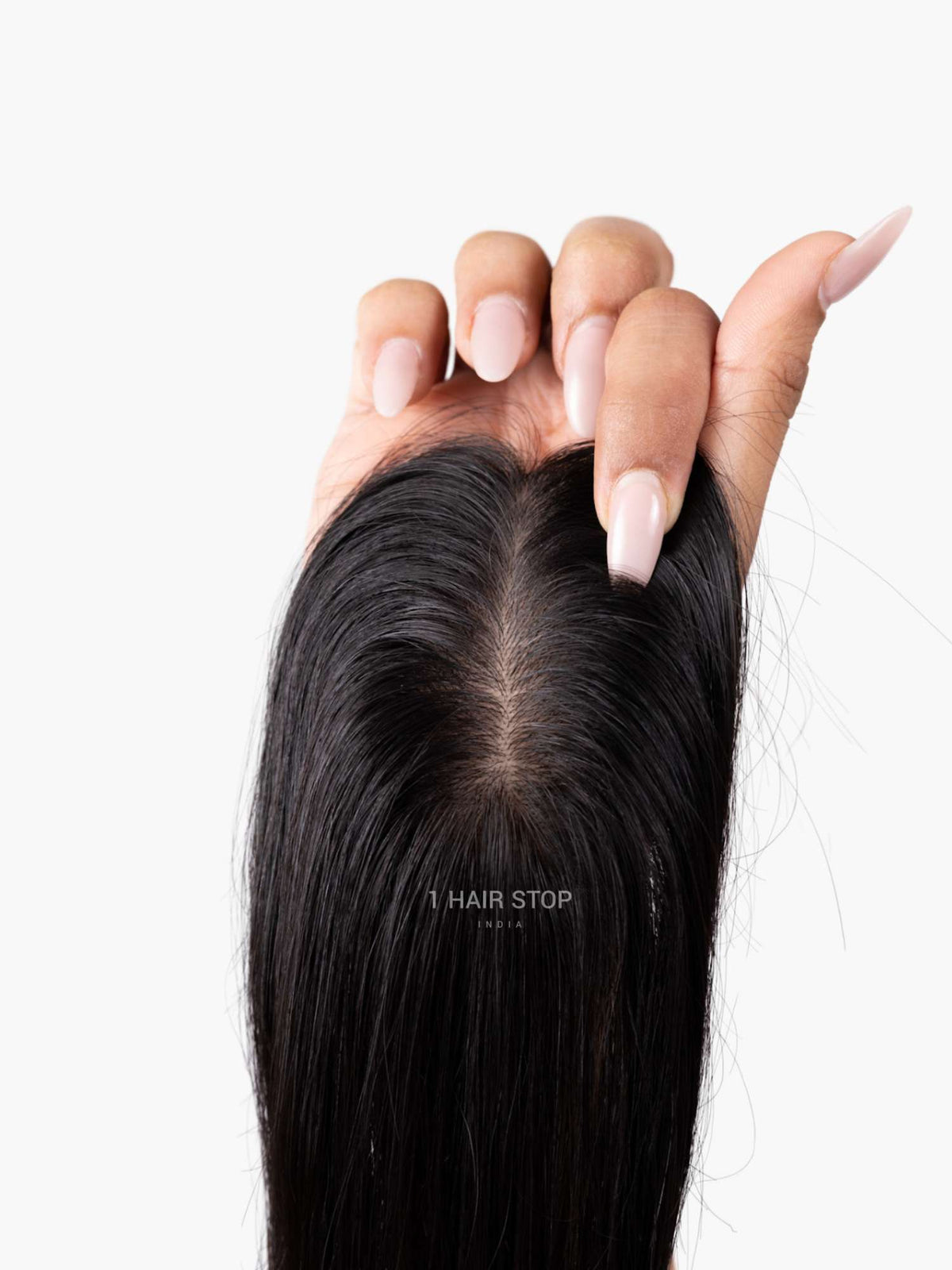
- Weight is a real constraint: A clip holds by gripping a small section of your own hair, and the weight of the piece hangs from those specific strands all day. On fine hair that is fewer and narrower strands carrying the same load. This is why our smallest silk toppers run between thirteen and twenty grams, and why starting smaller than you think is the correct advice rather than a cautious one.
- The colour has to be closer: Fine hair is more translucent and reflects more light, so a shade that is slightly off shows more than it would on coarse hair. Match at the root and in daylight.
Against those three there is one genuine advantage, and it is the reason this route works at all. Adding density is the only intervention on this page that changes the underlying constraint rather than working around it. Every cut in the table above is a way of arranging the hair you have. This is the one that changes the number.
If the issue is specifically the parting or the crown rather than thinness throughout, the decision is a different one and it is set out properly in how to choose a hair topper for thinning hair. If this started happening around a particular stage of life rather than always being the case, hairstyles for women over 50 deals with that separately.
How 1 Hair Stop Makes This Easier
Fine hair is the texture our customers are most apologetic about, and it is the one the industry serves worst.
Trusted by 300,000+ women worldwide | 4.8★ from 14,700+ reviews | 100% Human Remy Hair | Sourced From Temples | Clip-Free | Handmade in our own facility since 2009 | Damage-free application guarantee
"A woman with fine hair has usually been sold something that did not work before she reaches us, and it is almost always because it was too heavy or the base was too thick. Those are the two failures. We publish the gram weights on the toppers for that reason, and we make clip-free versions because a woman with fine hair is the one who can least afford clips pulling on the hair she has. Start smaller. Nobody has ever written to us wishing they had bought a heavier piece."
Raina Grover and Richa Grover, Co-Founders, 1 Hair Stop
Every piece is hand-knotted or wefted in 100% human Remy hair in our own facility in Hyderabad. Our silk bases are built with two layers of netting, each strand individually knotted onto the lower layer and pulled through a fine top layer, which is what lets a parting read as scalp rather than as a base.
The honest limitation is the one in the quote. Fine hair has a genuine weight ceiling, and it is lower than most people expect. Use the free consultation and buy small first. A piece that is too heavy is not a piece you will wear.
Shop Pieces Built for Fine Hair
All of these are 100% human hair and all of them come off at the end of the day. Choose by weight and by base thickness rather than by how much hair you want.
-
The set built for a visible join: Add length and density without a ridge showing through with the Seamless 7 Set Clip-in Extensions, whose flat wefts sit against the scalp instead of sitting on top of it. On fine hair the thickness of the weft matters more than anything else about a set.
-
The lightest thing we make: Cover a widening parting with the 1.5x3 Silk Hair Topper, which weighs between thirteen and twenty grams depending on length. It is the smallest piece in the range and the right place to start if you have never worn one.
-
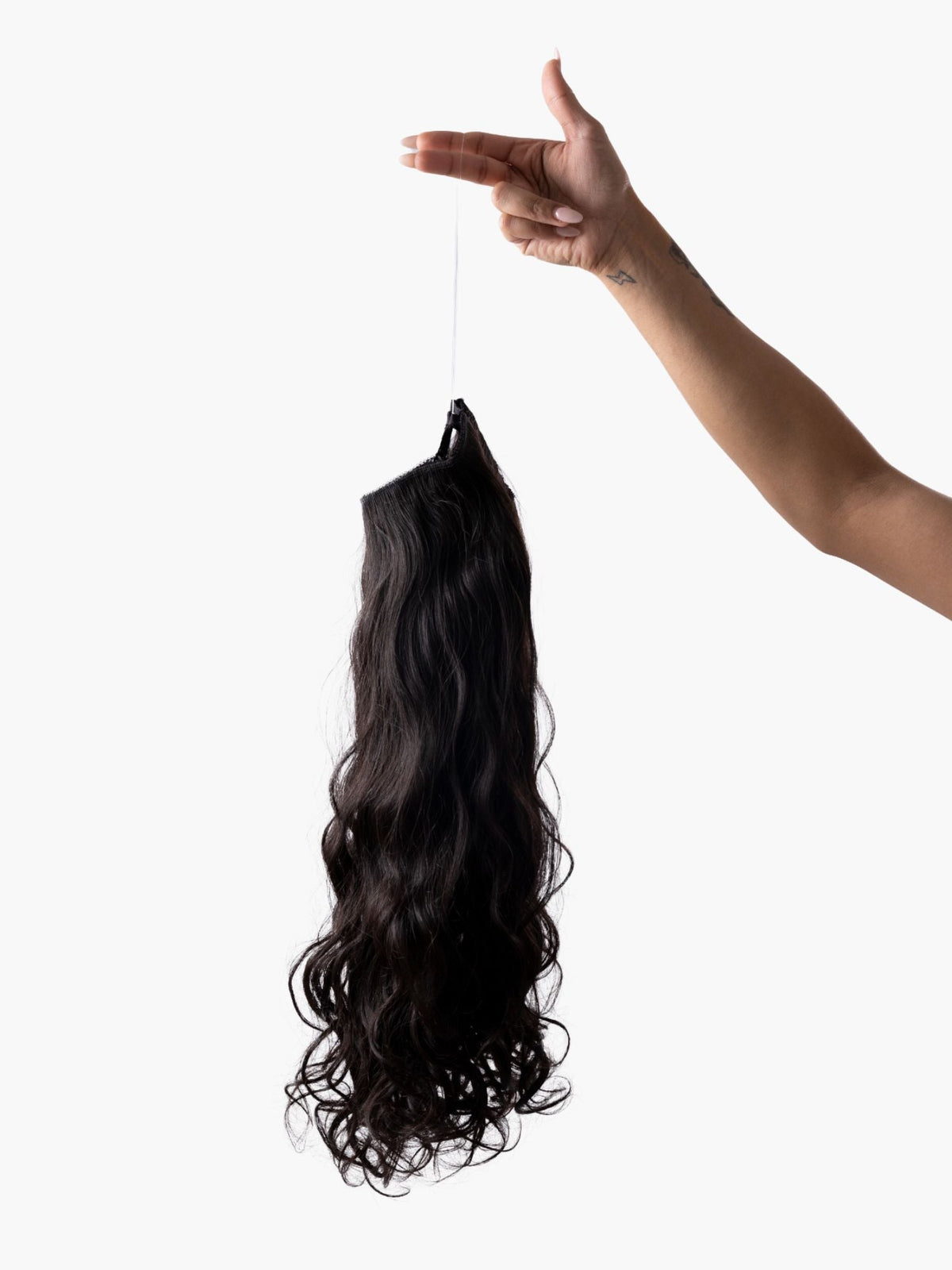
Density with nothing gripping your hair: Add thickness with zero tension using HaloHair Extensions, which sit on a fine adjustable wire about an inch behind the hairline. Nothing clips into your own hair, which matters most at exactly this texture.
-
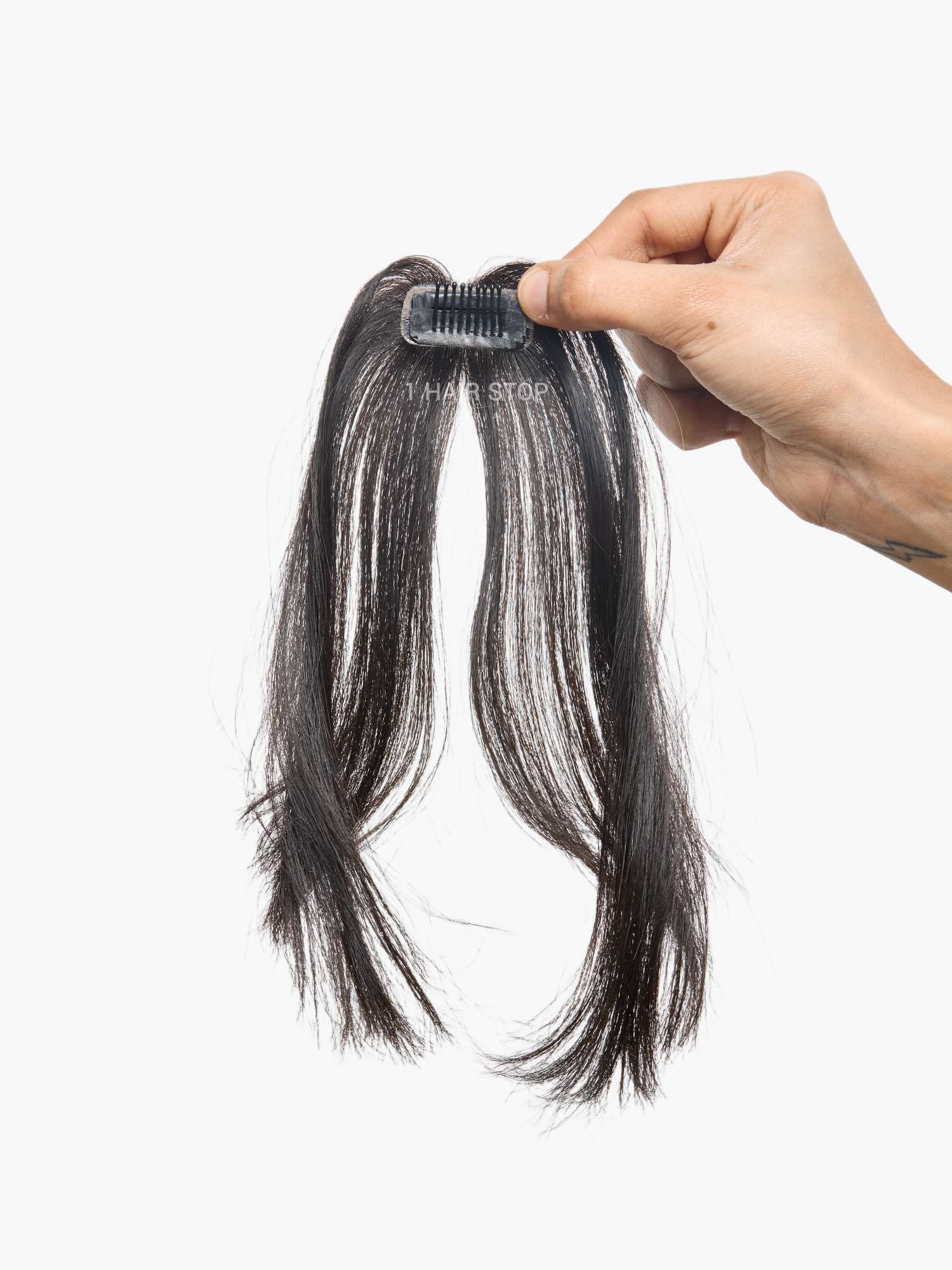
Density at the temples, without cutting any: Add hair at the front where thin hair shows first using Clip-In Curtain Bangs, two soft pieces that clip in at the top of the head in seconds. Cutting a fringe from sparse front hair takes it from the one place you cannot spare it.
-
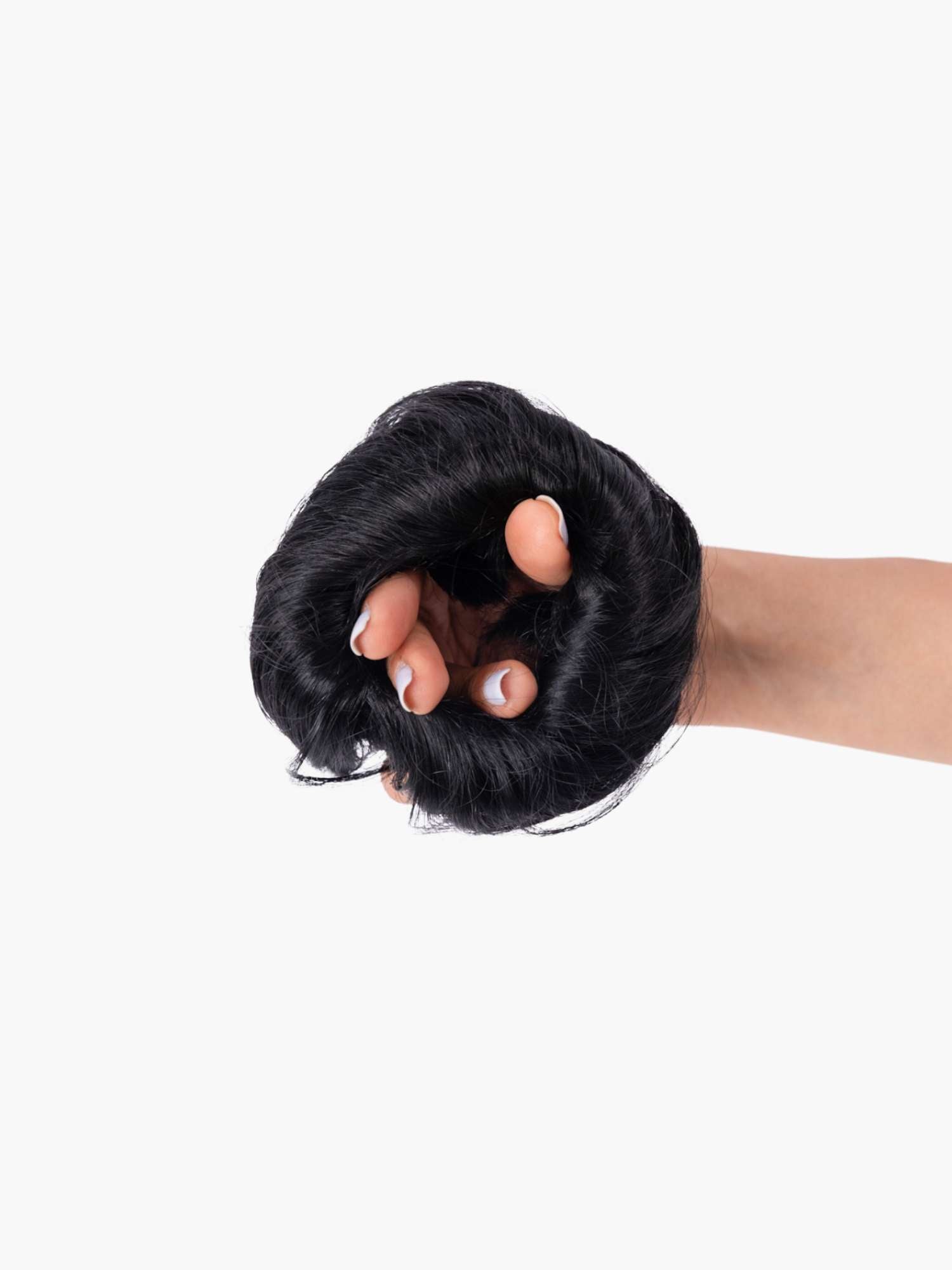
A bun your own gather cannot make: Build a full bun from a small gather with the Messy Bun Scrunchie, which goes over a loose gather in about two minutes rather than needing length to wrap around itself. It is the fix for a bun that comes out the size of a walnut.
-
A ponytail that stays flat at the base: Keep a fuller ponytail close to the head with Flat Clip-in Ponytail Extensions, secured on velcro and a hidden comb. A bulky base is the thing that gives a ponytail piece away, and on fine hair it gives it away fastest.

- Not sure whether yours is fine or sparse? Read how to choose a hair topper for thinning hair, or book a free video call and we will run the two tests with you in daylight.
Frequently Asked Questions
What is the difference between fine hair and thin hair?
Fine describes the strand, thin describes the count. Fine hair means each individual strand has a small diameter, which affects how it behaves and holds a style. Thin, or low density, means there are fewer hairs per square centimetre of scalp, which affects how much scalp shows. They combine, so you can have a great deal of very fine hair or a small amount of coarse hair, and those two need opposite advice. Thinning is a third thing again: density that is decreasing, which is a change rather than a texture.
How do I know if my hair is thinning or just fine?
By whether it has changed. Hair that has been the way it is for as long as you can remember is a texture, and it is a styling question. A parting that has widened, a ponytail that has got noticeably smaller, or more visible scalp than you used to have is a change. A change is worth a doctor's appointment rather than a haircut, and it is worth making early. Styling advice comes after that rather than instead of it.
Is short or long hair better for thin hair?
It depends which problem you have, which is why women with fine hair argue about this endlessly and all of them are right about their own heads. If your hair goes flat because the weight of the length pulls the roots down, cutting it shorter genuinely helps and you will see it immediately. If your hair looks sparse because there are not many strands, short hair gains you little volume and costs you every braid, ponytail and bun. Low density hair often looks best gathered, and gathering needs length.
Why does my fine hair go flat after a few hours?
Because volume in fine hair is held by friction and by the shape it was dried into, and fine strands have less surface area to hold either. Humidity, wind and running your hands through it all reset it. Build the volume at the root rather than through the length, because root lift survives the day and mid-length body does not. Style on second-day hair rather than freshly washed. Stop touching it, which sounds trivial and is not. And consider styles that do not rely on volume at all.
Should I get layers if I have fine hair?
Keep the perimeter blunt and put any layers inside the shape, starting well below the crown. A solid perimeter removes the tapered ends where fine hair fades out, which is what actually makes a blunt cut look thicker. Too many layers removes the density holding the shape together and leaves the ends looking ratty. Avoid face-framing layers unless you specifically want a fringe, because they take hair from the front of your head where thin hair shows first.
How often should I cut fine hair?
Every eight to ten weeks, even while growing it. This is the highest value habit for fine hair and the most commonly skipped. Fine hair does not end cleanly, it tapers, and strands break at different points, so the last several inches of long fine hair contain far fewer strands than the section above. Trimming removes that tapered section so the hair ends where it is still at full density.
Are clip-in extensions safe for fine hair?
Weight and base thickness are the two things to check. A clip holds by gripping a small section of your own hair and the weight of the piece hangs from those strands all day, which is a bigger ask on fine hair. Flat wefts and skin-like bases matter more here than at any other texture, because there is no hair above the join to hide it. Start with a lighter and smaller piece than you think you need. A wire-based halo avoids clipping into your own hair at all.


