


Ask this question anywhere and you get a number back with total confidence. Six to twelve months. Four months. Twelve to eighteen. One to three competition seasons. Years, if you look after it. Every one of those figures is published by somebody selling hair, and no two of them agree.
They are all sort of right, which is the problem. Lifespan is not a property of the hair. It is a property of how the hair is worn, and every published number is really an assumption about your habits, dressed up as a specification. A piece worn twice a month lasts a different life from the identical piece worn daily, heat-styled and slept in.
Short answer: Human hair outlasts synthetic on fibre life, usually by a wide margin, and it is the only one you can heat style and recolour. But the fibre is not what fails first. On human hair the colour usually goes before the hair does, fading warm or brassy in sunlight and never quite matching again after a re-dye. On synthetic the fibre goes first, hardening and matting at the ends through friction. Decide by which of those you would rather manage, not by a lifespan figure on a product page.
Everything we make is 100% human Remy hair, hand-knotted or wefted in our own facility, which is why the piece in that photograph moves and reflects light the way the hair it is attached to does. The full range is in ponytail extensions. This article still spells out where synthetic is the better buy, because on some purchases it genuinely is.

- Nobody Agrees on the Number
- Three Things Wear Out, Not One
- What Actually Kills a Human Hair Ponytail
- What Actually Kills a Synthetic One
- Human Hair vs Synthetic, Side by Side
- When Synthetic Is the Better Buy
- The Sourcing Question, Answered Properly
- How to Make Either One Last Longer
- How 1 Hair Stop Makes the Choice Easier
- Shop Human Hair Ponytails
- Frequently Asked Questions
Nobody Agrees on the Number
Search this question and collect the lifespan figures. You will find human hair ponytails described as lasting four months, six to twelve months, twelve to eighteen months, several years, and one to three seasons, depending on which shop you land on. Synthetic is more consistent at one to three months, but even that stretches to a year or more in places.
None of them is lying. They are answering different questions without saying so. Four months is a daily-wear, heat-styled, washed-often assumption. Several years is an occasional-wear, air-dried, stored-properly assumption. The same piece produces both outcomes depending on who owns it.
So the useful question is not how long does it last. It is what wears out, in what order, and which of those things you can do something about.
Three Things Wear Out, Not One
A ponytail piece has three separate lifespans running at once, and people talk as though it only has one.
The fibre: How long the hair itself stays smooth, strong and untangled. This is what every published lifespan figure is actually measuring, and it is where human hair wins clearly.
The colour: How long the shade still matches your own hair. Almost nobody measures this, and on human hair it is usually the first thing to fail.
The style hold: How long it keeps the wave, curl or straightness you bought it for without you having to redo it. This is where synthetic quietly wins, because the style is built into the fibre rather than applied to it.
A piece is finished when any one of the three fails, not when all three do. That is why a human hair ponytail can be in perfect physical condition and still be unwearable, and why long-term wearers so often end up with a drawer of pieces that are technically fine.
That is a photograph worth taking honestly. Most brands show only the new one, which is exactly why buyers are surprised twelve months later and conclude the hair was poor quality when what actually happened was entirely normal.
What Actually Kills a Human Hair Ponytail
Rarely the hair. Usually the colour.
Human hair sits in daylight all day and has no living follicle feeding it, so it behaves like the ends of very long hair that has not been cut in years. Untreated shades drift warm. Ash and cool browns go brassy. Dark shades lift slightly and pick up red. It happens gradually enough that you do not notice until you hold the piece against your own roots and the difference is obvious.
You can re-dye it, and long-term wearers do, but the honest version is that it rarely comes back to exactly where it was. People who have gone through this describe re-colouring periodically and never quite getting the original tone again, always slightly warm or reddish in certain light. The hair is still in beautiful condition. It just does not match any more.
The second failure is dryness, for the same reason. No scalp oils reach it, so the ends go coarse before the roots do, and the section that sits inside the join tangles first because it moves against itself all day.
Neither of these is a defect. It is what hair does when it is no longer attached to a head, and it is the single most useful thing to know before you spend money on a piece.
What Actually Kills a Synthetic One
The opposite. The colour holds almost indefinitely. The fibre gives up.
Synthetic fibre is manufactured in its colour rather than dyed into it, so sunlight does very little to it. Wearers with pieces years old describe them holding their exact original shade, which is the one thing synthetic does better than human hair by a distance.
What fails is texture. Friction where the piece rubs against clothing at the ends produces matting that cannot be brushed out, and unlike human hair it does not respond to conditioning treatment because there is no cuticle to smooth. Over time the fibre also hardens, which wearers describe as scratchy or plasticky, and once that happens the piece is done.
Standard synthetic also melts under heat tools. Heat-friendly versions exist and take limited styling, but they are more fragile to friction than standard fibre, so you trade one weakness for another.
Human Hair vs Synthetic, Side by Side
| What you are comparing | Human Hair | Synthetic |
|---|---|---|
| Fibre life | Longest, by a wide margin | Shortest, matting at the ends ends it |
| Colour life | Shorter, fades warm in sunlight | Longest, colour is built into the fibre |
| Style hold | You restyle it every time | Holds its set through washing and weather |
| Heat styling | Yes, like your own hair | No, unless heat-friendly, and then only lightly |
| Recolouring | Possible, though rarely an exact return | Not possible |
| Blending with your own hair | Better, it moves and reflects like real hair | Good on high quality fibre, poor on cheap |
| Effort per wear | Higher, it needs styling | Lower, put it on and go |
| Colour range available | Narrower, limited by what can be dyed well | Wider, including vivid and fashion shades |
Read down the first two rows together. That pairing is the whole decision, and it is the pairing nobody puts next to each other.
Bright light is the honest test and the one worth photographing. Human hair scatters it the way hair on a head does. Synthetic reflects it back more uniformly, which is what people mean when they say a piece looks plastic under strong lighting. On a good synthetic the difference is small. On a cheap one it is the first thing anyone notices.
When Synthetic Is the Better Buy
We only make human hair, so treat this section as the one where we have nothing to gain. There are real situations where synthetic is the better purchase and pretending otherwise would be useless to you.
- You want a colour that human hair cannot hold: Vivid shades, pastels, anything fashion. Synthetic keeps them and human hair does not.
- You want the same set every time with no styling: A synthetic piece comes pre-styled and returns to that style after washing. If you want a specific curl and no morning effort, that is a genuine advantage.
- You need it for one event: A wedding, a performance, a costume. Buying human hair for a single evening is spending on a durability you will never use.
- You are trying the idea out: Buying a cheap synthetic first to find out whether you actually like wearing a ponytail piece is sensible, and plenty of people do exactly that before committing.
- Humidity ruins your styling: Synthetic holds its shape in weather that would drop a human hair curl within the hour.
Human hair earns its cost when you will wear it regularly, want it to blend invisibly with your own hair, and want the freedom to restyle and recolour. If none of those apply to you, buy the synthetic and spend the difference elsewhere.
The Sourcing Question, Answered Properly
A significant number of people choose synthetic specifically because they are uncomfortable with where human hair comes from, and that concern deserves a straight answer rather than being ignored, which is what most of this category does.
The concern is legitimate. Human hair is a global commodity and parts of that supply chain are genuinely opaque, with hair changing hands several times between the person who grew it and the brand selling it, and very little traceability in between.
Ours is ethically temple-sourced in South India, where hair is given as a religious offering, and we buy it directly rather than through a chain of traders. It is never acid-stripped, which is the aggressive processing shortcut that lets low-grade mixed hair be sold as premium. Every piece is then hand-knotted or wefted in our own facility in Hyderabad by our own staff, over 200 of them, rather than outsourced.
That is not an argument that everyone should be comfortable with human hair. If the objection is to the principle, synthetic is the right answer for you and no sourcing story changes that. It is an argument that if you are comfortable in principle but want to know the specifics, they exist and we will tell you them.
How to Make Either One Last Longer
Most of the difference between a piece that lasts three months and the same piece lasting three years is here, not in the material.
For human hair. Keep it out of direct sun when you are not wearing it, because sunlight is what shifts the colour. Wash it far less than you think, every twenty to thirty wears rather than weekly, since washing is what strips it. Condition the lengths and ends, never the base. Air dry flat. Use heat sparingly and always with protection. Detangle from the ends upward, never from the join downward.
For synthetic. Wash with cool water and products made for synthetic fibre, because ordinary shampoo strips the coating. Never apply heat unless it is explicitly heat-friendly. Watch the ends where they rub against clothing, since that is where matting starts, and a piece worn against a coarse coat collar will die faster than one that is not.
For both. Take it off before bed rather than sleeping in it. Store it flat or hanging rather than folded in a drawer. And detangle before you put it away rather than after, because a tangle left in overnight sets.
That storage photograph is worth including on the product pages too. Folding is the single most common thing people do wrong, and it is the one that produces a permanent kink at the fold line that no amount of conditioning will remove.
How 1 Hair Stop Makes the Choice Easier
We make what we sell. Every piece is hand-knotted and wefted in our own facility in Hyderabad, one strand per knot where the construction calls for it, in 100% human Remy hair with the cuticles aligned in one direction, which is what keeps it from tangling against itself.
Trusted by 300,000+ women worldwide | 4.8★ from 14,700+ reviews | 100% Human Remy Hair | Sourced From Temples | Clip-Free | Handmade in our own facility since 2009 | Damage-free application guarantee
"We only make human hair, so it would be easy for us to say it wins on everything. It does not. Synthetic holds a colour and holds a set better than we can, and if that is what matters to you then that is what you should buy. What human hair gives you is a piece that moves like your own and that you can change your mind about later."
Raina Grover and Richa Grover, Co-Founders, 1 Hair Stop
Because we manufacture rather than resell, we know what is in every piece and where it came from. On a purchase where the honest answer to how long it lasts depends entirely on how it was made and how you treat it, that matters more than any figure on a product page.
Shop Human Hair Ponytails:
We only make human hair, so this is the half of the comparison we can actually supply.
-
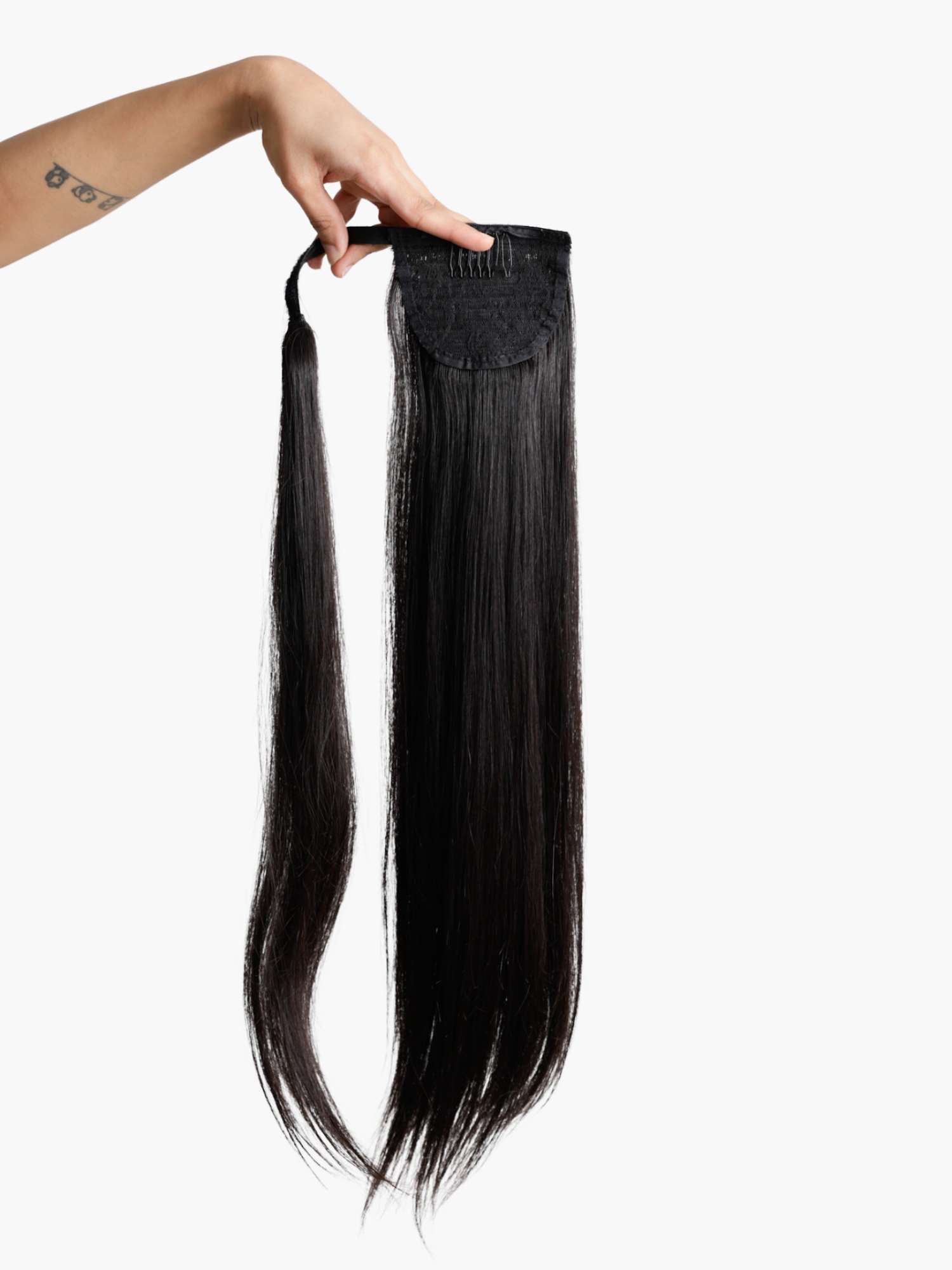
Firm base, most invisible finish: Get the most invisible finish with the Wrap Around Ponytail Extensions, which wrap around your own ponytail and hold with a comb and a velcro fastening rather than clips. Best when your own base is firm enough to keep the piece steady all day.
-
Fine hair or a small base: Add length without bulk using the Flat Clip-In Ponytail Extensions, whose base lies flat against the head so it stays hidden on fine hair. Available in four lengths from 8 to 18 inches, so you can pick the drop you actually want.

-
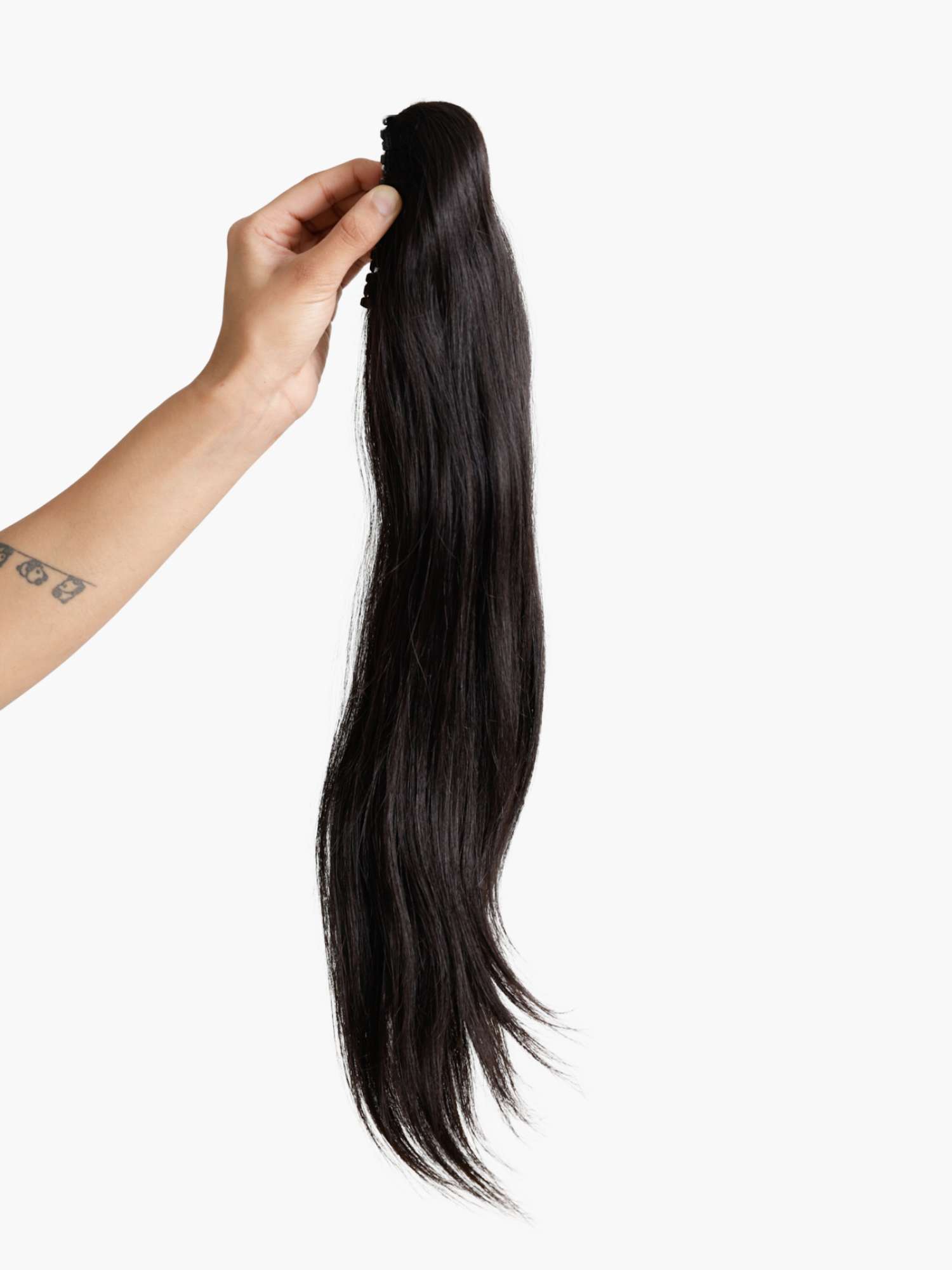
Fastest everyday option: Go from a gathered ponytail to a finished one in a single movement with the Clip-In Ponytail Extensions, the quickest attachment in the range. The sensible pick if it is going on and coming off every day.
-
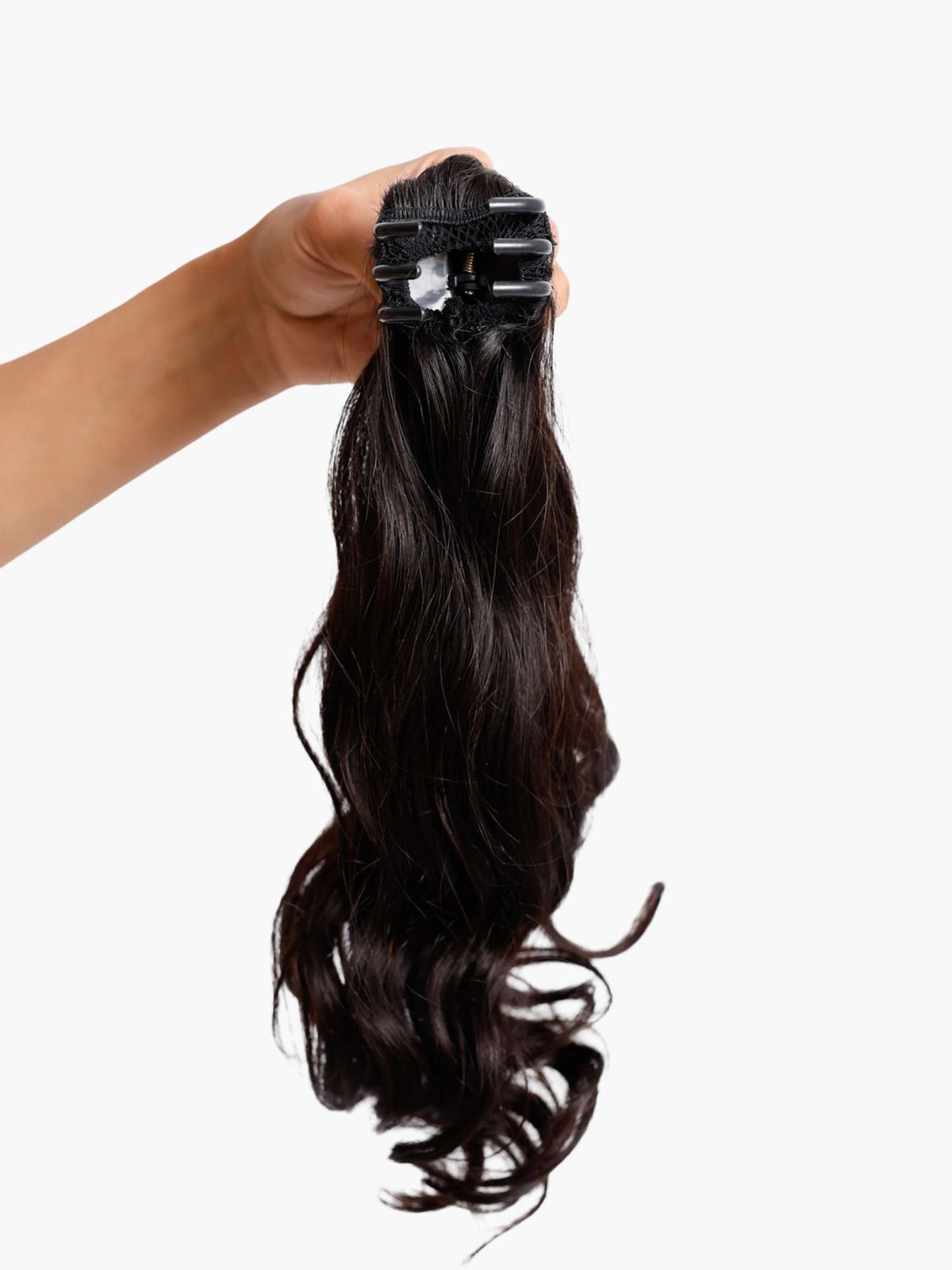
Short hair or very little to gather: Add a ponytail to short hair with the Mini Clip-In Ponytail Extensions, the smallest and lightest piece we make. Less weight at the base means less strain on hair that is already fragile.
-
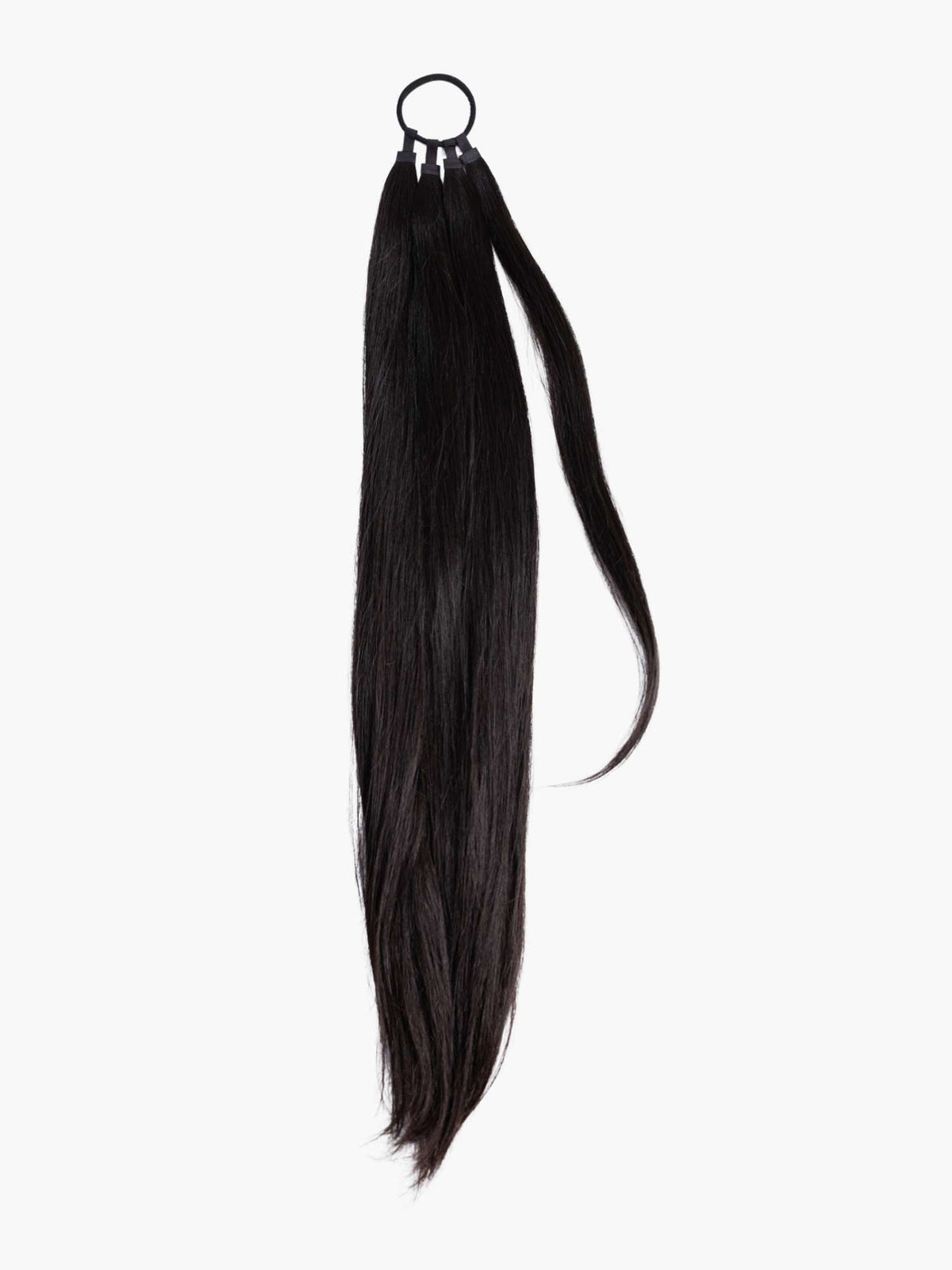
A join that will not hide: Hide a stubborn join with the Braided Ponytail Extensions, where the braid sits over the attachment instead of beside it. The piece covers its own join, which is what makes it work when wrapping never quite does.
- Not sure which attachment you need? Read clip-in vs wrap-around, or book a free video call.
Frequently Asked Questions
How long does a human hair ponytail actually last?
Longer than synthetic on fibre life, but there is no honest single number, because the answer depends almost entirely on how often you wear it, how often you wash it, whether you heat style it and whether you sleep in it. Occasional wear with careful storage produces a completely different lifespan from daily wear with weekly washing. Treat any published figure as an assumption about your habits rather than a specification.
Does human hair fade or change colour over time?
Yes, and this is the part most guides leave out. With no scalp feeding it, human hair sitting in daylight drifts warm. Cool and ash shades go brassy, dark shades pick up red. It can be re-dyed but rarely returns to the exact original tone. On human hair the colour usually fails before the hair does.
Is synthetic hair ever the better choice?
Yes, in several real situations. If you want a vivid or fashion colour, if you want the same pre-set style with no daily effort, if you need it for one event, if you are testing whether you like wearing a ponytail piece at all, or if humidity destroys your styling. Synthetic holds colour and holds a set better than human hair does.
Why does my synthetic ponytail go matted at the ends?
Friction, usually where the ends rub against clothing. Synthetic fibre has no cuticle to smooth, so once matting starts it cannot be conditioned out the way human hair can. Washing with cool water and synthetic-specific products slows it, and so does keeping the ends off coarse fabrics, but matting at the ends is what eventually finishes a synthetic piece.
Can I curl or straighten a ponytail extension?
Human hair, yes, exactly like your own hair, with heat protection and a moderate setting. Standard synthetic, no, it will melt. Heat-friendly synthetic takes limited styling but is more vulnerable to friction than standard fibre, so you are trading one weakness for another.
Where does your human hair come from?
Ethically temple-sourced in South India, where hair is given as a religious offering, bought directly rather than through a chain of traders, and never acid-stripped. Every piece is then hand-knotted or wefted in our own facility in Hyderabad by our own staff. If you are uncomfortable with human hair as a principle, synthetic is the right choice for you and no sourcing story should change that.


