


A woman posts photographs of her own hair, which is dense and curly and by any measure beautiful, and asks whether there are any interesting haircuts that curly girls can do. She wears it in braids every day, she says, because she really does not know what to do with it, and she has been getting jealous of the girls she sees with cool hair.
The most useful reply she gets does not name a single haircut. It tells her the cuts in her saved photographs are high manipulation cuts. They needed a blow dryer, a lot of brushing through, and texturizing products to look like that. It will not translate.
Short answer: The photograph you saved is not a haircut, it is a styling routine. Most cuts that look good on straight hair are built by a blow dryer, and curly hair will not reproduce them. Before choosing anything, know your shrinkage, which runs from about ten per cent on waves to fifty per cent on tight curls, because it decides where a cut will actually land. Then choose the cut by how much daily work it demands, not by how it looks in a photograph of somebody who spent forty minutes on it.
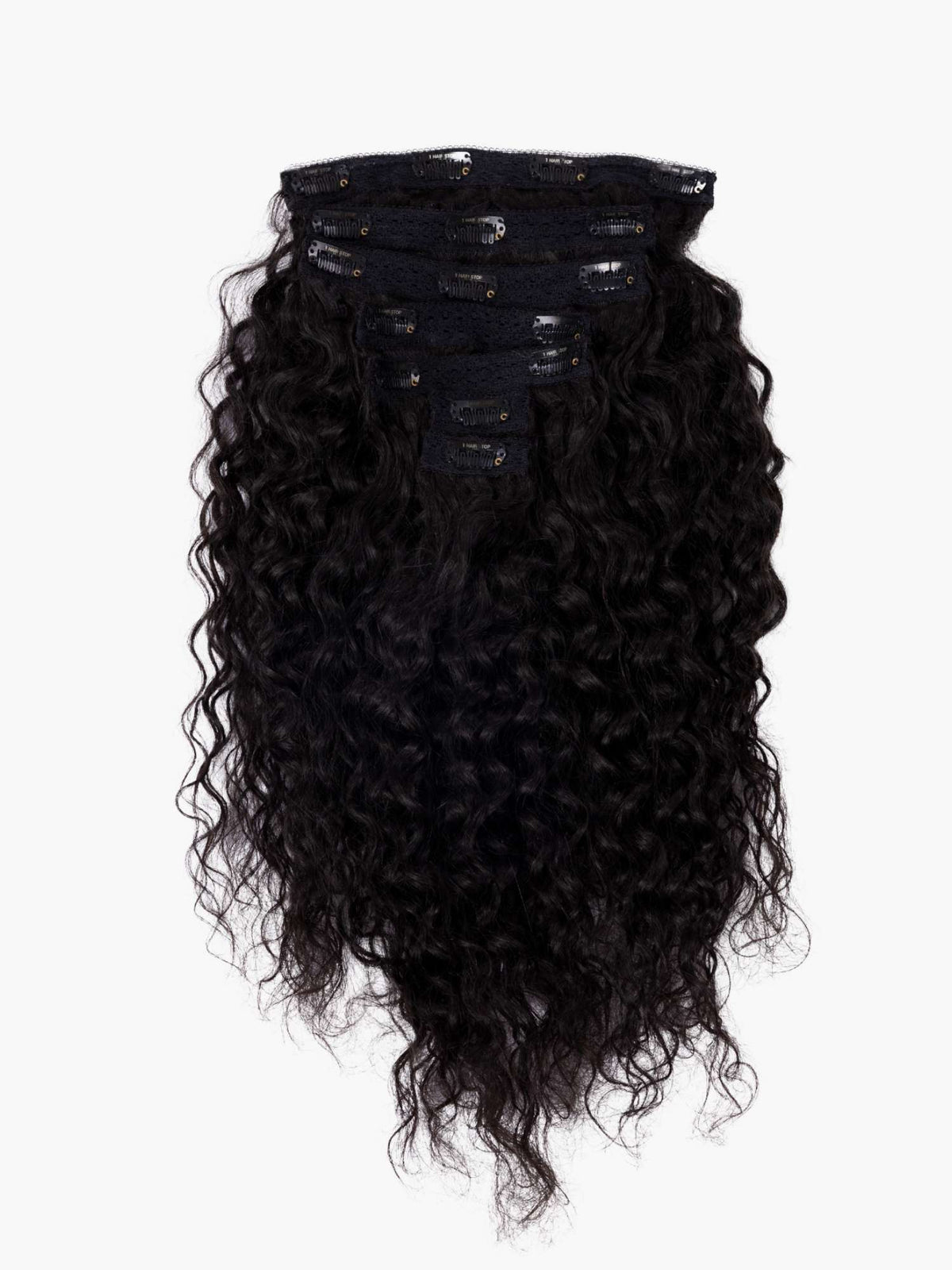
That piece is at the top of this article because of the one thing curly women are never offered. Almost every clip-in set on the market is straight or wavy, and a wavy set under curly hair separates the moment it dries. The Classic 7 Set Clip-in Extensions in Curly is made in a curl pattern rather than straightened and sold as versatile.
- Why the Photograph You Saved Will Not Work
- Shrinkage, as an Actual Number
- The Cooperation Scale
- Triangle Head, and Why It Happens
- Why One Side Is Always Flatter
- The Cuts, Described by What They Demand
- What to Ask For, and How to Find Someone Who Can Do It
- Adding Hair to Curly Hair
- How 1 Hair Stop Makes This Easier
- Shop Pieces Made in a Real Curl Pattern
- Frequently Asked Questions
Why the Photograph You Saved Will Not Work
This is the most important thing in the article and it takes one paragraph to explain.
A haircut is a shape. What you see in a photograph is that shape after somebody has spent thirty to sixty minutes imposing a second shape on top of it with heat and tension. On straight hair the two are close enough that the difference does not matter much. On curly hair they are completely different objects.
The commenter who explained this to the woman with the braids put it exactly right. Learn the name of the cut, she said, then search for that name with the word curly in front of it, because the version you are looking at required a blow dryer, brushing through and texturising products, and it will not translate the same way.
Somebody else in the same thread went further and said the harder thing. The inspiration photographs looked wavy to straight rather than curly, which meant the reader would have to spend real effort every single day getting her hair much straighter to look like them. And then the line that deserves to be in every article on this subject: we always want what we do not have, and you will naturally be attracted to styles that are not easy with your curls.
Two practical rules come out of that, and they cost nothing.
- Search the cut name with the word curly attached: Curly shag, curly wolf cut, curly bob, curly lob. You will see the shape as it actually behaves on your texture rather than as it behaves after a blow dry.
- Check whether your reference has your curl pattern: Not similar hair. The same pattern. A cut photographed on a loose wave tells you almost nothing about how it will sit on a tight curl, because the shrinkage is different by a factor of three.
Shrinkage, as an Actual Number
Shrinkage is the single most useful number in curly hair and almost nobody is given it.
Wet curly hair is stretched out by its own weight and by the water in it. As it dries, it coils and pulls up. A curl that hangs at the collarbone when wet can finish at the chin. Salons that work only with curly hair put the stretch at up to thirty per cent, which is why a stylist cutting your hair wet, to a length measured wet, is guessing.
| Your pattern | How it looks | Typical shrinkage | What that means at the chair |
|---|---|---|---|
| Wavy | An S shape that forms without a defined spiral | Roughly 10 to 20 per cent | Wet length is close to dry length. Cutting wet is survivable, though still not ideal |
| Loose to medium curl | Defined spirals, roughly the width of a marker pen or a finger | Roughly 20 to 35 per cent | Ten centimetres removed wet can read as fifteen dry. Ask for the cut to be assessed dry before you leave |
| Tight curl | Corkscrews roughly the width of a pencil or narrower | Roughly 35 to 50 per cent | Half your length can disappear as it dries. Cutting wet at this pattern is how most of the worst outcomes happen |
| Coily | Tight zigzags or very small coils, often with little visible spiral | The highest of any pattern | Length is effectively invisible until stretched. Shape and silhouette matter far more than measured length |
One honest caveat. The numbered curl typing system everybody uses is a descriptive convention rather than a measurement, and plenty of people have two or three different patterns on one head, usually tighter at the nape and looser at the crown. Use it as a rough sorter and not as an identity.
One image with a ruler in it would settle an argument that happens in salon chairs every day, and nobody in this category publishes it.
The Cooperation Scale
Here is the finding that reorganised this entire article, and it came from a woman who did not realise she had made it.
Asked what hairstyles she does, she wrote out her whole system. Then she read it back and added a line at the end: she had not realised it was such a science until she wrote it down, and she supposed there was a method to the madness.
Her system is not organised by occasion. It is not organised by curl type, or length, or face shape, which is how every article on this subject is organised. It is organised entirely by how the hair is behaving that morning. Cooperating, partially cooperating, semi cooperating, not cooperating at all. Each state has its own answer.
That is how curly hair is actually worn and no publisher has ever written it down. So here it is properly.
| How it is behaving | What that looks like | What to do |
|---|---|---|
| Fully cooperating | Curls are defined, both sides match, day one or two after washing | Wear it down. This is what the whole routine is for and it is a waste to put it up. A side parting adds volume for free |
| Partially cooperating | The length is fine but the pieces around your face are doing something strange | Pin the front. Twist the face-framing pieces back and clip them at the temple, leaving two or three loose so there is a transition. The back does not need touching |
| Semi cooperating | Volume is uneven, one side flatter, definition patchy | Half up. It takes the disputed section out of play and the bottom half is usually the part still behaving |
| Not cooperating at all | Frizzy, flat, day four, slept on badly | Up and away. A bun, a ponytail, or a braid. This is not defeat, it is the correct move, and it is what the fourth day exists for |
Read the row you are in rather than scrolling a list of fifty styles. That is the whole method.
One other woman in the same discussion gave the compressed version of it, at fourteen upvotes, and it is funnier and just as true. Wash it, let it air dry and hope for the best, or give up and put it in a messy bun.
She is describing rows one and four. The useful part of this article is rows two and three, because that is where most mornings actually land and where most women have no plan at all.
Triangle Head, and Why It Happens
Two commenters name it without being asked and a post elsewhere asks whether round haircuts are the only curly option. Four hundred and ninety three people upvoted that question.
The triangle is the shape you get when the hair is flat at the crown and widest at the ends, so the silhouette reads as a pyramid. It is the most common complaint about curly haircuts and it has a purely mechanical cause.
Curly hair takes up space sideways. When it is cut to one length, every strand on your head ends at the same place, so all of that sideways volume accumulates at the bottom. Meanwhile the hair at the crown is carrying the weight of everything below it, which pulls the curl pattern out and flattens it. Wide at the bottom, flat at the top. That is the triangle, and it is caused by the cut rather than by the hair.
The fix is layers, but specifically and not generally.
- Weight removed from inside, not from the perimeter: Curly hair needs bulk taken out of the interior of the shape while the outline stays intact. Thinning scissors and razoring at the ends do the opposite and cause frizz, because they cut across the curl rather than within it.
- Layers that start high enough to matter: Layers beginning around the cheekbone and releasing through the length let the crown spring up. Layers that start below the shoulder do nothing about a flat crown.
- Shorter underneath at the nape: Slightly shorter layers beneath the perimeter at the back lift the whole shape away from the head. It is a small structural decision and it is what stops a long curly cut hanging like a curtain.
One woman in these threads reported the result of getting this right in eight words. More layers equals more curls. That post has 2.3 thousand upvotes.
Why One Side Is Always Flatter
A small exchange, easy to miss, and worth a section because of the reply it got.
One woman mentions that she sometimes pins back a bit of the side with less hair, because for some reason that side always ends up super flat. Somebody replies immediately: she thought she was the only one who suffered this.
Nearly everybody with curly hair has an uneven side and almost nobody knows it is universal. Three things cause it and two are fixable in about a minute.
How you sleep: Most people favour one side, and eight hours of weight on one half of your head flattens the curl pattern there. This is the largest single cause and it is why the flat side is usually the same side every time.
Where your parting sits: A parting sends more hair to one side than the other, so the lighter side has less mass to build volume with. Moving the parting even a centimetre changes the balance.
Your actual head: Curl pattern genuinely varies across one head, and the two sides are rarely identical. This part is not fixable and it is also not a flaw.
The practical answers, in order of effort. Sleep with your hair up and off the pillow, in a loose pineapple at the crown or a silk covering. Switch your parting to the opposite side for a day and let the lift redistribute. And if one side is permanently lighter, stop trying to equalise it and use it: that is the side to pin, and an asymmetric style is a decision rather than a fault.
The Cuts, Described by What They Demand
Every list of curly haircuts describes how each one looks. Here is the same list described by what it costs you, because that is the thing that decides whether you still like it in month two.
| Cut | Daily work | Best for | Where it fails |
|---|---|---|---|
| Curly bob, chin to shoulder | Low. Wash and go is realistic | Nearly every pattern. Removing length removes the weight that flattens the crown | Cut wet without accounting for shrinkage. This is the cut where a wet measurement does the most damage |
| Long layers with a defined perimeter | Low to medium | Keeping length without the triangle. The default recommendation for a reason | Over-layering a looser wave, which leaves it flat rather than defined |
| Curly shag | Medium. The shape needs encouraging as it dries | Anybody who wants visible movement and is prepared to scrunch | Very dense hair, where heavy layering can read as unfinished rather than textured |
| Curly pixie | Lowest of anything here. Very little product, no heat | Tighter patterns, where curl supplies the shape by itself | Nothing much, except that it needs recutting every six to eight weeks to keep its outline |
| Tapered cut | Low | Coily patterns. Keeps fullness at the crown and sculpts the sides and nape | A stylist who has not assessed the nape, which is almost always tighter than the crown |
| Curly lob | Low to medium. A diffuser and a cream and it behaves | Waves that go flat when short and heavy when long | A straight-across perimeter, which will dry shorter at the sides than at the back |
That last cell is worth reading twice. Curls spring up more at the sides than at the back, so a perimeter cut level when wet finishes uneven when dry. A stylist who cuts curly hair regularly builds a slightly rounded perimeter to compensate. One who does not will hand you a cut that looks crooked and is not.
If you are considering a curly bob specifically, the shape at the back of your head matters more than your face shape does, and that is set out in bob haircuts for women.
What to Ask For, and How to Find Someone Who Can Do It
In the related posts around these threads there are requests for curly stylists in seven different cities. That is the real bottleneck, and it is worth saying out loud: the constraint in curly hair is not choosing the cut, it is finding somebody who can execute it.
Four things to say, in order.
-
Ask whether they cut curly hair dry: This is the single screening question and the answer tells you everything. Dry cutting means each curl is cut where it actually falls, with the shrinkage already happened. If the answer is that they always cut wet and comb it out first, book somebody else.
-
Say your shrinkage out loud: My hair loses roughly a third of its length as it dries. It reframes every length decision in the appointment and it takes four seconds.
-
Ask for weight removed from inside the shape: Not thinned at the ends and not razored. Interior weight removal keeps the outline and kills the triangle. Naming the technique tells them you know the difference.
- Do not leave until you have seen it dry: Every curly specialist says the same thing and almost no client insists on it. A curly cut that looks correct wet can be a completely different shape ninety minutes later, and by then you are at home.
On finding the person, the method that works is not searching for a salon. It is searching the cut name with your curl pattern and looking at whose work keeps appearing, then going to that stylist by name. Ask for photographs of their own clients with your pattern, dry. Anybody good will have them and will be pleased to be asked.
One more thing on bangs, because the salon sources are unanimous and it is the most reversible mistake in this article. Curly bangs spring up and sit shorter and fuller than the reference photograph. Ask for them cut conservatively long, because you can always take more off and you cannot put it back. If you want to see the shape before committing at all, the case for that is set out in hairstyles with bangs for women.
Adding Hair to Curly Hair
This is the part we know better than any salon, because it is what we make.
Matching a piece to curly hair is harder than matching one to any other texture, and the reason is that there are three things to match rather than one. Shade, which everybody thinks about. Curl pattern, which decides whether the piece reads as your hair. And how each behaves when wet, which is the one nobody considers and the one that gives the game away.
Three rules, and they hold for everything we make.
- Match the pattern before the shade: A slightly imperfect colour on a correct curl pattern disappears into curly hair, because curls break up colour by themselves. A perfect colour in the wrong pattern is visible from across a room. This is the opposite of the rule for straight hair.
- A wavy piece is not a curly piece: Most sets sold as suitable for curly hair are wavy, on the reasoning that the customer can curl them. You can, and it will hold for one wear. The piece will return to its own pattern and yours will not, and by the end of an evening they are two different textures.
- Curly hair hides attachment better than any other texture: The genuine advantage. Wefts, clips and bands vanish under curls in a way they never do under straight hair, because there is no smooth surface for an edge to show against. Curly hair is the easiest texture to wear pieces in, and almost nobody tells curly women that.
If the thinning is at the hairline or the crown rather than through the lengths, the decision is a different one, and it is covered properly in our guide to curly hair toppers.
How 1 Hair Stop Makes This Easier
We make hair, we do not cut it, and curly is the texture our customers have the hardest time buying for anywhere.
Trusted by 300,000+ women worldwide | 4.8★ from 14,700+ reviews | 100% Human Remy Hair | Sourced From Temples | Clip-Free | Handmade in our own facility since 2009 | Damage-free application guarantee
"The industry sells wavy hair to curly women and calls it versatile. It is not versatile, it is cheaper to make, because a real curl pattern has to be set and it takes longer. We make curly properly because the alternative is telling a woman to curl it herself every morning, which is exactly the thing she is trying to get away from."
Raina Grover and Richa Grover, Co-Founders, 1 Hair Stop
Every piece is hand-knotted or wefted in 100% human Remy hair in our own facility in Hyderabad. Our curly pieces are heat resistant and can be re-coloured, and because it is human hair a stylist can cut a piece into your shape rather than leaving it hanging as a separate length underneath.
Two honest limitations. Curl patterns are a range rather than a set of exact matches, so expect to get close rather than identical, and use the free consultation rather than guessing from a screen. And a curly piece needs the same care yours does: detangled gently, air dried, and never brushed dry.
Shop Pieces Made in a Real Curl Pattern
All of these are 100% human hair and all of them come out at the end of the day. Choose by where you want the hair, not by how much.
-
Length and density in a real curl: Add hair that matches your pattern rather than fighting it with the Classic 7 Set Clip-in Extensions in Curly, seven wefts on a flexible fabric-stitched band. It is made curly rather than straightened and sold as versatile, so it holds its pattern through a wash.
-
A curly ponytail that does not shrink: Get a full defined ponytail without losing half the length to shrinkage using Flat Clip-in Ponytail Extensions, available in a curly texture and secured on velcro and a hidden comb. The flat base keeps it close to the head instead of bulking at the gather.

-
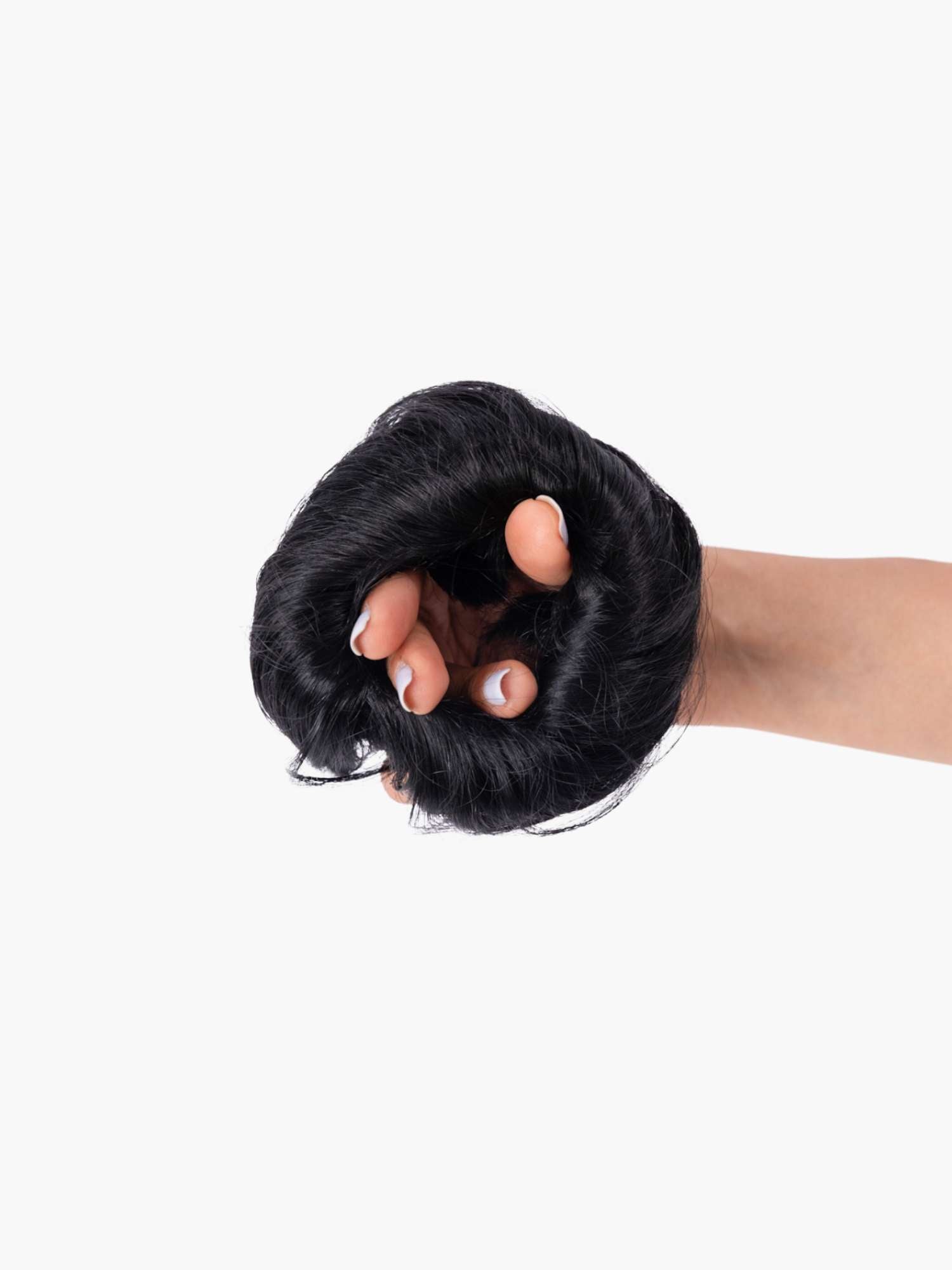
For the fourth day, done properly: Turn the emergency bun into a deliberate one with the Messy Bun Scrunchie, which goes over a loose gather in about two minutes. It is the fix for a bun that comes out small because the curl has taken all the length.
-
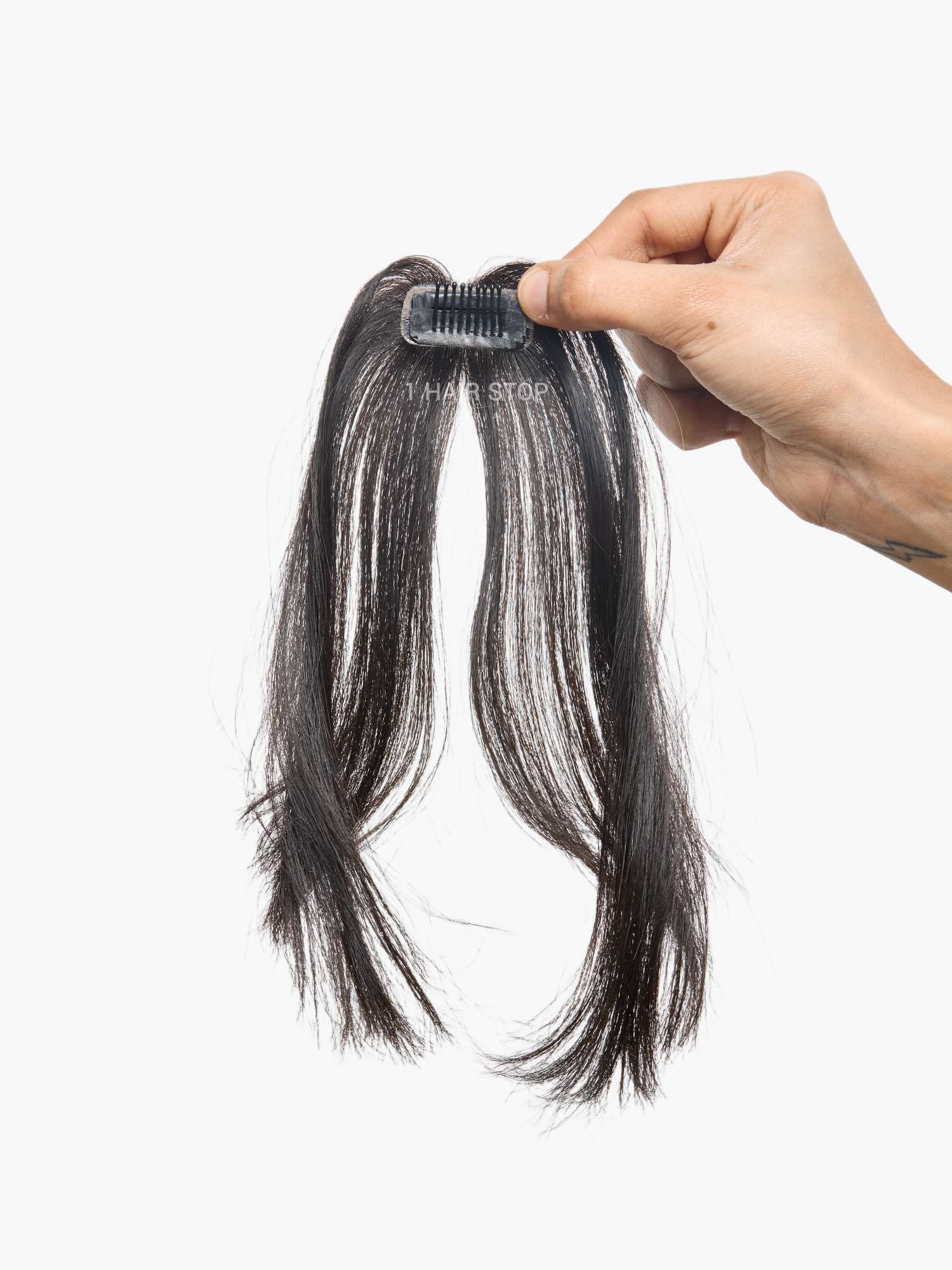
Curly bangs, without the irreversible cut: See how a fringe sits on your curl pattern before anybody trims it, using Clip-In Curtain Bangs, two soft pieces that clip in at the top of the head in seconds. Curly bangs spring shorter than expected, which makes this the one cut worth testing first.
-
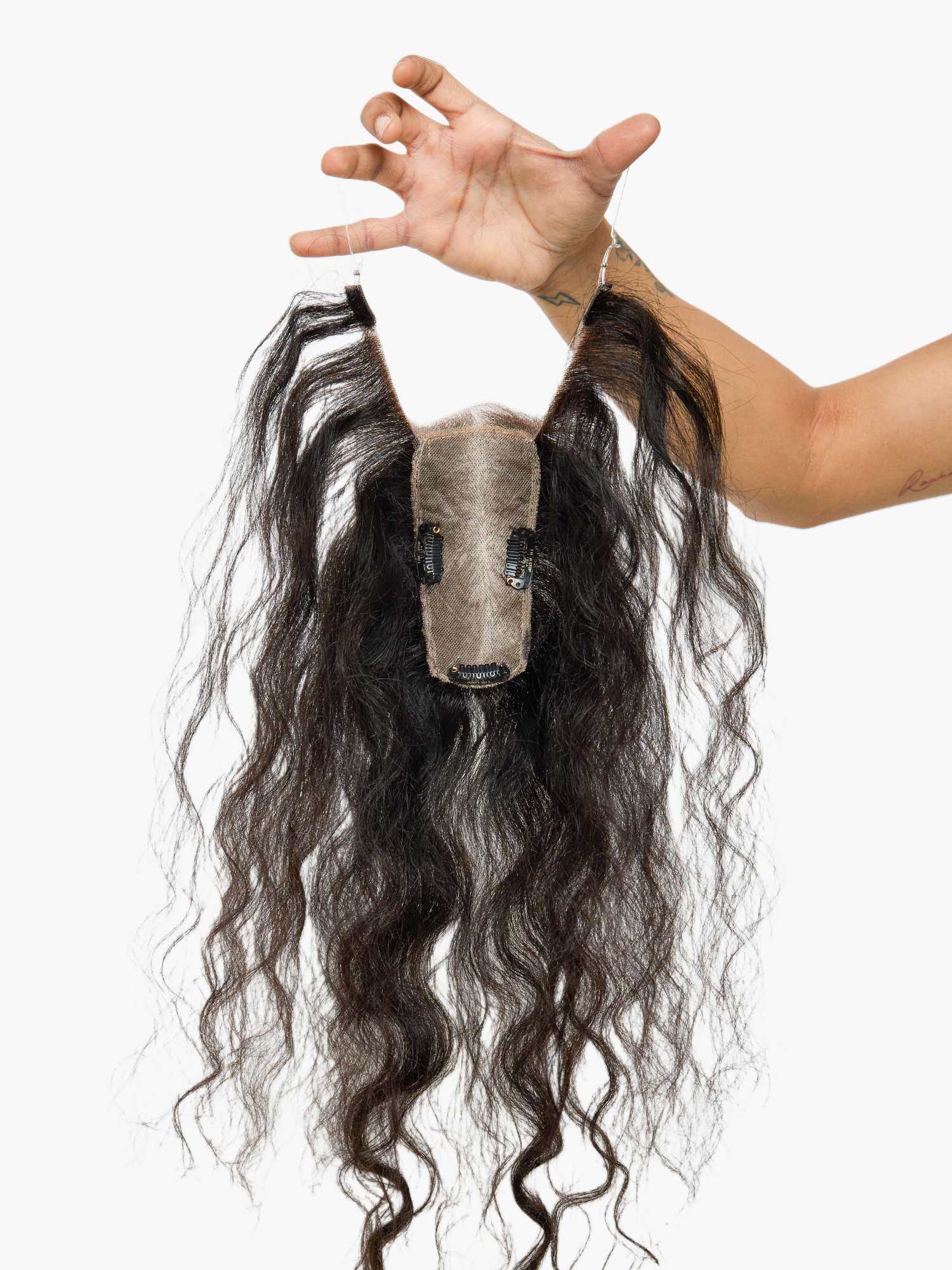
When it is the hairline or crown: Cover frontal and crown thinning in a matching texture with the Receding Hairline Hybrid Topper in Curly, built on a silk base with invisible lace and a seven-inch hairline band. It holds on to clips plus an adjustable band, so the weight is shared rather than hanging off the front.
-
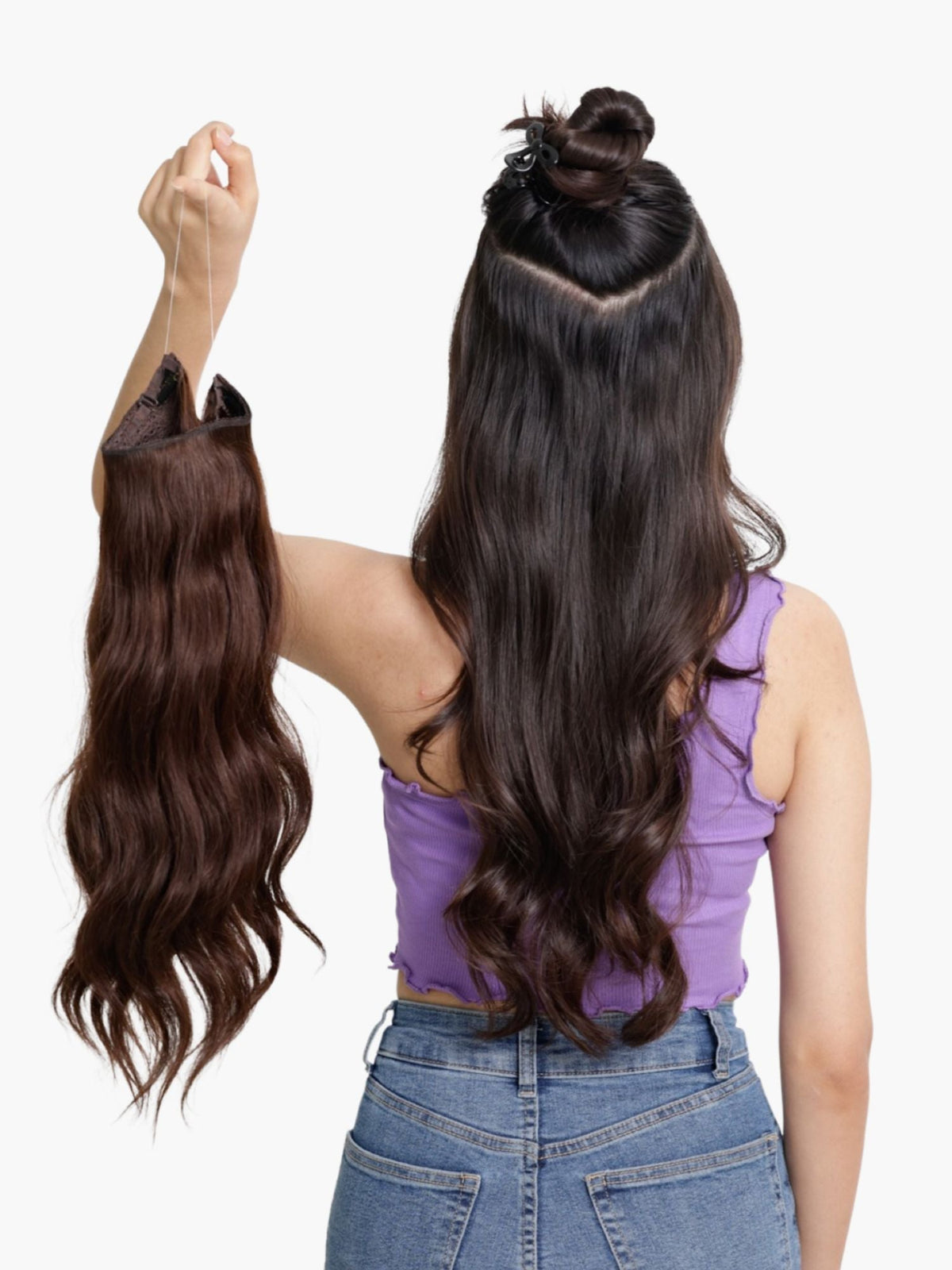
Filling the side that goes flat: Even out uneven volume with HaloHair Extensions, which sit on a fine adjustable wire about an inch behind the hairline with nothing clipped into your own hair. Curly hair hides the wire better than any other texture.
- Not sure which pattern you actually have? Read easy everyday hairstyles for women for the grip and gather checks, or book a free video call and we will look at your curls dry with you.
Frequently Asked Questions
Why does my curly hair never look like the photo?
Because the photograph is a styling routine, not a haircut. Most cuts you save were created with a blow dryer, brushing through and texturising products, and that second shape sits on top of the cut. On straight hair the difference is small. On curly hair they are different objects. Search the cut name with the word curly attached to see how the shape actually behaves on your texture, and check that your reference has your curl pattern rather than just similar hair.
Should curly hair be cut wet or dry?
Dry, and it is the single screening question worth asking a salon. Wet curly hair is stretched by water and its own weight, by up to about thirty per cent, so a length measured wet is not the length you leave with. Cutting dry means each curl is cut where it actually falls. If a salon tells you they always cut wet and comb it out first, that is a reason to book elsewhere.
How much does curly hair shrink when it dries?
Roughly ten to twenty per cent on waves, twenty to thirty five per cent on loose to medium curls, thirty five to fifty per cent on tight curls, and more than that on coils. It matters most at the tighter end, where half your apparent length can disappear as the hair dries. Say your own figure out loud at the start of the appointment, because it reframes every length decision made afterwards.
How do I stop my curly hair looking like a triangle?
Layers, but specific ones. The triangle happens because one length means every strand ends at the same place, so sideways volume piles up at the bottom while the crown is flattened by the weight beneath it. The fix is weight removed from inside the shape rather than thinned at the ends, layers starting around the cheekbone so the crown can spring up, and slightly shorter layers under the perimeter at the nape to lift the back.
Why is one side of my curly hair flatter than the other?
Almost everybody with curly hair has this and almost nobody realises it is universal. Three causes. Sleeping on one side flattens the curl pattern there, which is the biggest single factor and the reason it is the same side every time. A parting sends more hair to one side than the other. And curl pattern genuinely varies across one head. Sleep with your hair up off the pillow, try switching your parting for a day, and if one side is permanently lighter, use it as the side you pin.
Do I need a special curly haircut or will a regular one do?
What matters is the technique, not the name of the service. A stylist who cuts curly hair dry, removes weight from inside the shape rather than thinning the ends, and builds a slightly rounded perimeter to allow for curls springing up more at the sides than the back will give you a good result whatever the appointment is called. One who combs it flat, measures it wet and cuts straight across will not, however the service is branded.
Can you get hair extensions for curly hair?
Yes, and the rule is the opposite of the one for straight hair: match the curl pattern before the shade. Curls break up colour by themselves, so a slightly imperfect shade in the right pattern disappears, while a perfect shade in the wrong pattern is visible across a room. Be careful with sets sold as suitable for curly hair that are actually wavy, because they return to their own pattern after a wash. The upside is that curly hair hides wefts, clips and wires better than any other texture.


