


Most guides give you the same six steps. Brush, tie, push the comb in, wrap a strand around the base, pin it, style it. Follow them exactly and the piece can still slide, still show its seam by lunchtime, and still read as obviously not your hair from the side.
The steps are not where it goes wrong. What decides whether a ponytail extension looks real is the relationship between how much it weighs and how much of your own hair is holding it up. There is a version of this where the colour match is flawless, the curl matches perfectly, and it still looks wrong, because the piece is heavier than the head it is hanging from. Get the weight right and the technique is easy. Get it wrong and no amount of bobby pins will save it.
Short answer: Test your base before you buy anything, because the weight your own ponytail can carry decides everything else. Buy shorter than you are tempted to, since length is a weight decision. Build a firm base with a second tie an inch below the first, slide the comb in above the elastic, fasten the velcro snugly, then hide the join. If it slides or drags, the piece is too heavy for the hair holding it.
That is a wrap around ponytail extension in 100% human Remy hair, and it is the attachment that gives the most invisible finish when your own base is firm enough to hold it. If your hair is fine or your base is small, the flat clip-in ponytail is the safer starting point. Both are covered properly further down.
- Why Ponytail Extensions Look Fake
- Start With the Base, Not With the Piece
- Why Buying the Longest One Is the Mistake
- Which Attachment to Choose
- How to Put It On, Step by Step
- Hiding the Join
- If It Will Not Stay Up
- Five Ways to Wear It That Are Not a High Ponytail
- Keep the Tension Off Your Hairline
- How 1 Hair Stop Makes the Choice Easier
- Shop Ponytail Extensions
- Frequently Asked Questions
Why Ponytail Extensions Look Fake
There is one moment that gives a ponytail extension away, and it is not the colour and not the texture. It is the join opening up.
The whole weight of the piece hangs from a single anchor point at the base of your ponytail. Every time you turn your head, that weight pulls downward and slightly back. If the base is not firm enough, or the piece is heavier than the base can carry, the attachment creeps a few millimetres over the course of a morning. The wrapped strand loosens, the velcro or the comb becomes visible from underneath, and anyone standing slightly behind you can see two separate pieces of hair instead of one.
There is a second, subtler version of the same problem. A piece that is too heavy drags your own ponytail downward and changes the angle it sits at. Nothing is visibly wrong, no seam is showing, and yet it does not read as hair growing out of a head. It reads as something attached to one. Women who have hit this describe getting the colour and the curl exactly right and still not being happy, which is the clearest sign that the problem was never cosmetic.
So the real technique is not a better wrap. It is choosing a piece your own hair can carry, and building a base strong enough to hold it.
Start With the Base, Not With the Piece
Before you buy anything, do this test. Gather your hair into a ponytail exactly where you plan to wear it, high or mid or low, and secure it properly. Then take hold of the ponytail and pull gently downward, the way an extension would.
- The base holds firm and the ponytail stays put. You can wear most attachment types at that height, including a full wrap-around.
- The base shifts, or the elastic slides down. Either drop to a lower position, where gravity works with you instead of against you, or choose a lighter piece.
- You cannot make a ponytail that holds at all, because your hair is too short or too fine. A wrap-around will not work at that height. Read the section further down before you buy.
Three things make a base stronger. Wear it a touch higher than the finished look you want, because the added weight will pull it down. Use a strong elastic rather than a soft fabric one, and double it if the hair is slippery. And if your hair is fine or freshly washed, backcomb the base lightly so the comb has something with texture to grip, since clean silky hair gives it nothing to hold.
This test takes ten seconds and it is the most useful thing on this page. Nearly every complaint about ponytail extensions comes from someone who bought the length she wanted rather than the weight her base could carry, and no styling technique fixes that after the fact.
Why Buying the Longest One Is the Mistake
Length is the lever most people pull without realising it is a weight decision. A 24 inch piece is not just longer than a 16 inch one. It is heavier, and every extra inch adds load to the same single anchor point.
The pattern is consistent. Somebody orders the longest option because the photographs look dramatic, the piece arrives, the colour match is perfect, they style it to match their own hair exactly, and it still feels wrong. Too heavy. Constant pull on the roots. Uncomfortable within an hour. And a finished look that reads as slightly off without anything obviously being wrong.
Two rules save you from this.
Buy for your base, not for the photograph. If your own hair is fine, or your ponytail is small, size down on length. A shorter piece that sits secure and moves like your own hair beats a longer one that drags, every time.
Remember that a low ponytail wears longer than a high one. The same piece falls further down your back when it starts lower, so if you want length, dropping the height gets you some of it for free without adding any weight to a high anchor.
If you have already bought one that is too long, a stylist can cut it. It is 100% human hair, so it cuts like your own, and taking three or four inches off the bottom removes a surprising amount of weight.
Which Attachment to Choose
Attachment type is usually presented as personal preference. It is not. Each suits a different amount and thickness of hair, and picking against your hair type is the second most common reason these look wrong.
The short version. A clip-in grips your ponytail directly, goes on in under a minute and holds on a small base, which makes it the forgiving choice for fine or short hair. A wrap-around uses a comb and a velcro strap hidden under a wrapped strand, the most invisible finish available, but it needs a firmer base and a couple more minutes. A mini claw is fastest and bulkiest at the join. A braided piece hides its join better than any of them.
The full comparison, including how each one fails rather than just what it does, is in clip-in vs wrap-around ponytail extensions. Read that first if you have not bought yet. The rest of this page assumes you have chosen and want to fit it well.
Our full range sits in the ponytail extensions collection, all in 100% human hair so it can be heat styled and recoloured to match rather than approximated off a swatch card.
If you are between two of these, pick the lighter one. A piece slightly shorter than you imagined, sitting secure and flat all day, reads as real. A longer piece that creeps and exposes its own join does not, however good the hair itself is.
How to Put It On, Step by Step
This is written for a wrap around ponytail extension, which is the fiddliest of the five. Everything else is a simplified version of the same sequence.
- Brush both. Your own hair and the extension, separately, before anything else. A tangle underneath the join becomes a lump you cannot smooth out later.
- Build the base. Ponytail at your chosen height, slightly higher than the finished look, strong elastic, doubled if needed.
- Add a second tie. Tie a second elastic about an inch below the first. It lifts the ponytail, gives the comb a firmer platform, and noticeably reduces slipping over a long day. This one step fixes more problems than any product.
- Add grip if your hair is fine. A light backcomb at the root, or a little texture spray, gives the comb something to bite into.
- Slide the comb in. Directly above the elastic, teeth pointing down towards your scalp, pushed in until it sits flat rather than propped at an angle. An angled comb is what works itself loose during the day.
- Fasten the velcro. Wrap it firmly around the base, snug enough that the piece does not rotate when you turn your head. Test by turning fully to each side before you go further.
- Tuck the nape. Short hairs at the back of your neck poke out below the join and are visible from behind long before anything else gives you away. Sweep them upward into the base with a little product.
- Hide the join. Covered in the next section.
- Blend the top. Match your own hair and the extension with the same tool. If you curl one, curl the other. Two different finishes at the join is as obvious as a colour mismatch.
- Smooth the edges last. Gel or spray on a bristle brush, after everything is secure, so you are not fighting a set surface while you position the piece.
Hiding the Join
Take a thin section of hair from the underside of the ponytail, not the top, since hair from underneath reads as the shade your own hair looks in shadow. Wrap it fully around the base with the turns stacked tightly rather than spiralling, covering the velcro and the elastic completely. Then pin the end underneath, pointing upward into the wrap, with a U-shaped pin rather than a flat one.
That is the technique, and it is only part of the answer. The wrap is one of six things that expose a join, and it is rarely the one that fails first. Colour matched to your lengths rather than your roots, a piece rotating on freshly washed hair, and placement above the widest point of your head all give it away before a good wrap ever comes loose.
Directly behind at eye level is the angle worth judging it by, and the one nobody checks. A hand mirror takes five seconds and catches the problem while you can still fix it, rather than at the end of the day when someone mentions it.
The full method, including the root-shade rule that fixes most stubborn joins, is in how to hide the join on a ponytail extension.
If It Will Not Stay Up
This is the situation almost no guide addresses, and it is common. Shoulder-length hair, fine hair, or hair that simply will not hold a high ponytail under weight. You are not doing it wrong. The base is too small for what you are asking it to carry.
Three things actually work.
Split the weight. Instead of one heavy wrap-around, use two or three clip-in ponytail pieces and position them separately in the ponytail. Each piece is lighter, the load spreads across several grip points instead of one, and you can move each one to where it sits comfortably. This is the single most effective fix for fine hair and hardly anyone recommends it.
Drop the height. A mid or low ponytail asks far less of your base than a high one, because the weight hangs closer to the head rather than levering away from it. A low ponytail that stays flawless all day beats a high one you are adjusting every twenty minutes.
Switch to a bun. If a ponytail base will not hold at all, a bun will. The wider base spreads tension across a much larger area, and the shape hides the attachment far more easily, because there is no single exposed join at the back. You also need less added hair for the same visual volume.
For genuinely fine hair, the flat clip-in ponytail is usually the better starting point than a wrap around. It sits closer to the head, adds far less bulk at the join, and comes in shorter lengths that do not overload a small base.
Five Ways to Wear It That Are Not a High Ponytail
A common complaint from people who own one is that it only ever gets worn one way, and that way is a very high, very long, very obvious ponytail. It does not have to be your only option, and the alternatives are usually more comfortable because they load the base less.
- Low ponytail at the nape. The easiest and the kindest to your hairline. Same piece, less tension, and it reads as everyday rather than event.
- Half-up. Attach to a half-up section rather than a full ponytail. Your own hair falls loose around it, which hides the join beautifully and needs almost no blending.
- Wrapped bun. Fit the ponytail as normal, then coil and pin it. You get a full bun with none of the pinning gymnastics thin hair usually needs.
- Braided down. Braid your own hair and the piece together as one. A braid disguises a join better than any other style because the crossing sections break up the line.
- Low and to one side. Swept over one shoulder, which puts the join out of view from directly behind and softens the whole look.
Two of these, the half-up and the braid, are worth trying first if you are nervous about anyone noticing. Both hide the attachment structurally rather than relying on the wrap alone.
Keep the Tension Off Your Hairline
Worth saying plainly, because nobody selling these says it. A heavy piece, anchored high, worn tight, every single day, puts sustained pull on the hair at your temples and front hairline. That is the hair least able to take it.
None of this means avoid ponytail extensions. It means wear them the way you would wear anything with weight in it. Vary the height rather than parking it in the same spot daily. Loosen the base slightly if you can feel tension at your temples, because you should not be able to. Take it off in the evening rather than sleeping in it, which also stops the piece matting overnight. And if you are wearing one most days, choose the lightest attachment that gives you the look rather than the heaviest you can get away with.
If you have already noticed thinning or movement at your front hairline, covering a receding hairline without surgery covers the options, including the clip-free pieces built for exactly that area.
How 1 Hair Stop Makes the Choice Easier
We make what we sell. Every ponytail piece is hand-knotted in our own facility in Hyderabad in 100% human Remy hair, ethically temple-sourced in South India and never acid-stripped, which is why it can be heat styled and recoloured to match your own hair rather than approximated from a swatch.
Trusted by 300,000+ women worldwide | 4.8★ from 14,700+ reviews | 100% Human Remy Hair | Sourced From Temples | Clip-Free | Handmade in our own facility since 2009 | Damage-free application guarantee
"People come to us asking for the longest ponytail we make, and the honest answer is usually that they will be happier with a shorter one. A piece that stays exactly where you put it from morning to night is what reads as real hair. One that creeps, however long and however beautiful, announces itself every time you turn your head."
Raina Grover and Richa Grover, Co-Founders, 1 Hair Stop
Because we manufacture rather than resell, we carry every attachment type in the same hair, so you can move between wrap around, flat clip-in, claw and braided without the colour or texture shifting on you. That matters more on a ponytail than almost anywhere else, since the join sits at the back of your head where you cannot see it and everyone else can.
Shop Ponytail Extensions
Pick by what your own base can hold, not by the length you want. Everything below is 100% human Remy hair.
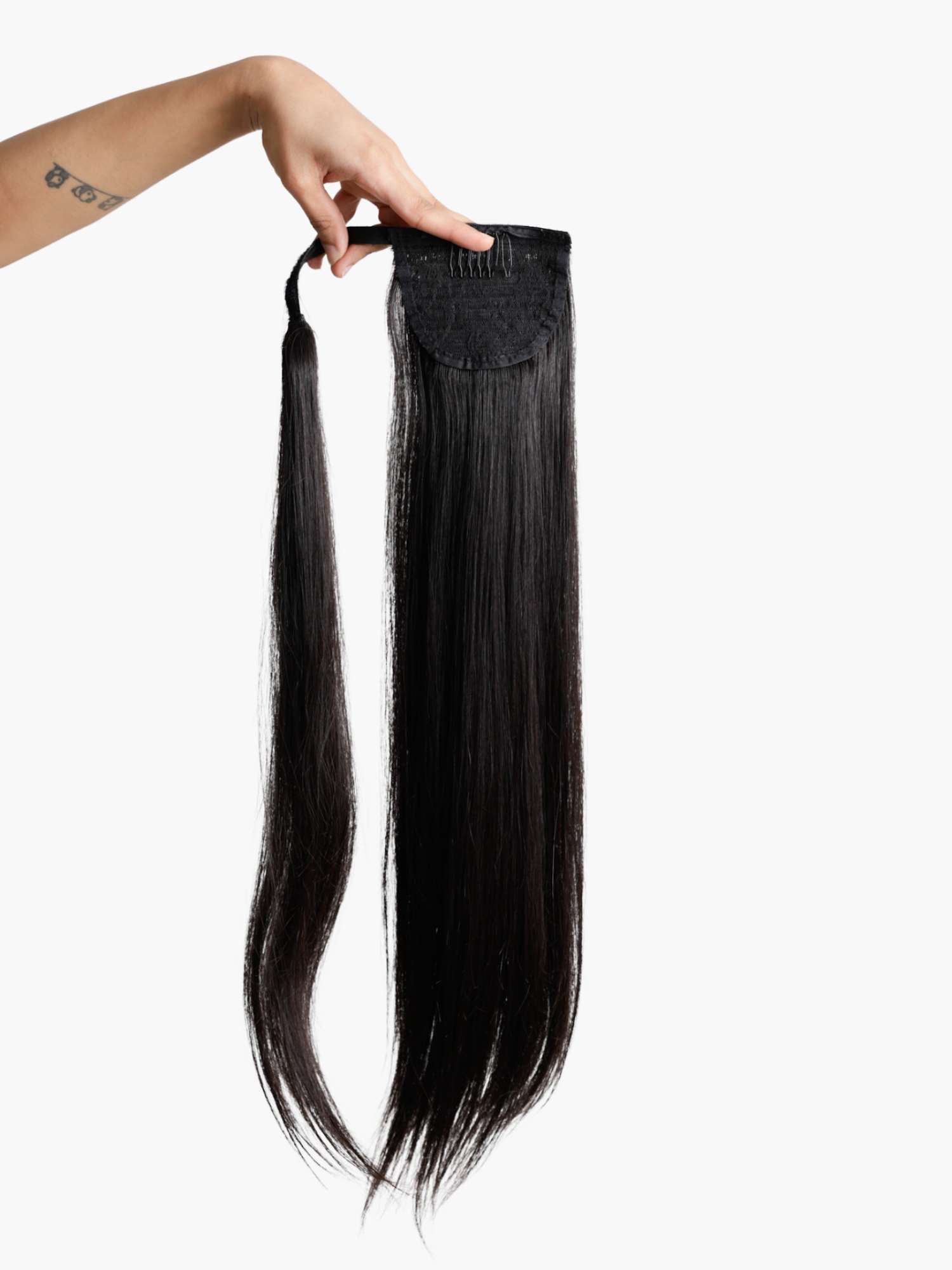
- Firm base, most invisible finish: Get the most invisible finish with the Wrap Around Ponytail Extensions, which wrap around your own ponytail and hold with a comb and a velcro fastening rather than clips. Best when your own base is firm enough to keep the piece steady all day.
-
Fine hair or a small base: Add length without bulk using the Flat Clip-In Ponytail Extensions, whose base lies flat against the head so it stays hidden on fine hair. Available in four lengths from 8 to 18 inches, so you can pick the drop you actually want.

-
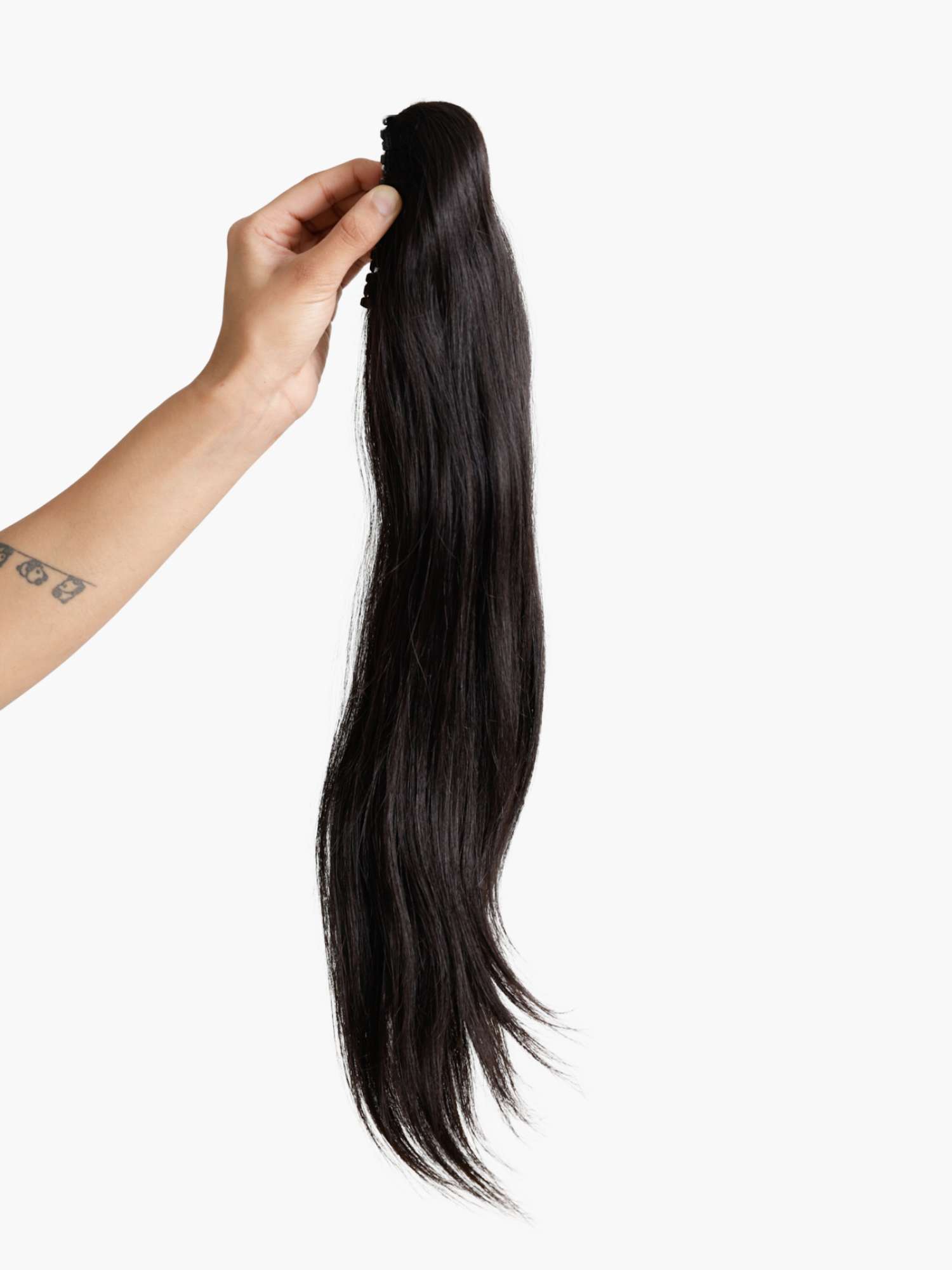
Fastest everyday option: Go from a gathered ponytail to a finished one in a single movement with the Clip-In Ponytail Extensions, the quickest attachment in the range. The sensible pick if it is going on and coming off every day.
-
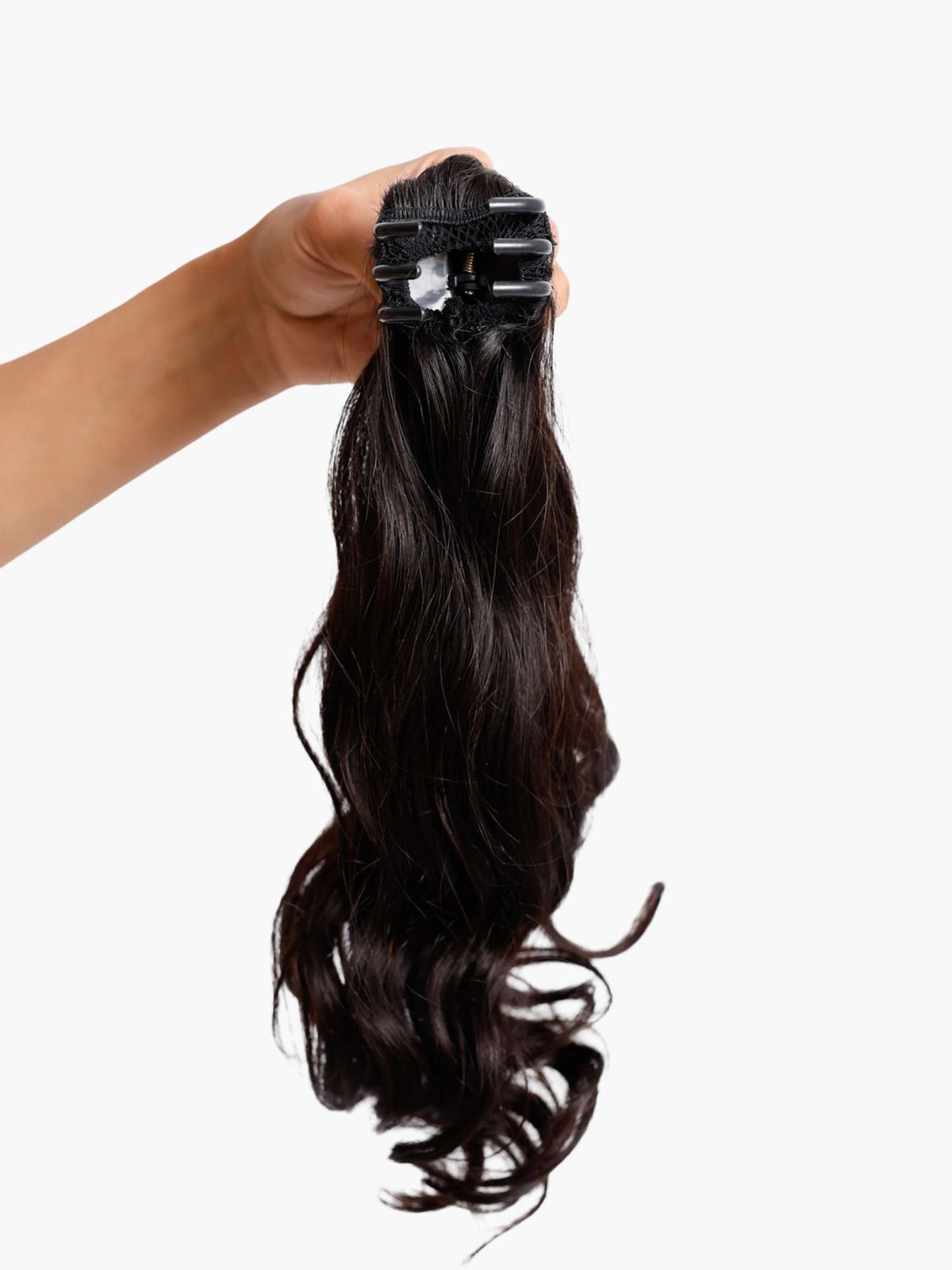
Short hair or very little to gather: Add a ponytail to short hair with the Mini Clip-In Ponytail Extensions, the smallest and lightest piece we make. Less weight at the base means less strain on hair that is already fragile.
-
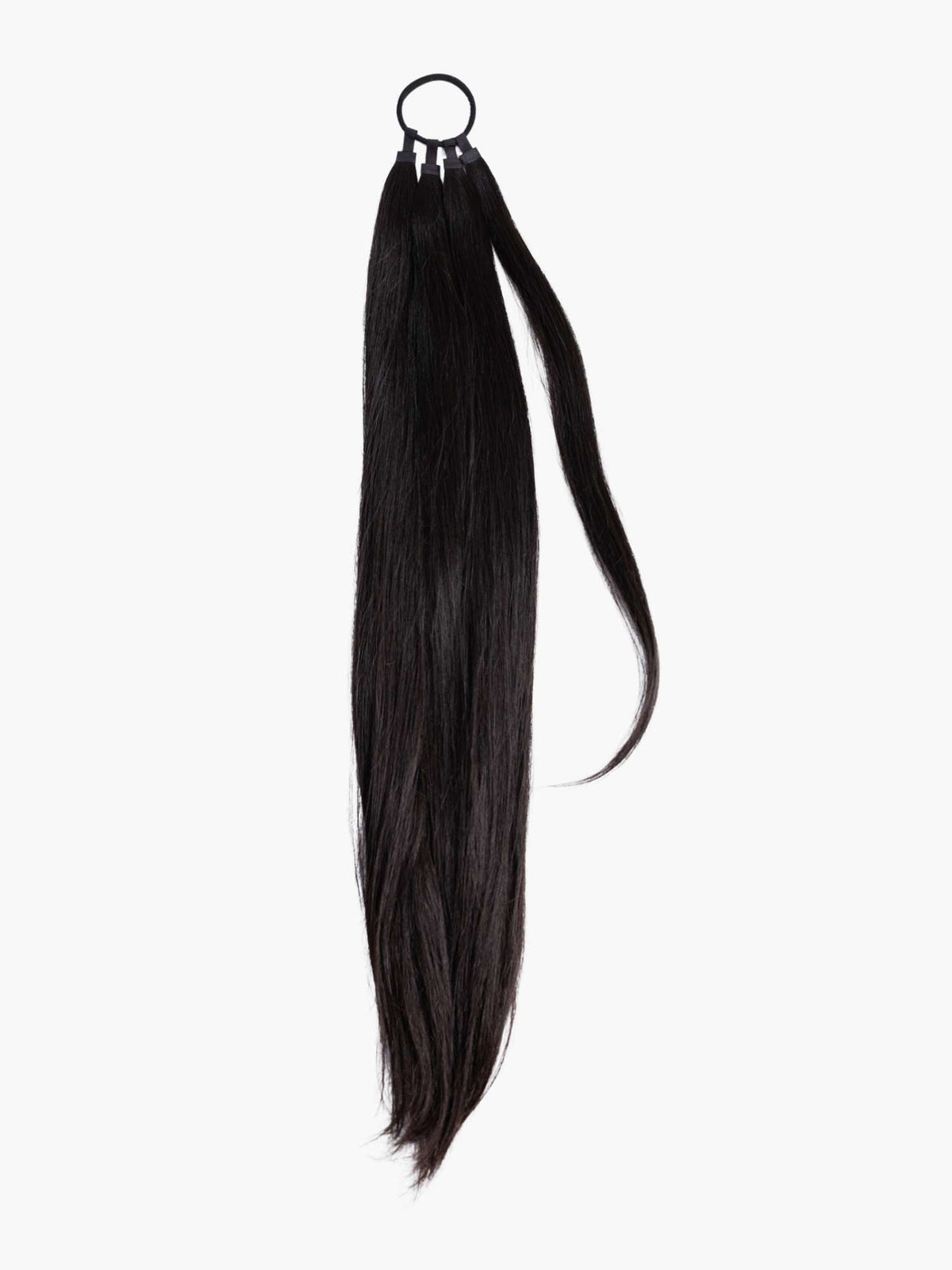
A join that will not hide: Hide a stubborn join with the Braided Ponytail Extensions, where the braid sits over the attachment instead of beside it. The piece covers its own join, which is what makes it work when wrapping never quite does.
- Not sure which attachment you need? Read clip-in vs wrap-around, or book a free video call.
Frequently Asked Questions
Why does my ponytail extension keep slipping down?
Almost always because the piece is heavier than the base holding it, or the base was not tight enough to begin with. Fix the base first: strong elastic, doubled if your hair is slippery, a second tie an inch below the first, tied slightly higher than the finished look, with a light backcomb at the root if your hair is fine. If it still creeps, the piece is too heavy for your hair. Go shorter, or split the length across two clip-in pieces.
Can anyone tell I am wearing a ponytail extension?
Only if you let the join show, and the honest answer is that this happens more often than brands admit. What gives it away is the attachment creeping loose during the day, short hairs at the nape poking out below the base, or a piece heavy enough to drag your own ponytail out of its natural angle. Fix those three and it is genuinely difficult to spot. Check from directly behind in a hand mirror, because that is the angle nobody checks.
What length ponytail extension should I buy?
Shorter than you are tempted to. Length is a weight decision, and every extra inch loads the same single anchor point. If your hair is fine or your ponytail is small, size down. Remember that the same piece falls further when worn in a low ponytail than a high one, so dropping the height gets you length without adding weight. A piece bought too long can be cut by a stylist, since it is human hair.
Can I wear a ponytail extension with short or shoulder-length hair?
Sometimes, but not usually at a high position, because the base is too small to anchor the weight. A low ponytail works better, a shorter and lighter piece works better than a long one, and a bun is often the more reliable answer because the wider base spreads the weight and hides the attachment far more easily.
Which ponytail extension is best for fine hair?
A flat clip-in, or two or three smaller clip-in pieces rather than one wrap around. Both sit closer to the head, add less bulk at the join and spread the weight across more grip points. A mini claw can also work, but cover the claw deliberately, because on fine hair it can show through the hair above it.
Will wearing a ponytail extension damage my hair?
Worn occasionally and fitted properly, it should not. The thing to avoid is a heavy piece anchored high and worn tight every day, since that puts sustained pull on the fine hair at your temples and front hairline. Vary the height, keep the base snug rather than painfully tight, take it off before bed, and choose the lightest attachment that gives you the look you want.


