


Somewhere on the back of your head there is a line. Not a parting, a line. Hold your hair up in front of a mirror with the light behind you and you may see a band of short broken hairs standing straight up, all finishing at roughly the same height, in exactly the spot where your hair tie sits.
It is one of the most common things women with long hair find and one of the least understood. Most advice about it is a variation of wear it looser, which is useless if you tie your hair up because it needs to be out of the way. The useful version of this answer is not about tightness at all. It is about repetition, and about the fact that a ponytail damages two completely different places on your head for two completely different reasons.
Short answer: Move the tie. Not looser, elsewhere. Hair breaks where a tie sits in the same position day after day, and it thins at the temples where the same section is pulled in the same direction day after day. Changing the height and the parting daily does more for both than any single product will. Then use a soft fabric tie with no metal, never tie wet hair, and take it down before bed.
Most ponytail tension is not about security, it is about fullness, and a light piece worn low removes the reason to pull. That is a mini clip-in ponytail, deliberately the smallest one we make. If the thinning is already at your front hairline rather than at the tie, a ponytail piece is the wrong product and the clip-free Hairline Series is the right one.
- Two Kinds of Damage, in Two Places
- Why the Same Spot Is the Real Culprit
- The Split-Section Method, Assessed Honestly
- A Rotation That Actually Works
- What to Tie It With
- The Gym Problem Nobody Writes About
- The Flyaway Cycle, and How to Break It
- The Third Damage Site Is Night
- Where a Ponytail Extension Helps, and Where It Does Not
- How 1 Hair Stop Makes This Easier
- Shop the Lighter Options
- Frequently Asked Questions
Two Kinds of Damage, in Two Places
Almost every guide on this subject treats ponytail damage as one problem. It is two, they happen in different places, and the fixes are not the same. If you only ever solve one of them you will keep wondering why the other has not improved.
| Breakage at the tie | Thinning at the hairline | |
|---|---|---|
| Where you see it | A band of short broken hairs at the height the tie sits | Temples, the front of the parting, the nape |
| What it looks like | Short hairs the same length, standing up, mid-shaft | Sparse edges, fine baby hairs, a widening gap at the front |
| What causes it | Friction and compression at one fixed point on the strand | Sustained pull on the strand where it leaves the scalp |
| What fixes it | Changing the height of the tie and what the tie is made of | Changing the direction of the pull and how firmly you secure it |
| Grows back? | The broken hair does not repair, but new growth is unaffected | Usually yes if you stop early, which is why early matters |
Breakage is a hair problem. Thinning at the hairline is a scalp problem. Silk scrunchies solve the first one and do almost nothing for the second, which is why so many women switch to silk, feel virtuous, and still watch their edges disappear.
Why the Same Spot Is the Real Culprit
Here is the part the tightness advice misses. A hair tie does not damage hair the way a blade does, in one go. It damages hair the way a folded piece of paper wears out, by being creased in the same place repeatedly until the fibre gives.
Most of us have a default. The same height, the same firmness, the same twist of the wrist, five or six days a week for years. That means one narrow band of every long strand takes all the compression, and one narrow section of scalp takes all the pull, while the rest of your head takes none. The load is not high. It is just relentlessly, exactly repeated.
This is why a woman who ties her hair loosely but always at the crown can end up with a clearer breakage line than a woman who ties it firmly but differently every day. Position beats tension more often than people expect.
It also explains something that confuses people. The breakage line does not appear gradually across your whole head. It appears suddenly, all at one height, because every strand was being worn down at the same point at the same rate and they reached the end together.
This is the photograph almost nobody in this category publishes, and it is the one that makes the whole article make sense in two seconds. Most women do not know to look for it, and cannot picture what they are meant to be looking for from a written description alone.
The Split-Section Method, Assessed Honestly
The technique doing the rounds at the moment is the split-section ponytail, and it does work, though not quite for the reason it is usually sold. Here it is properly:
- Part your hair horizontally from ear to ear, so you have a front section and a back section.
- Clip the front section forward and out of the way.
- Gather the back section and secure it where you want the ponytail to sit, using the height you want.
- Release the front section. Sweep it back over the top and join it to the ponytail without dragging it. Let it lie, do not pull it.
- Secure the two together with a second soft tie, sitting slightly below the first.
What this does is take the front section, the part that grows from your hairline and temples, out of the tightening step entirely. When you gather all your hair at once and pull, the front travels the furthest and takes the most tension, which is precisely why the hairline is where the thinning shows. Doing the back first means the front is only laid into place rather than yanked into it.
What it does not do is remove tension. There is still a tie, still in a spot, still doing the same thing to the mid-shaft. So the split-section trick is a fix for problem two in the table above, not problem one. Use it, and still move the tie.
It is also worth knowing that it gives a smoother top surface than a single gather, because the front is combed back over rather than pulled up through. If you have been avoiding high ponytails because of lumps at the crown, this solves that as a side effect.
A Rotation That Actually Works
The single highest-value habit here costs nothing, and almost nobody does it consistently because it requires thinking about your hair on a day you would rather not.
Rotate three things, not one. Most people who try this only change the height.
Height. Crown, mid, nape. Three positions, and each one puts the compression band in a different place on the strand and the pull on a different part of the scalp.
Parting. Move it a centimetre either side. A fixed parting concentrates the pull at one point of the front hairline for years, and it is the reason thinning so often shows on one side first.
Shape. A ponytail, a low braid, a loose twist, a claw clip. A braid spreads the load along the length instead of concentrating it at a single point, which is why the runners and the long-hair crowd end up there.
A workable week is something like a low ponytail, a braid, a mid ponytail, a claw clip, a high ponytail if you want one, and at least one day where it is simply down or in something loose. Not a rule, a pattern. The point is that no single position gets used two days running.
What to Tie It With
This part is genuinely simple and gets over-complicated by people selling ties.
Avoid anything with a metal join. That crimp is a hard edge pressing into a bundle of hair under tension, and it is the single most avoidable cause of a clean snap.
Avoid thin elastic bands. A narrow band concentrates all the pressure into a narrow line, which is exactly the pattern you are trying to break. Wider is better because it spreads the same force.
Fabric over rubber. A silk or satin scrunchie glides against the cuticle instead of gripping it, so hair moves against it rather than being held and dragged. This is the change that helps breakage most.
Spiral coil ties are the compromise. They hold more firmly than a scrunchie and do not sit in one narrow line, which is what makes them the usual answer for anyone who needs security and cannot get it from fabric.
Take it out gently. A surprising share of ponytail damage happens in the four seconds it comes down. Do not drag an elastic over the length. Unwind it, or cut a hopeless one out rather than pulling it through.
Never tie wet hair. Wet hair stretches, and hair held stretched while it dries stays deformed and snaps far more easily. If you have to tie damp hair, tie it loose and low and take it down as soon as it is dry.
The Gym Problem Nobody Writes About
Every article on this subject ends up recommending loose and low, and every woman who trains knows why that answer fails. Loose does not survive a run. Low, in a bun or a claw, becomes a lump you cannot lie on the moment you get onto a bench or a mat. So the advice gets ignored and the tight high ponytail continues, five days a week, in the same spot, with sweat in it.
What women who train have actually landed on is worth more than the generic advice:
- Braids, not ties, for anything with impact. Runners consistently end up here. One thick braid or two, secured only at the end, so the load is spread down the length and there is nothing pressing at the crown. A claw clip bounces out.
- A high braided ponytail rather than a high ponytail. You keep the height and the out-of-the-way, and the length is contained instead of whipping, which is where a lot of gym breakage comes from.
- A low profile flat claw clip for floor work. The standard objection to a claw is that you cannot put your head back. A flat one designed to lie down solves that, and personal trainers tend to be the ones who have found this.
- Two low buns or two low braids. Splits the weight either side of the centre, so nothing sits behind your head at all.
- A little oil through the lengths beforehand. Not on the scalp. It reduces friction between strands and gives sweat something to sit on rather than soaking straight into the hair.
The last one to say plainly, because someone has already said it better than we could: several months of a tight high bun with a cloth headband over it is enough to take out a hairline permanently. Cloth headbands sit exactly on the most fragile hair on your head and grip it while you move. If you are wearing one every session, that is the first thing to change.
The Flyaway Cycle, and How to Break It
There is a loop here that catches almost everyone, and naming it is half the fix.
Breakage at the hairline and the nape produces a halo of short hairs. The short hairs will not lie flat. To control them, you pull the ponytail tighter and smoother. Pulling tighter causes more breakage, which produces more short hairs, which makes you pull tighter still. One woman described it exactly: if it were not for the wispies and baby hairs turning into a floof, she would not care whether it was tight, and she suspects the floof is the breakage in the first place.
The way out is to stop trying to win the smoothness fight with tension.
- Lay the flyaways down instead of pulling them in. A little cream, gel or a soft brush along the hairline does what an extra centimetre of tension does, without the cost.
- Accept a slightly softer finish on most days and keep the very smooth version for occasions.
- Use the split-section method, because the front section is where the wispies live and it is the section that method stops dragging.
- Remember that new short hairs at the front are not always damage. Regrowth looks identical. If they are getting longer over months, that is the good version.
Two photographs settle this argument better than a paragraph does, because the reason women pull tight is that they believe the softer version looks unfinished. Showing that it does not is the actual persuasion.
The Third Damage Site Is Night
Eight hours of friction against a pillow, with your own body weight on it, is a longer and heavier load than your commute. Sleeping in a ponytail adds a fixed compression point to that.
Take it down. If your hair must be contained overnight, a loose plait secured at the end, or a very loose twist, keeps it under control without a tie sitting anywhere under pressure. A silk or satin pillowcase is a real improvement rather than a marketing one, because a cotton weave grips the cuticle and drags at it every time you move.
And if you get out of the shower at night, dry it before it goes anywhere near a tie. Damp hair plus a tie plus a pillow is the worst combination on this page.
Where a Ponytail Extension Helps, and Where It Does Not
We sell ponytail extensions, so here is the honest boundary rather than the convenient one.
An extension does not protect your hairline. It attaches to your own ponytail, at the same place, and it adds weight. If you already have breakage at the tie and thinning at the temples, clipping something heavy on to the same spot makes both worse, not better. Anyone telling you otherwise is selling.
What it genuinely changes is the reason you were pulling tight in the first place. A great deal of ponytail tension is not about security, it is about fullness. Thin ends make a ponytail look sparse, so you gather harder and higher to fake density, then redo it three times a day when it slips. A piece removes that motive. You can tie lower, softer, and once.
If you are going to use one on hair that is already fragile, the rules are narrow:
- Go lighter and shorter than you think. A mini clip-in ponytail or a flat clip-in ponytail puts far less load on the base than a long, dense piece.
- Wear it lower rather than at the crown, because a high position hangs the whole weight off the most stressed part of your scalp.
- Take it off the moment you are home. It is not a thing to keep in for fourteen hours.
- Rotate it the same way you rotate everything else. A piece worn in exactly one spot every day is subject to everything in this article.
- If you want the volume without a hanging length at all, a messy bun scrunchie or a braid hairband gives you the look with almost no pull.
If the thinning is already at the front hairline rather than at the tie, an extension is the wrong product entirely. That is what the clip-free hairline series exists for, because clips are the one thing you cannot put on a hairline that is already under strain. Our clip-free hairline band sits on the front without gripping the hair it covers. If you are not sure whether what you are seeing at the front is breakage or something else, how to tell if your hairline is receding walks through what to look at.
Most ponytail extension photography shows a high, hard, glossy ponytail, which is exactly the wear pattern this article is arguing against. A low and soft one is both the safer version and, for daily wear, the more wearable one.
How 1 Hair Stop Makes This Easier
We have spent seventeen years fitting hair on women whose own hair is under strain, and the pattern is consistent. Nobody arrives having decided to damage their hairline. They arrive having done the same thing every morning because it was the only version that looked finished.
Trusted by 300,000+ women worldwide | 4.8★ from 14,700+ reviews | 100% Human Remy Hair | Sourced From Temples | Clip-Free | Handmade in our own facility since 2009 | Damage-free application guarantee
"The women who come to us about their hairline are almost never careless with their hair. They are usually the ones who care most, and who have been holding it tightly and neatly every day for years. We would rather sell somebody a smaller, lighter piece they can wear low and safely for a decade than a heavy one that looks impressive for a season."
Raina Grover and Richa Grover, Co-Founders, 1 Hair Stop
Every piece we make is hand-knotted or wefted in our own facility in Hyderabad in 100% human Remy hair, and our clip-free range exists specifically for hair that cannot take a clip. If you are not sure which of your two problems you actually have, book a free video call and we will look at your hairline and your tie line in daylight with you before recommending anything.
Shop the Lighter Options
If you are already seeing damage, weight and position matter more than length. These are the lightest pieces we make.
-
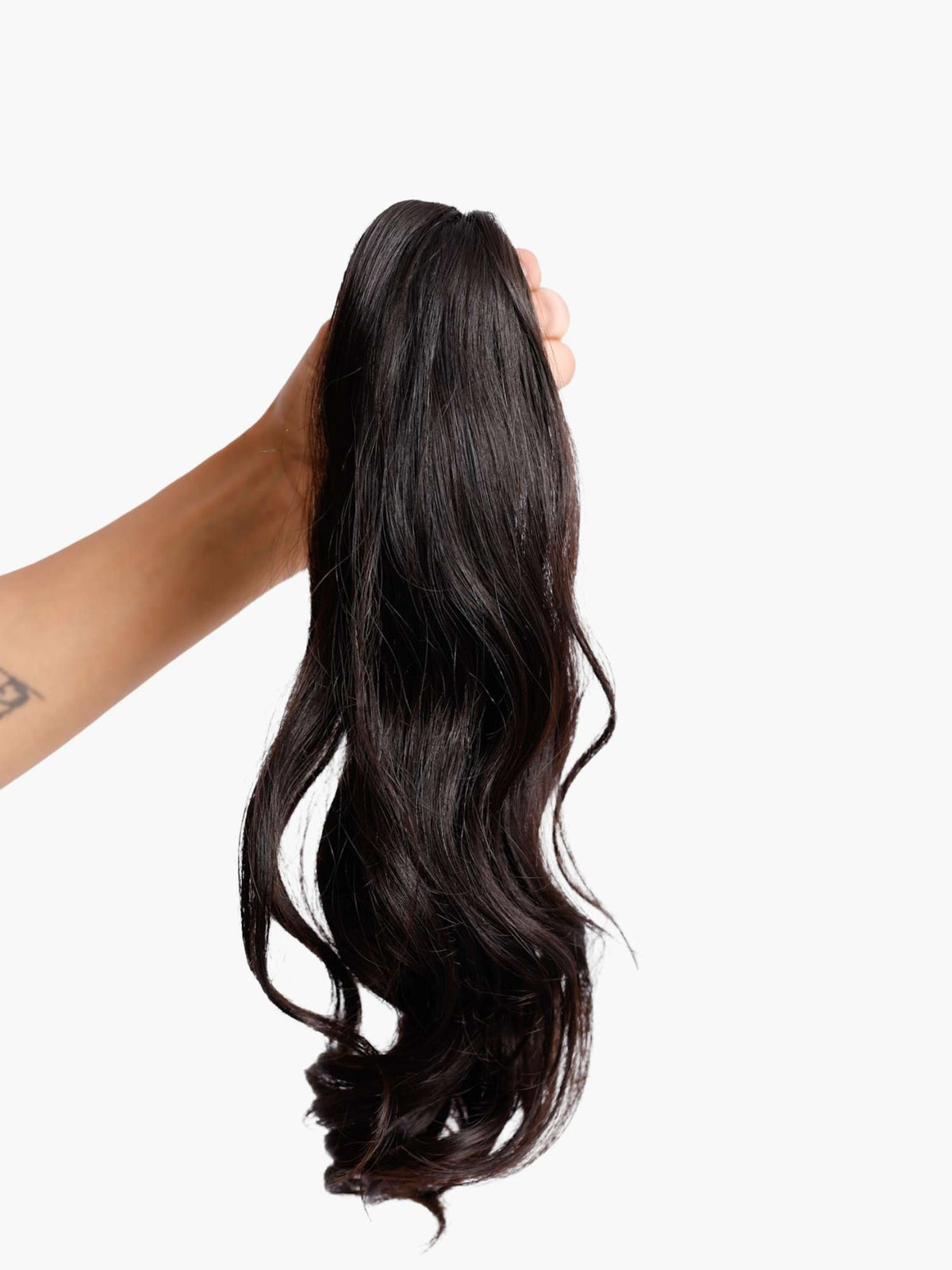
Least weight on the base: Add a ponytail to short hair with the Mini Clip-In Ponytail Extensions, the smallest and lightest piece we make. Less weight at the base means less strain on hair that is already fragile.
-
Fine hair, worn low: Add length without bulk using the Flat Clip-In Ponytail Extensions, whose base lies flat against the head so it stays hidden on fine hair. Available in four lengths from 8 to 18 inches, so you can pick the drop you actually want.

-
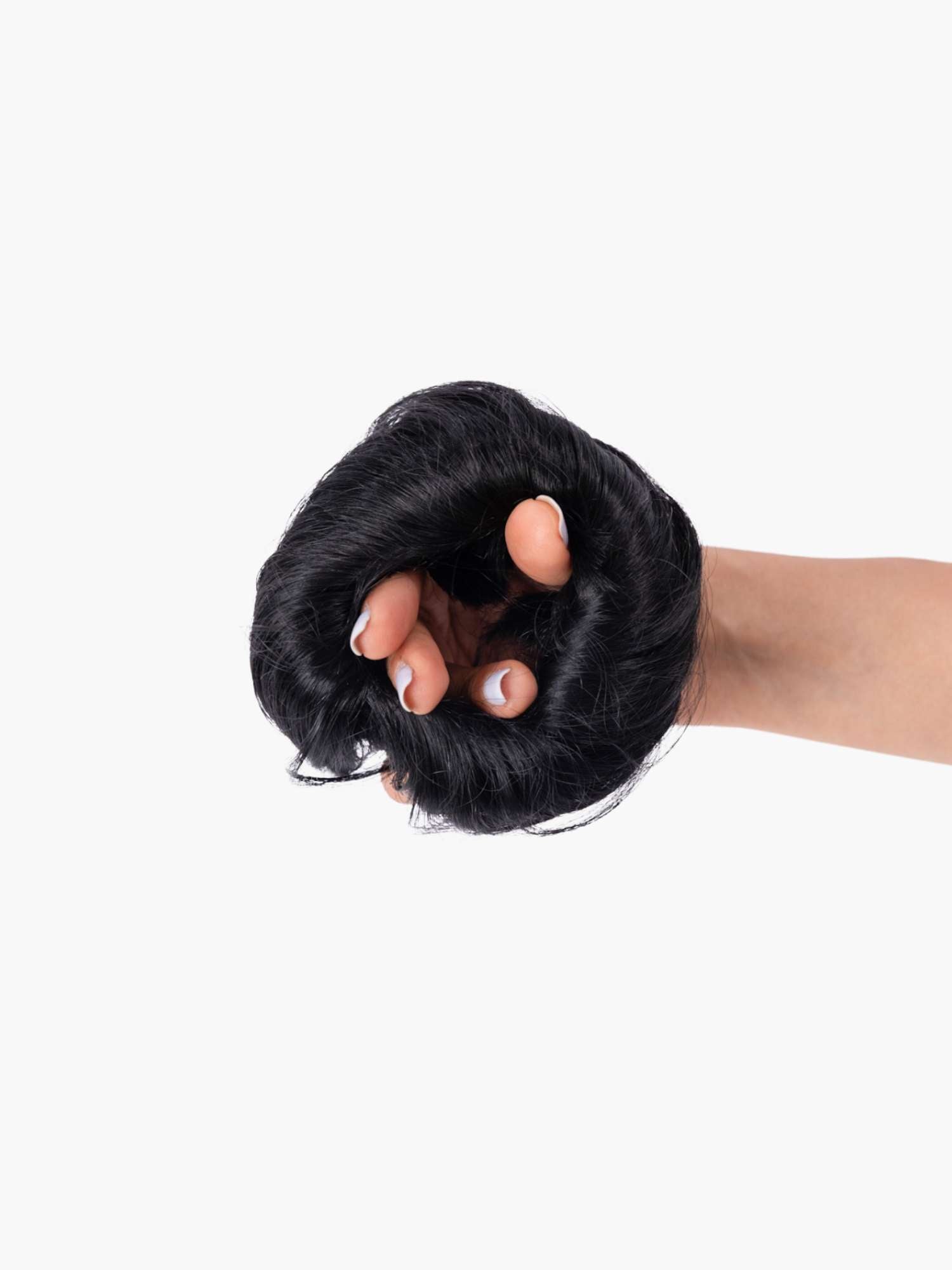
Volume in an updo with almost no pull: Build a full bun in seconds with the Messy Bun Scrunchie, which goes on over a loose ponytail instead of being tied in. You get volume at the crown with almost none of the pull a tight bun needs.
-
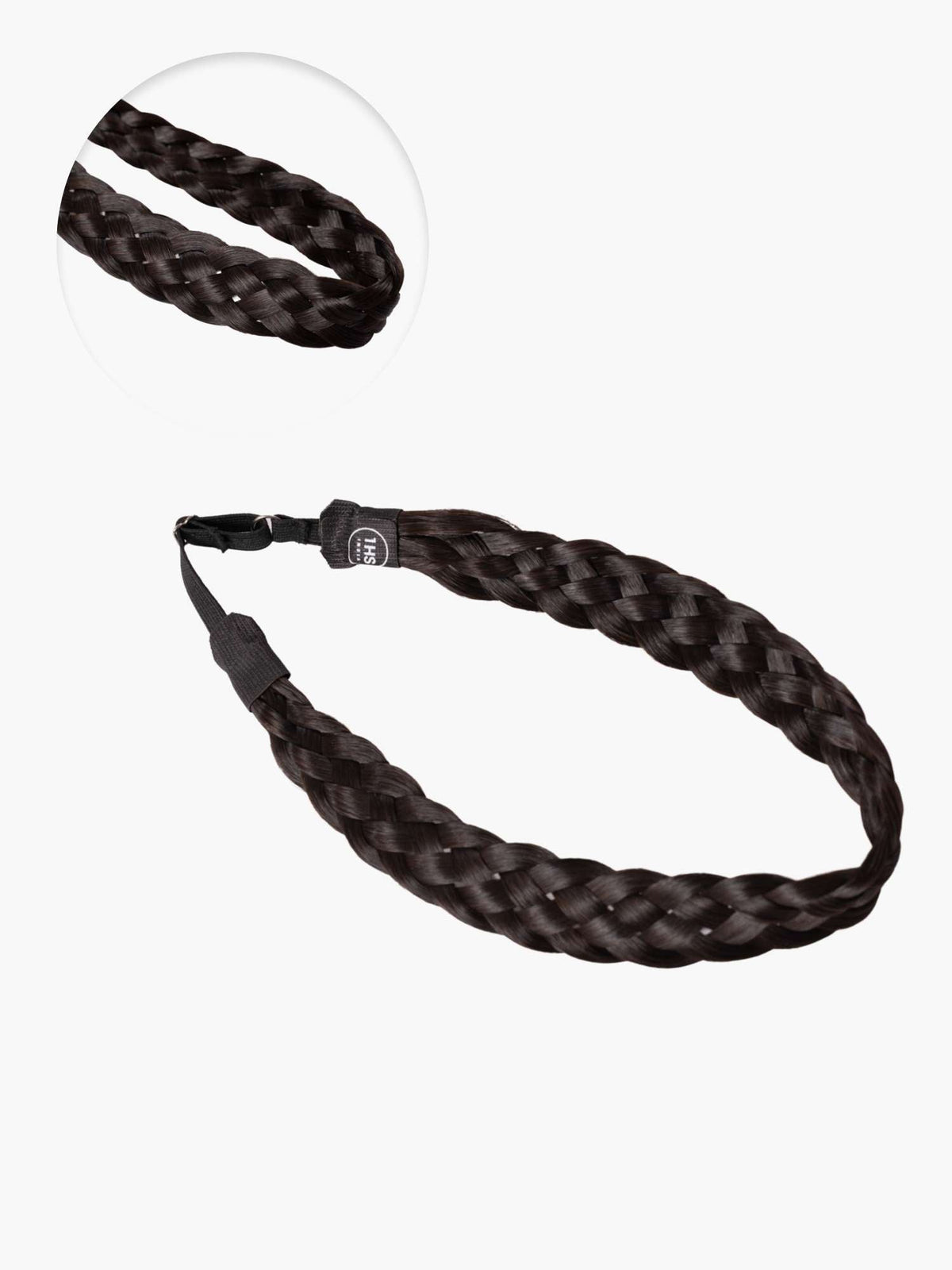
Covering the front without a tie at all: Wear your hair back without exposing the front using the Braid Hairband, a braid on a flexible band that sits over the hairline rather than behind it. It finishes the style and covers the front edge in the same step.
- Not sure whether it is breakage or thinning? Read how to tell if your hairline is receding, or book a free video call.
Frequently Asked Questions
Can hair damaged by a ponytail grow back?
The two kinds behave differently. Hair broken at the tie does not repair, but the follicle is undamaged and new growth comes through normally, so it grows out over time as the broken lengths are trimmed away. Thinning at the hairline from repeated pulling usually recovers if the pulling stops early enough, which is the reason to change habits at the first sign rather than waiting to be sure.
Is it the tightness or the position that causes ponytail damage?
Both, but position is the one people underestimate. Tension causes the thinning at your temples. Repetition in the same spot causes the breakage line at the tie. A loose ponytail worn at exactly the same height every day for years still produces a clear breakage line, which is why moving the tie matters as much as loosening it.
What is traction alopecia and how do I know if I have it?
It is the term for hair loss caused by sustained pulling, usually at the hairline, and it is the reason this advice matters. We are not able to tell you whether you have it from an article. The rough distinction is that breakage shows as short hairs of similar length still growing from the scalp, while genuine loss shows as bare or sparse skin. If you are seeing sparse skin, receding edges or bald patches rather than short broken hairs, that is a question for a doctor or a trichologist rather than a hair brand.
Are silk scrunchies actually better for your hair?
For breakage, yes, meaningfully. A smooth wide fabric glides against the cuticle instead of gripping and dragging it, and it spreads pressure over a wider band than a thin elastic. For hairline thinning they do very little, because that is caused by the direction and duration of the pull rather than by the surface of the tie. They are worth using and they are not a complete answer.
How do I keep my hair up at the gym without wrecking it?
Braid it rather than tie it for anything with impact, since a braid spreads the load down the length instead of concentrating it at one point, and it will not bounce out the way a claw clip does. If you need to lie on your back, a low profile flat claw clip is designed for exactly that. Two low braids or two low buns keep the back of your head clear. Avoid cloth headbands over a tight bun, which is a combination that has cost a lot of people their edges.
Does wearing a ponytail extension damage your hair?
It can, if you use it wrongly. It attaches to your own ponytail and adds weight at the same point, so a long dense piece worn high in the same spot every day makes both breakage and hairline strain worse. Worn lower, kept light, taken off at home and rotated, it usually reduces damage overall, because the main reason people pull a ponytail painfully tight is to fake fullness they no longer have.


