


Almost every comparison of these two sorts them by permanence. Ponytail extensions are the quick temporary option for events, clip-ins and wefts are the daily all-over option. That framing is tidy and it is not the question you are actually asking.
The thing that decides this is not how long you want your hair or how long you want the piece to last. It is how you wear your hair on an ordinary Tuesday. A woman whose hair is up most days and a woman whose hair is down most days need different products, even if they want the exact same result, and almost nothing written on this subject asks her which one she is.
Short answer: If your hair is up most days, a ponytail extension gives you the fullest result for the least effort. If your hair is down most days, clip-in extensions are the only one of the two that works. If it is a mix, clip-ins win, because clip-ins can be worn in a ponytail but a ponytail piece can never be worn down. That asymmetry is the whole decision for most people, and it is the thing nobody says out loud.
If the answer turns out to be a ponytail piece, the flat clip-in ponytail is the one that works on the widest range of hair, because the base sits flat against the head instead of building bulk. For a firmer base and the most invisible finish, the wrap around ponytail is the alternative. Both sit in the ponytail extensions range.

- The Question to Ask Before Either
- What a Ponytail Extension Actually Is
- What Clip-In Extensions Actually Are
- Ponytail Extension vs Clip-Ins, Side by Side
- The Asymmetry Nobody Mentions
- Colour Matching Is Not Equal Between Them
- Where Halo Fits, and Where It Does Not
- Which One Do You Actually Need
- Both Put Tension Somewhere
- How 1 Hair Stop Makes the Choice Easier
- Shop Ponytail Extensions
- Frequently Asked Questions
The Question to Ask Before Either
Before you look at a single product, answer this honestly. Over a normal week, how often is your hair up and how often is it down.
Not how you would like to wear it. How you actually wear it, on the mornings when you are running late and the answer is whatever takes ninety seconds. That is the pattern the piece has to serve, because a piece that only suits your best-case styling day ends up unworn.
- Up most days: Ponytails, buns, half-up, claw clips. A ponytail extension gives you the biggest visible change here for the least fuss, because it is built for exactly this and nothing else.
- Down most days: A ponytail extension does nothing for you. It cannot be worn with your hair down. Clip-ins are the answer, and it is not close.
- A mix, or you genuinely do not know: Clip-ins, for the reason set out further down. They cover both situations. A ponytail piece covers one.
Everything else, budget, application time, how long it lasts, matters far less than this, and it is the reason so many of these purchases sit in a drawer. People buy for the look they saw in a photograph rather than the way they get dressed.
What a Ponytail Extension Actually Is:
A ponytail extension is one piece of hair that attaches to a ponytail you have already made. It adds length and thickness to that ponytail and to nothing else on your head.
It attaches in one of a few ways depending on the style. A wrap-around uses a hidden comb pushed in above your elastic, a velcro strap around the base, and a strand of hair wrapped over the join to hide it. A claw or flat clip grips the base directly. Either way it is a single unit doing a single job.
The advantage is speed and impact. A minute or two, and a thin ponytail becomes a full one. The limit is right there in the name. Take your hair down and the piece comes off with it.
Our ponytail extensions collection covers wrap around, flat clip-in, mini claw, clip-in and braided styles, all in 100% human hair.
Note what that image shows. One piece versus seven. That is the practical difference between the two categories before you get anywhere near how they look on, and it explains most of what follows.
What Clip-In Extensions Actually Are:
Clip-in extensions are a set of separate wefts, usually seven pieces of varying width, that clip into sections across the back and sides of your head. Together they add length and thickness through your whole head of hair rather than to one ponytail.
You section your own hair horizontally, clip a weft in near the roots, drop the hair back down over it, and repeat working upward. Ten to fifteen minutes the first few times, five once you know your own head. They come out the same way at the end of the day.
Because the wefts are separate, you decide where they go. That is the property that makes them flexible in a way a single-piece product cannot be, and it matters more than most guides let on.
Our clip-in extensions collection carries Classic and Seamless 7 sets. Classic sit on a fabric weft, Seamless sit on a thin silicone-backed band that lies flatter against the head, which is the better choice if your own hair is fine enough that a weft edge might show through.
Ponytail Extension vs Clip-Ins, Side by Side
| What you are comparing | Ponytail Extension | Clip-In Extensions |
|---|---|---|
| What it is | One piece attached to a ponytail | A set of separate wefts across the head |
| Hair worn down | Not possible | Yes, this is the main use |
| Hair worn up | Yes, built for it | Yes, with the wefts positioned lower |
| Time to put on | One to three minutes | Five to fifteen minutes |
| Where the weight sits | All on one anchor point | Spread across several clips |
| Best for fine hair | Only the lighter flat clip styles | Yes, especially seamless wefts |
| Colour range available | Narrower, solid shades | Wider, including blended and balayage tones |
| Learning curve | Almost none | A few attempts to get sectioning right |
Read that table with your own week in mind rather than in the abstract. The row that decides it for most people is the second one.
The Asymmetry Nobody Mentions
Here is the thing that should settle this for anyone genuinely torn, and no comparison article says it plainly.
Clip-in extensions can be worn in a ponytail. A ponytail extension can never be worn down.
The trick is to position the wefts lower and further back than you would for hair-down wear, then gather everything into the ponytail together. The clips sit below where the elastic goes, so nothing shows, and the added hair comes through into the ponytail with your own.
Women with fine hair often find this works better than a dedicated ponytail piece, for a reason that has nothing to do with looks. Two or three wefts spread the weight across several separate grip points instead of loading it all onto one anchor at the base of the ponytail. It feels lighter on the head, it pulls less, and you can move each weft to wherever it sits comfortably rather than accepting where a single piece puts it.
So if you are undecided, clip-ins are the safer buy. You are choosing the product that covers both situations rather than the one that covers half of them. The honest exception is if your hair is up every single day without fail, in which case a ponytail piece is quicker and there is no reason to make yourself section hair every morning.
Colour Matching Is Not Equal Between Them
This one surprises people and it is worth checking before you decide, because it is not a small difference.
Ponytail pieces are almost always made in a narrow range of solid shades. Ours come in jet black, natural black and dark brown depending on the style. Clip-in sets are made in a much wider range, including blended and balayage tones like caramel, honey, chestnut and mocha where the colour shifts down the length.
The reason is production, not preference. A seven-piece set justifies the extra work of a blended colour in a way a single ponytail piece does not, so the shade ranges diverge across the whole industry rather than just here.
It matters because a ponytail sits behind you at eye level where you cannot check it and everyone else can. If your own hair is anything other than a solid shade, a dark-toned dyed length, highlights, balayage, grown-out roots, the odds of a clean match are better on the clip-in side. Order colour samples before you commit either way, but be aware you are choosing from a shorter list on one of them.
That photograph is worth taking honestly rather than flatteringly. If your own hair is a single solid shade, either side matches easily and the difference does not affect you. If it is highlighted or has any depth change through the length, the wider range is doing real work, and it is better that you see that before ordering than after.
Where Halo Fits, and Where It Does Not
Halo extensions come up constantly in this conversation, so it is worth being direct about them.
A halo is a single weft of hair sitting on a thin, nearly invisible wire that rests on your head like a headband, with your own hair pulled over the top to hide it. Our HaloHair Extensions use exactly that construction. No clips, no tension on individual strands, on and off in under a minute. For hair worn down it is the easiest thing in this whole category.
It does not work for a ponytail. The wire needs your own hair covering it from above, and pulling everything up into a ponytail exposes the wire and leaves the halo with nothing to sit under. Women who have tried it say the same thing: it will not stay, and it is visible.
So halo is a third option, not a middle ground. If your hair is down most days and you want the least fuss available, it is arguably the best answer of the three. If your hair goes up regularly, it is the wrong product, and no technique fixes that.
Which One Do You Actually Need:
Work down these and stop at the first that describes you.
- Hair up almost every day, and you want the quickest possible result: Ponytail extension. Start with a wrap around if your hair is medium to thick, or a flat clip-in ponytail if it is fine.
- Hair down most days: Clip-in extensions, or a halo if you want the fastest possible application and never wear it up.
- A mix of both, or you are not sure: Clip-ins. They cover both, a ponytail piece covers one, and the price of that flexibility is ten minutes of learning.
- Fine hair and worried about weight or pulling: Seamless clip-ins, positioned across several points, whether you plan to wear them up or down.
- Your own colour is balayage, highlighted, or anything other than a solid shade: Lean clip-in, because the shade range is wider and the match will be better.
If you want the fitting detail rather than the choice, how to style clip-in curtain bangs covers the general principles of blending a clip-in piece into your own hair, which apply across the range.
Both Put Tension Somewhere
Worth saying plainly, because the marketing on both sides tends to imply otherwise. Anything that attaches hair to your head puts some load on the hair it attaches to. The question is how much and how it is distributed, not whether.
A ponytail extension puts all of it on one point, at the base of a ponytail, which is also under tension from the elastic. Clip-ins spread the same weight across several clips in different places, which is gentler per point but means more points. Halo puts almost none on individual strands, because the wire rests rather than grips, which is its real advantage over both.
None of that is a reason to avoid any of them. It is a reason to take them out in the evening rather than sleeping in them, to vary where you position them rather than using the same spots daily, and to size down on weight if you can feel pulling. If you are already noticing thinning or movement at your front hairline, covering a receding hairline without surgery is the more relevant read.
How 1 Hair Stop Makes the Choice Easier:
We make what we sell. Every piece is hand-knotted or wefted in our own facility in Hyderabad, in 100% human Remy hair that is ethically temple-sourced in South India and never acid-stripped, which is why any of it can be heat styled and recoloured to match your own hair.
Trusted by 300,000+ women worldwide | 4.8★ from 14,700+ reviews | 100% Human Remy Hair | Sourced From Temples | Clip-Free | Handmade in our own facility since 2009 | Damage-free application guarantee
"We sell both, so we have no reason to push one over the other, and the honest answer is that most women who cannot decide should buy the clip-ins. A ponytail piece is quicker and it looks wonderful, but it only exists for one hairstyle. If you are not certain you will wear that hairstyle most days, buy the thing that works either way."
Raina Grover and Richa Grover, Co-Founders, 1 Hair Stop
Because we carry both categories in the same hair, you can add a ponytail piece later and have it match a set you already own, which is not something you can rely on when the two come from different brands.
Shop Ponytail Extensions:
If the answer is a ponytail piece rather than a full set, start here.
-
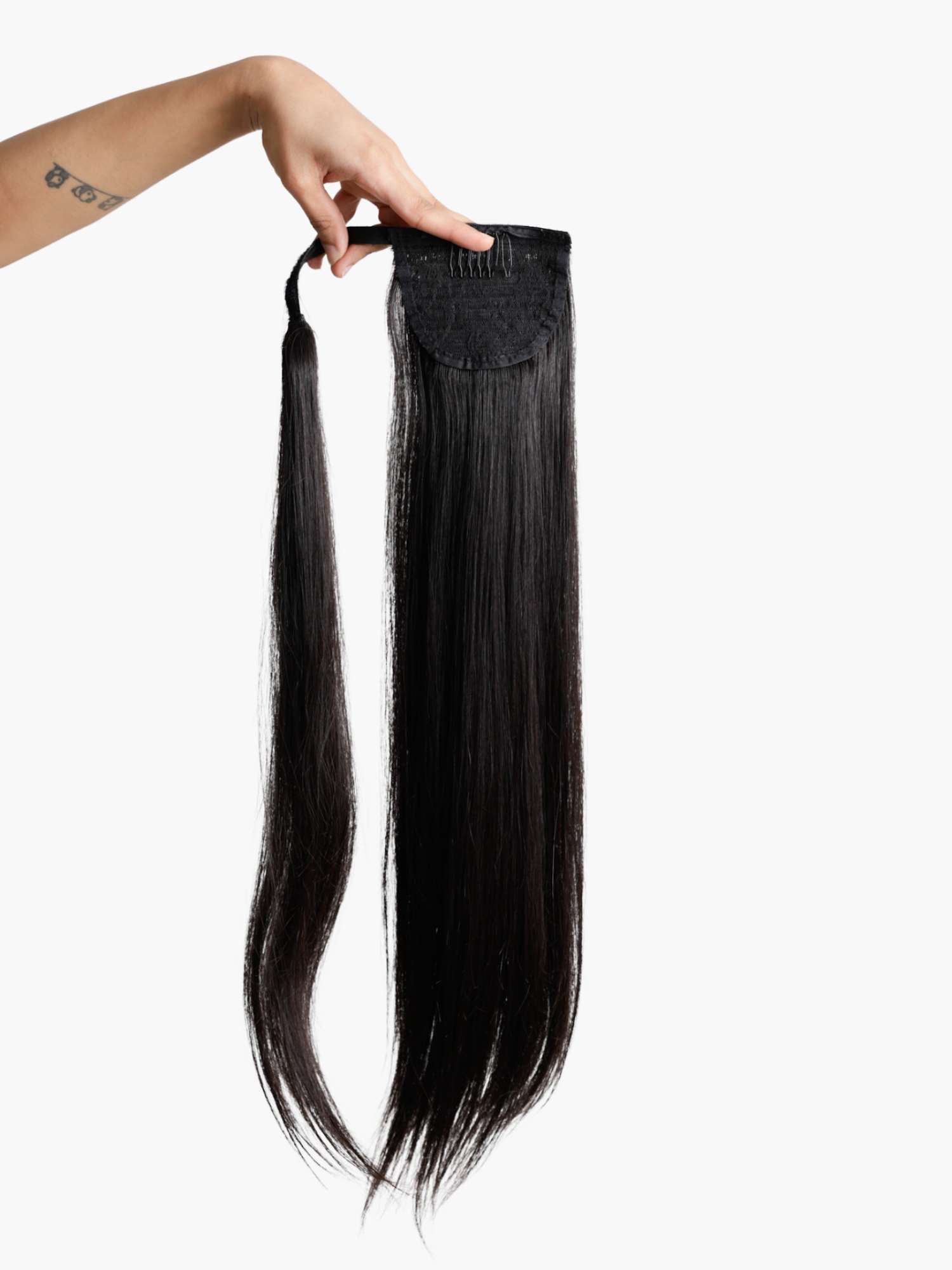
Firm base, most invisible finish: Get the most invisible finish with the Wrap Around Ponytail Extensions, which wrap around your own ponytail and hold with a comb and a velcro fastening rather than clips. Best when your own base is firm enough to keep the piece steady all day.
-
Fine hair or a small base: Add length without bulk using the Flat Clip-In Ponytail Extensions, whose base lies flat against the head so it stays hidden on fine hair. Available in four lengths from 8 to 18 inches, so you can pick the drop you actually want.

-
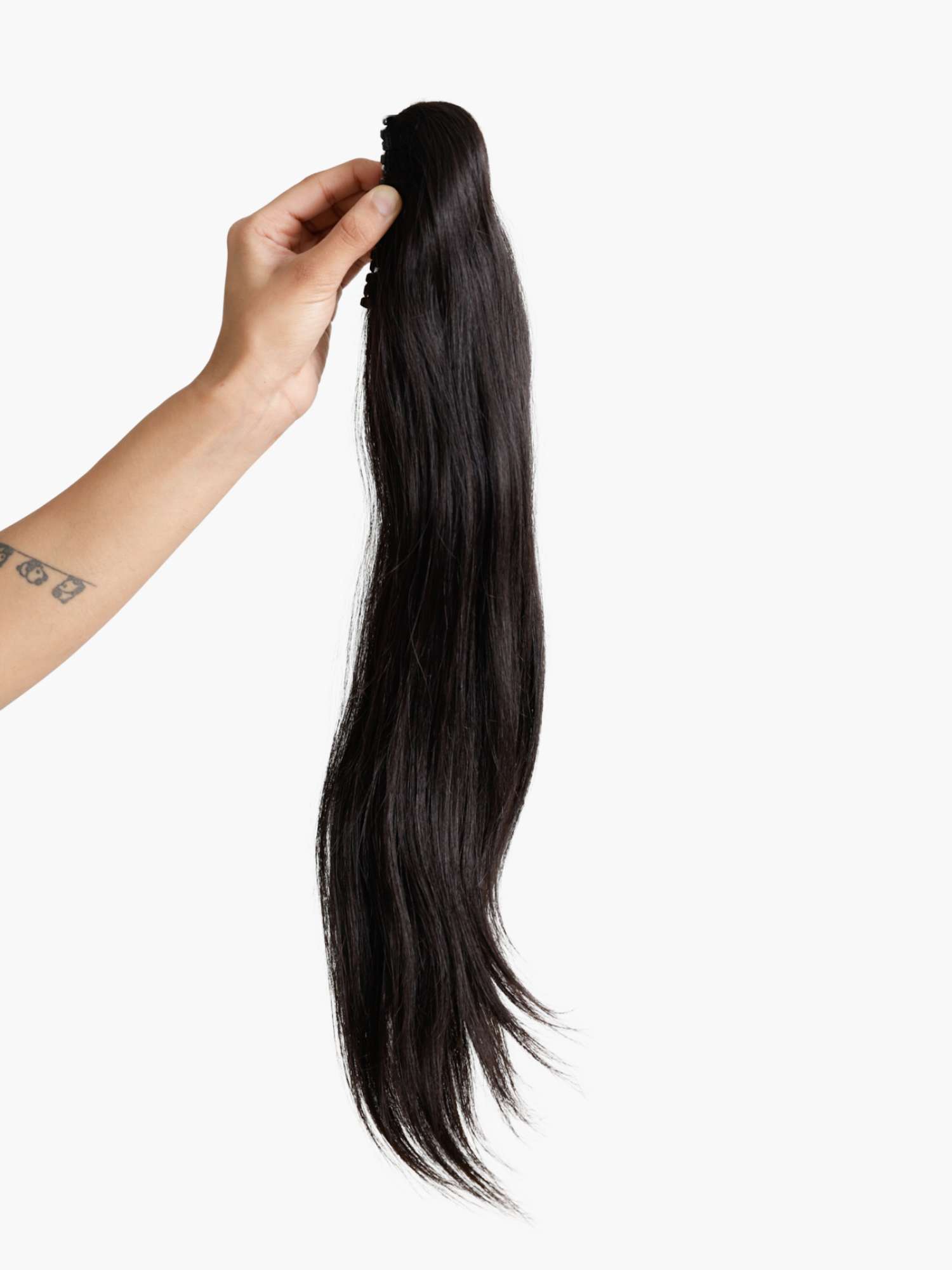
Fastest everyday option: Go from a gathered ponytail to a finished one in a single movement with the Clip-In Ponytail Extensions, the quickest attachment in the range. The sensible pick if it is going on and coming off every day.
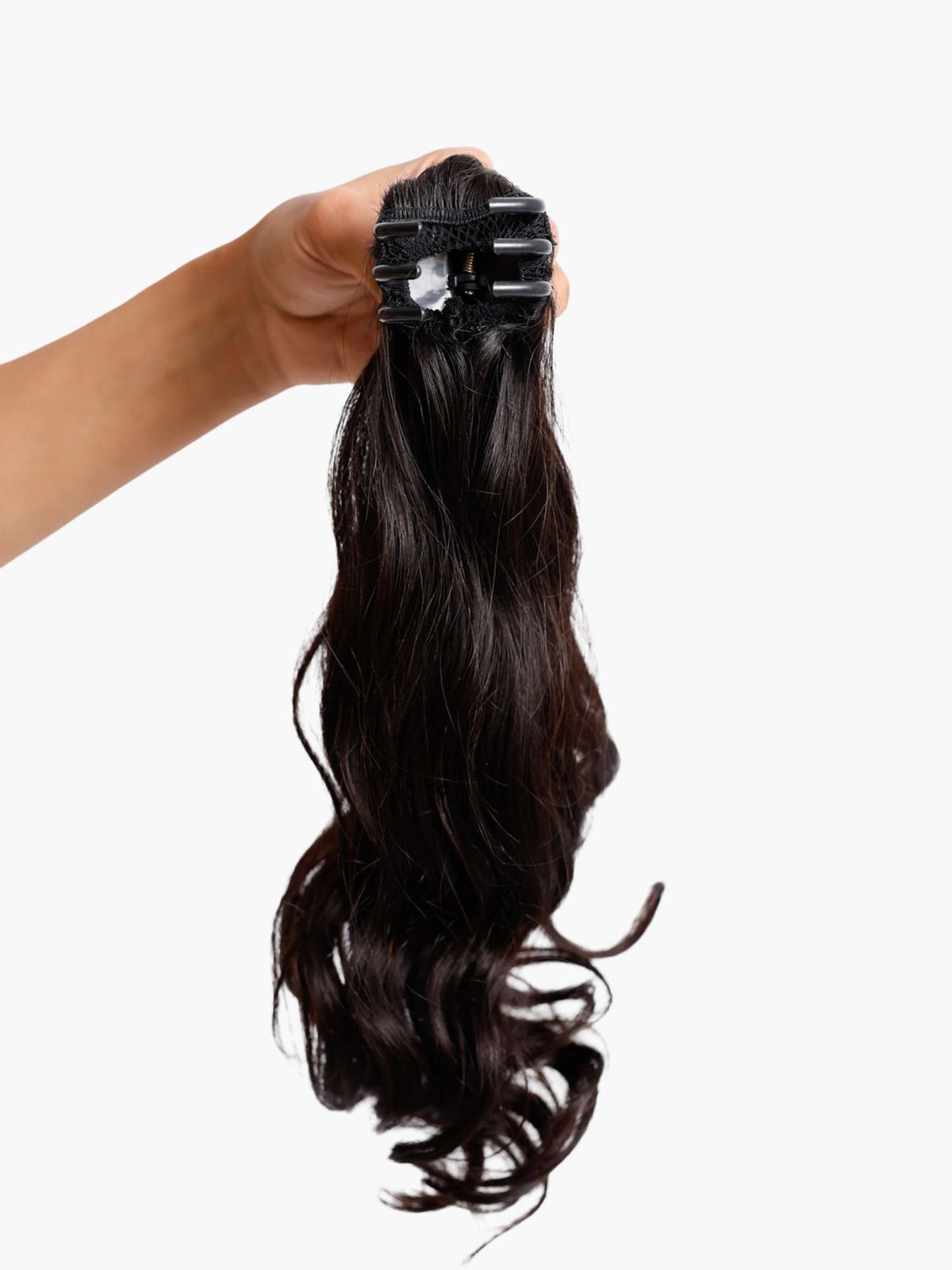
- Short hair or very little to gather: Add a ponytail to short hair with the Mini Clip-In Ponytail Extensions, the smallest and lightest piece we make. Less weight at the base means less strain on hair that is already fragile.
- Volume everywhere, not just in a ponytail: Add length and volume everywhere with a full set of Clip-In Hair Extensions, worn down as well as gathered up. The right buy when you want the hair to work in every style, not only in a ponytail.
- Not sure which one you need? Read human hair vs synthetic, or book a free video call.
Frequently Asked Questions
Can you wear clip-in extensions in a ponytail?
Yes, and it works better than most people expect. Position the wefts lower and further back than you would for wearing your hair down, so the clips sit below where the elastic goes, then gather everything up together. On fine hair this is often more comfortable than a dedicated ponytail piece, because two or three wefts spread the weight across several grip points instead of loading it all onto one anchor.
Can you wear a ponytail extension with your hair down?
No. A ponytail extension attaches to a ponytail you have already made, so there is nothing for it to hold onto with your hair down. This is the single biggest practical difference between the two, and it is why clip-ins are the safer buy if you are undecided.
Which is better for fine hair, a ponytail extension or clip-ins?
Clip-ins, especially seamless ones, because the weight spreads across several separate points rather than hanging from one. If you do want a ponytail piece on fine hair, choose a flat clip-in style rather than a heavy wrap around, and size down on length rather than buying the longest option.
Can I use halo extensions in a ponytail?
No. A halo sits on a thin wire that needs your own hair pulled over it from above to stay hidden and secure. Putting your hair up exposes the wire and leaves the halo with nothing to sit under. Halo is an excellent option for hair worn down and the wrong product if you wear it up regularly.
Which one is easier to colour match?
Clip-in sets, because they are made in a wider range of shades including blended and balayage tones, while ponytail pieces are usually offered in a narrower set of solid colours. If your own hair is highlighted, balayage or anything other than one flat shade, you will have more to choose from on the clip-in side. Order colour samples either way.
Do I have to choose one, or can I own both?
Plenty of people own both and use them for different days, and buying from one brand means the colour and texture will match across the two. If you are starting with one, start with the one that suits how you actually wear your hair most weeks, and add the other later if you find you want it.


